Q2 2021 Real Estate Report: From “Zero Initial Capital” to Making the Dream of Owning an Apartment Come True
Q2 2021 Real Estate Report: From “Zero Initial Capital” to Making the Dream of Owning an Apartment Come True
Q2 2021 Real Estate Report: From “Zero Initial Capital” to Making the Dream of Owning an Apartment Come True
|
Analytics
Analytics

Thanks to a business strategy strongly focused on pricing policy, the apartment real estate market in Q2.2021 showed signs of recovery. Especially in May 2021, the bold move by Vinhomes Smart City & Masterise Homes to launch a solution to the “settle down and build a career” problem with only “0 initial capital” generated a large volume of discussion and directly impacted many target customers’ demand for apartment home ownership.
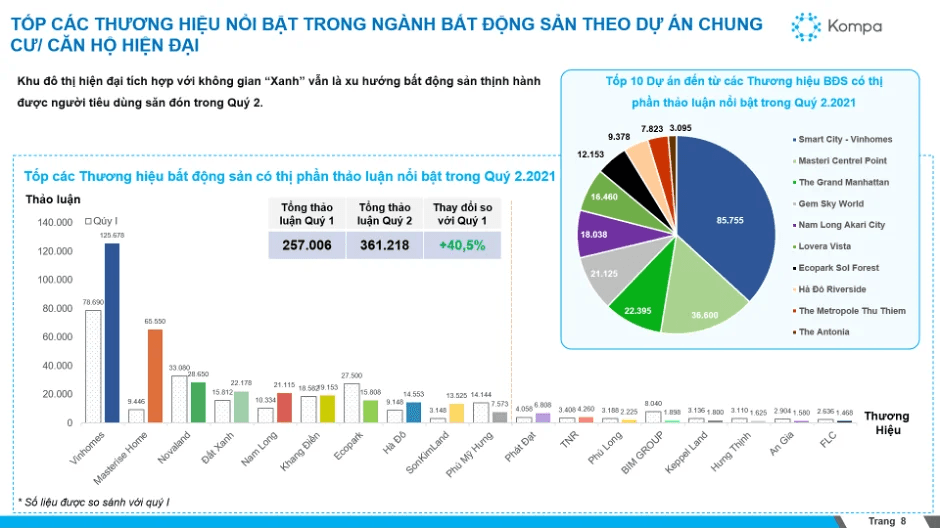
With more than 360,000 user discussions in Q2, Kompa conducted an overview study of the modern condominium/apartment real estate segment during Q2.2021. The report summarizes and analyzes trends, customer concerns, and the factors that drive customers to consider when deciding to purchase apartment real estate.
The report was produced by Kompa – a provider of technology solutions based on Big Data and Artificial Intelligence (A.I) to help businesses grow more strongly in the Digital Era.
Market trend assessment:
Investors shift focus toward young customers
From the multi-sector ecosystem of Vingroup, Vinhomes Smart City accounted for more than ⅓ of total discussion volume in the Top 10 brands with the largest discussion share about condominium/apartment real estate projects.
Notably, on 24.05.2021, this brand launched the “Vinhomes Priority” campaign focused on young customer groups with the 3-No message: “No initial capital – No financial pressure – No waiting,” striking a chord with many customers who want to invest in buying a home at a young age despite lacking sufficient initial financial capacity.
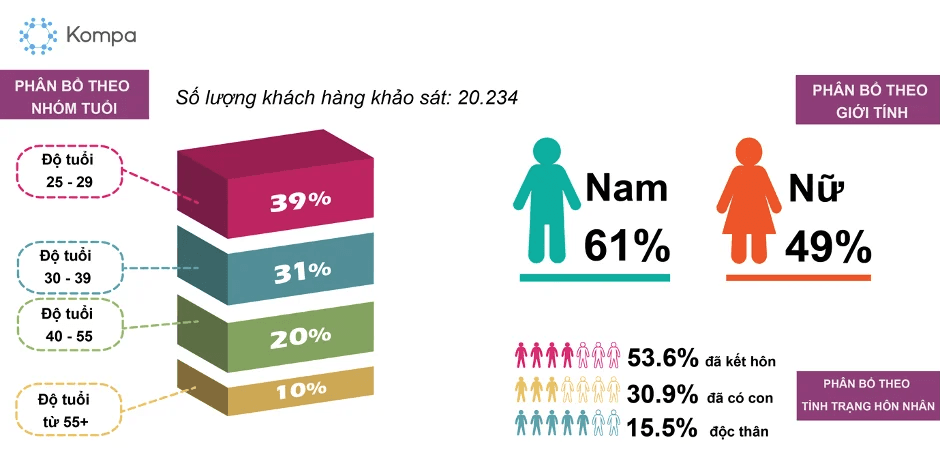
The program not only attracted major interest from customers, but also showed Vinhomes Smart City’s long-term vision in shifting focus to the younger generation aged 25–29, who account for 39%; however, the middle-aged group from 40–45 is still considered a potential customer segment for the brand in the future. (Link)
The market became vibrant again in 05.2021
At the beginning of the year, the condominium/apartment real estate market had not fully recovered, with transaction volume down more than 50% compared to the same period last year. However, by early Q2.2021, thanks to the launch of demand-stimulation programs and price control, the condominium/apartment real estate market gradually returned to the race.
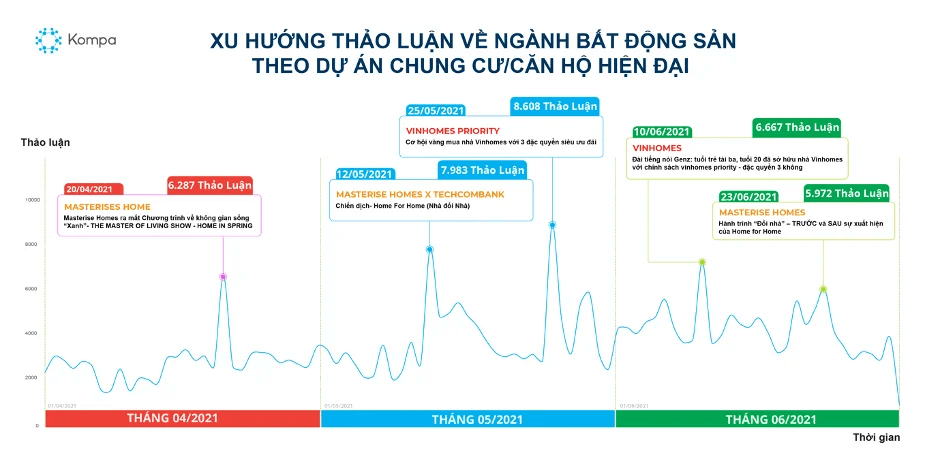
Especially in May 2021, many brands began deploying a series of new demand-stimulation programs to boost transaction volume, notably “Vinhomes Priority” from Vinhomes & “Home Exchange” from Masterise Homes.
Vinhomes Smart City was the pioneer in best understanding buyer needs. Among 5 brands, Vinhomes condominiums/apartments held an overwhelming discussion volume across most factors customers care about most. Amenities, Price & financial support programs, and Living space were the top 3 discussion topics about Vinhomes condominiums/apartments.
With a multi-sector ecosystem, Vinhomes condominium/apartment amenities were considered highly convenient for residents. The brand was also viewed as competitive in pricing and apartment purchase incentives.
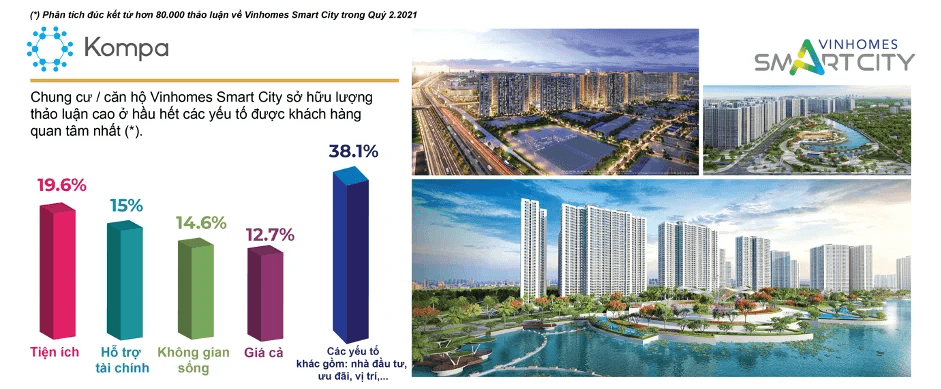
At this stage, customers considered purchasing condominium/apartment real estate mainly based on the investor’s reputation. Strengthening communication activities, ensuring security, and having favorable locations helped condominium/apartment real estate brands reinforce their competitive advantages. Amenities and living space were added values that stimulated users’ desire to own an apartment.
If Vinhomes Smart City focused on young customer groups, Masterise Homes’ strategy was a form of Upsell, encouraging customers to experience premium living spaces at a more reasonable cost.
Behind both programs was strong support from Techcombank (Link). Previously, customers were required to pay a portion upfront (usually 20–30%); today, they can borrow up to 100%, with mortgage account conditions. The bold steps by these two developers and Techcombank’s backing helped accelerate project liquidity in condominium/apartment real estate, while creating leverage to boost home ownership demand during this period.
Facebook & Forums dominate the under-4.5-billion segment
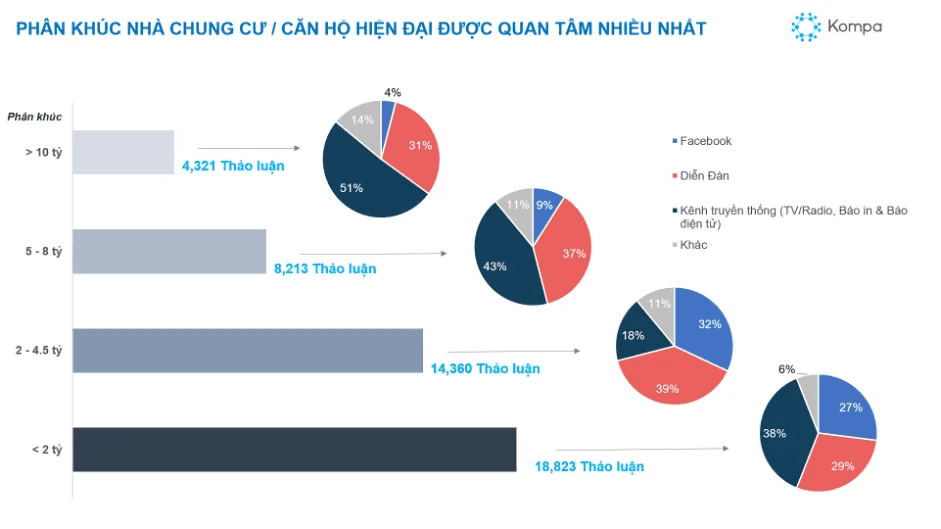
The trend of researching condominium/apartment real estate still mainly came from official information sources such as print newspapers, online newspapers, and forums. The higher the real estate value, the more dominant traditional sources became.
For the condominium/apartment segment under 4.5 billion, Kompa recorded over 50% of discussions on Facebook and Forum channels.
Facebook community groups recorded lively discussions about real estate brands. The 2–4.5 billion condominium/apartment segment received many consultation requests. Mid-range two-bedroom apartments were the most interested-in products (Link).
By contrast, forums recorded discussion streams on topics such as “Should I buy an apartment or a townhouse?” (Link) and “Effective financial allocation to invest in or own apartment real estate” (Link).
Customer concerns about condominium/apartment real estate
Stage of starting to learn about condominium/apartment real estate
“Price” is the decisive factor
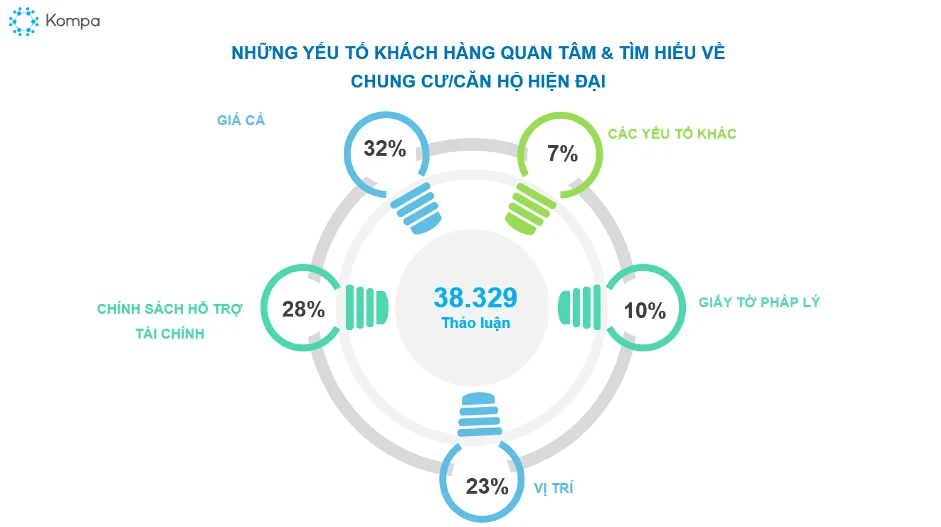
In Q1/2021, a real estate “bubble” occurred, pushing market prices high. 32% of customers said apartment buying first depends on whether their finances can meet the price level.“Payment policy” is top priority
Customers at the initial research stage for condominium/apartment real estate placed payment policy above other factors: “Even if the apartment has a poor design and not many amenities, a fairly okay payment policy is still worth considering.”“Apartment location” has major influence on purchase decisions
23% of discussions said “Location” greatly affects condominium/apartment purchase decisions. Many customers commented that although an apartment met diverse needs, they did not proceed because of inconvenient transportation location.
At this stage, users were mainly concerned with “Price” and “Payment policy.” Focusing on these contents helps brands encourage potential buyers to pay attention to and learn about projects.
Stage of considering between brands
Investor “reputation” is the decisive foundation
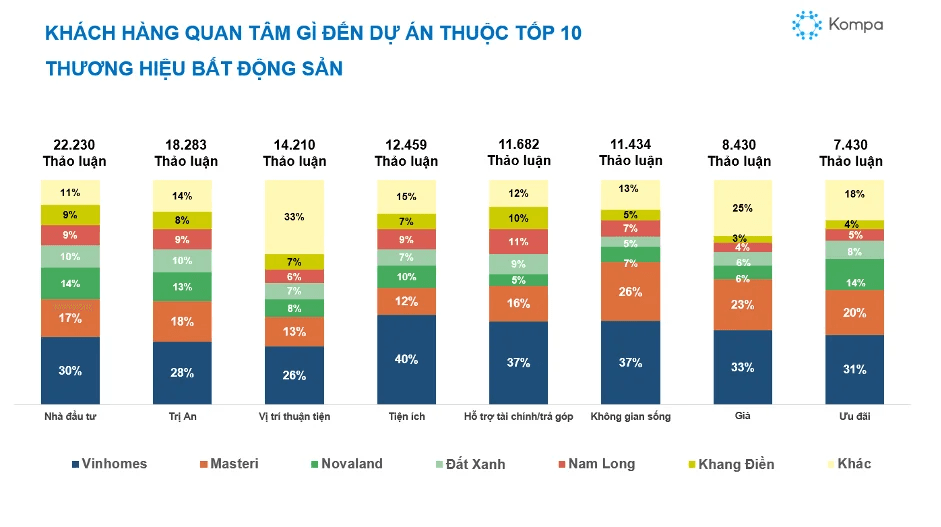
More than 20,000 discussions evaluated “Investor” as a long-term decisive factor. Many customers believed that reputable “Investors” would have experience and financial capacity—a solid foundation for a chain of factors: from infrastructure quality and management process to transparency in legal procedures.The “Security” factor is emphasized
Not limited to managing entry and exit, customers also care about “Safety” factors such as fire prevention systems, surveillance cameras, elevator quality, balcony design, and evacuation maps in emergencies.Condominium location is a key factor
The “Location” factor directly affects daily life and future real estate value. Apartments with convenient “Location,” such as near central areas or public works, received high customer interest and consultation requests.The “green living” trend is on the rise
When brands pay attention to internal amenities and living space, customers give positive discussion feedback, especially regarding green living.
Ecopark projects were highly rated for “green living” space design. Meanwhile, Masterise Homes carried out “The Master Of Living Show” with a message of elevating the living-space experience. Episode 2, titled “Bringing Nature Home,” attracted more than 1.1 million views. (Link)
Analysis of the condominium & apartment segment real estate market
Strengths
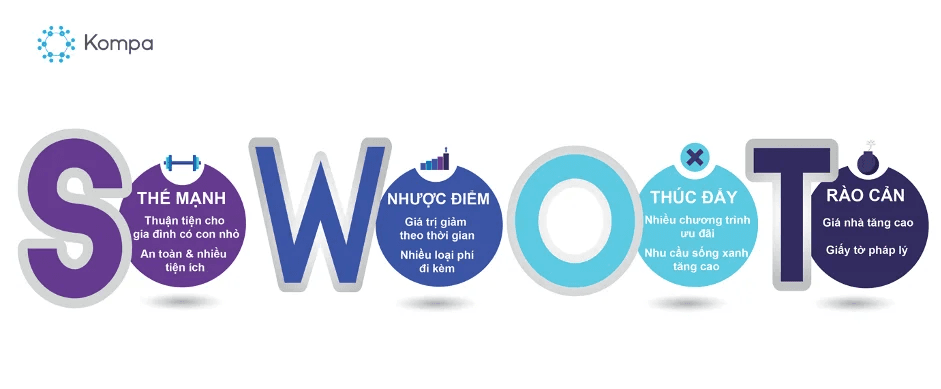
Convenient for families with young children
Customers believed communities in condominiums often socialize and interact, creating an environment for children to interact and develop social skills (Link). Having people around to observe also helps reduce accidents among young children. Apartment complexes often integrate amenities such as parks and supermarkets, convenient for families with young children. Airiness and fewer insects were also factors of concern.Security is continuously monitored
Most discussion opinions said choosing condominiums/apartments helps ensure security, such as dedicated parking basements and less worry about theft, thanks to building management and 24/24 surveillance camera systems (Link, Link).Integration of diverse amenities
Amenities are among the factors customers like most. Discussions mentioned that integrating diverse facilities such as gyms, parks, supermarkets, etc., helps save time and supports daily convenience.
Weaknesses
Value decreases over time
The value of condominium/apartment real estate and townhouses was weighed by many customers. Over time, condominiums/apartments deteriorate, leading to lower value. At the same time, condominium/apartment real estate appreciates slowly or depreciates, not providing long-term investment benefits (link).Many accompanying service/utility fees
Integrating diverse amenities leads to increased monthly expenses. Customers hesitate about actual benefits versus service quality: “Developers hold back maintenance fees,” “Unreasonable charges,” or “Management boards have poor professionalism.”Lack of privacy and comfort
Many people said condominium residents are too crowded, feeling uncomfortable because they are constantly watched (link). In addition, 20% of comments felt constrained because “if you want to renovate space or make repairs, you must ask permission from the building management board.”
Driving factors
Promotions and installment-support activities
Vinhomes Smart City and Masterise Homes successively launched “financial” support programs, targeting customers’ hesitation about initial capital when they need to buy a home. The messages “0 initial capital” and “Home Exchange” from the two brands attracted a large discussion volume for consideration and research, changing perceptions about condominium/apartment ownership.Demand for green living and improving living standards
As living standards rise, customers prefer owning apartments with airy space and views of outside scenery (link). Beautiful interior design helps create goodwill and stimulates users’ desire to own an apartment.
The trend of green living, close to nature, is also considered a way to elevate living standards. Ecopark’s focus on nature-oriented space design was commented on as “this is Vietnam’s most livable city.”
Barrier factors
Rising housing prices create pressure on buyers
The topic “2-billion condos are about to go extinct” in one forum recorded more than 1,000 discussions. Many opinions said condominium/apartment real estate is a “consumption asset” — “a condo is like long-term rental housing, but ownership is time-limited.” Moreover, buyers also expressed concern that to get a lower price, they must accept remote and inconvenient locations.Legal documents remain unclear, especially pink books and red books
Non-transparent ownership papers are the biggest barrier for most homebuyers. Many comments criticized the “delay or even never issuing pink books” by a series of previous apartment developers.
Customers emphasized “only buy when the certificate is available,” proving that unguaranteed ownership causes anxiety for those intending to research and buy apartments.
Conclusion
On communication channels
Official sources remain the dominant communication channel in condominium/apartment real estate. The higher the apartment value, the more trusted official information channels are.
In the under-4.5-billion apartment segment, buyers tend to research and refer to information in Facebook community groups and forums. Topics analyzing apartment selection criteria attracted many users to discuss. Brands can leverage posts in these channels to develop seeding discussions suitable to each customer segment’s needs.
On Marketing Activities
Communication activities focused on “price” and “payment policy” help brands hit financial concerns and attract attention from diverse customers.
Vinhomes Smart City’s “0 initial capital” home-buying program was successful in helping the community become more open to condominium/apartment real estate products, while expanding potential customer groups to younger audiences.
For premium-value real estate brands, investing in living-space programs helps “shape the market” and effectively support apartment sales.
Masterise Homes carried out “The Master Of Living Show” program to introduce premium living experiences. At the same time, the brand launched the “Home Exchange” campaign, encouraging buyers to elevate their lifestyle with lower investment costs. The Ecopark project fanpage also focused on building posts that honor “nature-oriented living space.”
On customer concerns
Depending on the research stage, customers have different concerns. For customers in the initial stage of research, “price” and “payment policy” are the top two concerns. Messages focused directly on this topic, like Vinhomes Smart City, will attract customers to explore more deeply.
In contrast, for experienced customers, “Investor reputation” is the decisive factor. Brands need to strengthen activities that reinforce brand name and build trust with this buyer segment.
Apartment “location” is among top concerns when customers consider purchase decisions, at any stage. Building values such as “stylish interior” and “closeness to nature” helps brands increase real estate value for customer groups seeking to improve and elevate living-space quality.
—
This article was produced by Kompa – a provider of technology solutions based on Big Data and Artificial Intelligence (A.I) to help businesses grow more strongly in the Digital Era.
Thanks to a business strategy strongly focused on pricing policy, the apartment real estate market in Q2.2021 showed signs of recovery. Especially in May 2021, the bold move by Vinhomes Smart City & Masterise Homes to launch a solution to the “settle down and build a career” problem with only “0 initial capital” generated a large volume of discussion and directly impacted many target customers’ demand for apartment home ownership.
With more than 360,000 user discussions in Q2, Kompa conducted an overview study of the modern condominium/apartment real estate segment during Q2.2021. The report summarizes and analyzes trends, customer concerns, and the factors that drive customers to consider when deciding to purchase apartment real estate.
The report was produced by Kompa – a provider of technology solutions based on Big Data and Artificial Intelligence (A.I) to help businesses grow more strongly in the Digital Era.
Market trend assessment:
Investors shift focus toward young customers
From the multi-sector ecosystem of Vingroup, Vinhomes Smart City accounted for more than ⅓ of total discussion volume in the Top 10 brands with the largest discussion share about condominium/apartment real estate projects.
Notably, on 24.05.2021, this brand launched the “Vinhomes Priority” campaign focused on young customer groups with the 3-No message: “No initial capital – No financial pressure – No waiting,” striking a chord with many customers who want to invest in buying a home at a young age despite lacking sufficient initial financial capacity.
The program not only attracted major interest from customers, but also showed Vinhomes Smart City’s long-term vision in shifting focus to the younger generation aged 25–29, who account for 39%; however, the middle-aged group from 40–45 is still considered a potential customer segment for the brand in the future. (Link)
The market became vibrant again in 05.2021
At the beginning of the year, the condominium/apartment real estate market had not fully recovered, with transaction volume down more than 50% compared to the same period last year. However, by early Q2.2021, thanks to the launch of demand-stimulation programs and price control, the condominium/apartment real estate market gradually returned to the race.
Especially in May 2021, many brands began deploying a series of new demand-stimulation programs to boost transaction volume, notably “Vinhomes Priority” from Vinhomes & “Home Exchange” from Masterise Homes.
Vinhomes Smart City was the pioneer in best understanding buyer needs. Among 5 brands, Vinhomes condominiums/apartments held an overwhelming discussion volume across most factors customers care about most. Amenities, Price & financial support programs, and Living space were the top 3 discussion topics about Vinhomes condominiums/apartments.
With a multi-sector ecosystem, Vinhomes condominium/apartment amenities were considered highly convenient for residents. The brand was also viewed as competitive in pricing and apartment purchase incentives.
At this stage, customers considered purchasing condominium/apartment real estate mainly based on the investor’s reputation. Strengthening communication activities, ensuring security, and having favorable locations helped condominium/apartment real estate brands reinforce their competitive advantages. Amenities and living space were added values that stimulated users’ desire to own an apartment.
If Vinhomes Smart City focused on young customer groups, Masterise Homes’ strategy was a form of Upsell, encouraging customers to experience premium living spaces at a more reasonable cost.
Behind both programs was strong support from Techcombank (Link). Previously, customers were required to pay a portion upfront (usually 20–30%); today, they can borrow up to 100%, with mortgage account conditions. The bold steps by these two developers and Techcombank’s backing helped accelerate project liquidity in condominium/apartment real estate, while creating leverage to boost home ownership demand during this period.
Facebook & Forums dominate the under-4.5-billion segment
The trend of researching condominium/apartment real estate still mainly came from official information sources such as print newspapers, online newspapers, and forums. The higher the real estate value, the more dominant traditional sources became.
For the condominium/apartment segment under 4.5 billion, Kompa recorded over 50% of discussions on Facebook and Forum channels.
Facebook community groups recorded lively discussions about real estate brands. The 2–4.5 billion condominium/apartment segment received many consultation requests. Mid-range two-bedroom apartments were the most interested-in products (Link).
By contrast, forums recorded discussion streams on topics such as “Should I buy an apartment or a townhouse?” (Link) and “Effective financial allocation to invest in or own apartment real estate” (Link).
Customer concerns about condominium/apartment real estate
Stage of starting to learn about condominium/apartment real estate
“Price” is the decisive factor
In Q1/2021, a real estate “bubble” occurred, pushing market prices high. 32% of customers said apartment buying first depends on whether their finances can meet the price level.“Payment policy” is top priority
Customers at the initial research stage for condominium/apartment real estate placed payment policy above other factors: “Even if the apartment has a poor design and not many amenities, a fairly okay payment policy is still worth considering.”“Apartment location” has major influence on purchase decisions
23% of discussions said “Location” greatly affects condominium/apartment purchase decisions. Many customers commented that although an apartment met diverse needs, they did not proceed because of inconvenient transportation location.
At this stage, users were mainly concerned with “Price” and “Payment policy.” Focusing on these contents helps brands encourage potential buyers to pay attention to and learn about projects.
Stage of considering between brands
Investor “reputation” is the decisive foundation
More than 20,000 discussions evaluated “Investor” as a long-term decisive factor. Many customers believed that reputable “Investors” would have experience and financial capacity—a solid foundation for a chain of factors: from infrastructure quality and management process to transparency in legal procedures.The “Security” factor is emphasized
Not limited to managing entry and exit, customers also care about “Safety” factors such as fire prevention systems, surveillance cameras, elevator quality, balcony design, and evacuation maps in emergencies.Condominium location is a key factor
The “Location” factor directly affects daily life and future real estate value. Apartments with convenient “Location,” such as near central areas or public works, received high customer interest and consultation requests.The “green living” trend is on the rise
When brands pay attention to internal amenities and living space, customers give positive discussion feedback, especially regarding green living.
Ecopark projects were highly rated for “green living” space design. Meanwhile, Masterise Homes carried out “The Master Of Living Show” with a message of elevating the living-space experience. Episode 2, titled “Bringing Nature Home,” attracted more than 1.1 million views. (Link)
Analysis of the condominium & apartment segment real estate market
Strengths
Convenient for families with young children
Customers believed communities in condominiums often socialize and interact, creating an environment for children to interact and develop social skills (Link). Having people around to observe also helps reduce accidents among young children. Apartment complexes often integrate amenities such as parks and supermarkets, convenient for families with young children. Airiness and fewer insects were also factors of concern.Security is continuously monitored
Most discussion opinions said choosing condominiums/apartments helps ensure security, such as dedicated parking basements and less worry about theft, thanks to building management and 24/24 surveillance camera systems (Link, Link).Integration of diverse amenities
Amenities are among the factors customers like most. Discussions mentioned that integrating diverse facilities such as gyms, parks, supermarkets, etc., helps save time and supports daily convenience.
Weaknesses
Value decreases over time
The value of condominium/apartment real estate and townhouses was weighed by many customers. Over time, condominiums/apartments deteriorate, leading to lower value. At the same time, condominium/apartment real estate appreciates slowly or depreciates, not providing long-term investment benefits (link).Many accompanying service/utility fees
Integrating diverse amenities leads to increased monthly expenses. Customers hesitate about actual benefits versus service quality: “Developers hold back maintenance fees,” “Unreasonable charges,” or “Management boards have poor professionalism.”Lack of privacy and comfort
Many people said condominium residents are too crowded, feeling uncomfortable because they are constantly watched (link). In addition, 20% of comments felt constrained because “if you want to renovate space or make repairs, you must ask permission from the building management board.”
Driving factors
Promotions and installment-support activities
Vinhomes Smart City and Masterise Homes successively launched “financial” support programs, targeting customers’ hesitation about initial capital when they need to buy a home. The messages “0 initial capital” and “Home Exchange” from the two brands attracted a large discussion volume for consideration and research, changing perceptions about condominium/apartment ownership.Demand for green living and improving living standards
As living standards rise, customers prefer owning apartments with airy space and views of outside scenery (link). Beautiful interior design helps create goodwill and stimulates users’ desire to own an apartment.
The trend of green living, close to nature, is also considered a way to elevate living standards. Ecopark’s focus on nature-oriented space design was commented on as “this is Vietnam’s most livable city.”
Barrier factors
Rising housing prices create pressure on buyers
The topic “2-billion condos are about to go extinct” in one forum recorded more than 1,000 discussions. Many opinions said condominium/apartment real estate is a “consumption asset” — “a condo is like long-term rental housing, but ownership is time-limited.” Moreover, buyers also expressed concern that to get a lower price, they must accept remote and inconvenient locations.Legal documents remain unclear, especially pink books and red books
Non-transparent ownership papers are the biggest barrier for most homebuyers. Many comments criticized the “delay or even never issuing pink books” by a series of previous apartment developers.
Customers emphasized “only buy when the certificate is available,” proving that unguaranteed ownership causes anxiety for those intending to research and buy apartments.
Conclusion
On communication channels
Official sources remain the dominant communication channel in condominium/apartment real estate. The higher the apartment value, the more trusted official information channels are.
In the under-4.5-billion apartment segment, buyers tend to research and refer to information in Facebook community groups and forums. Topics analyzing apartment selection criteria attracted many users to discuss. Brands can leverage posts in these channels to develop seeding discussions suitable to each customer segment’s needs.
On Marketing Activities
Communication activities focused on “price” and “payment policy” help brands hit financial concerns and attract attention from diverse customers.
Vinhomes Smart City’s “0 initial capital” home-buying program was successful in helping the community become more open to condominium/apartment real estate products, while expanding potential customer groups to younger audiences.
For premium-value real estate brands, investing in living-space programs helps “shape the market” and effectively support apartment sales.
Masterise Homes carried out “The Master Of Living Show” program to introduce premium living experiences. At the same time, the brand launched the “Home Exchange” campaign, encouraging buyers to elevate their lifestyle with lower investment costs. The Ecopark project fanpage also focused on building posts that honor “nature-oriented living space.”
On customer concerns
Depending on the research stage, customers have different concerns. For customers in the initial stage of research, “price” and “payment policy” are the top two concerns. Messages focused directly on this topic, like Vinhomes Smart City, will attract customers to explore more deeply.
In contrast, for experienced customers, “Investor reputation” is the decisive factor. Brands need to strengthen activities that reinforce brand name and build trust with this buyer segment.
Apartment “location” is among top concerns when customers consider purchase decisions, at any stage. Building values such as “stylish interior” and “closeness to nature” helps brands increase real estate value for customer groups seeking to improve and elevate living-space quality.
—
This article was produced by Kompa – a provider of technology solutions based on Big Data and Artificial Intelligence (A.I) to help businesses grow more strongly in the Digital Era.
Thanks to a business strategy strongly focused on pricing policy, the apartment real estate market in Q2.2021 showed signs of recovery. Especially in May 2021, the bold move by Vinhomes Smart City & Masterise Homes to launch a solution to the “settle down and build a career” problem with only “0 initial capital” generated a large volume of discussion and directly impacted many target customers’ demand for apartment home ownership.
With more than 360,000 user discussions in Q2, Kompa conducted an overview study of the modern condominium/apartment real estate segment during Q2.2021. The report summarizes and analyzes trends, customer concerns, and the factors that drive customers to consider when deciding to purchase apartment real estate.
The report was produced by Kompa – a provider of technology solutions based on Big Data and Artificial Intelligence (A.I) to help businesses grow more strongly in the Digital Era.
Market trend assessment:
Investors shift focus toward young customers
From the multi-sector ecosystem of Vingroup, Vinhomes Smart City accounted for more than ⅓ of total discussion volume in the Top 10 brands with the largest discussion share about condominium/apartment real estate projects.
Notably, on 24.05.2021, this brand launched the “Vinhomes Priority” campaign focused on young customer groups with the 3-No message: “No initial capital – No financial pressure – No waiting,” striking a chord with many customers who want to invest in buying a home at a young age despite lacking sufficient initial financial capacity.
The program not only attracted major interest from customers, but also showed Vinhomes Smart City’s long-term vision in shifting focus to the younger generation aged 25–29, who account for 39%; however, the middle-aged group from 40–45 is still considered a potential customer segment for the brand in the future. (Link)
The market became vibrant again in 05.2021
At the beginning of the year, the condominium/apartment real estate market had not fully recovered, with transaction volume down more than 50% compared to the same period last year. However, by early Q2.2021, thanks to the launch of demand-stimulation programs and price control, the condominium/apartment real estate market gradually returned to the race.
Especially in May 2021, many brands began deploying a series of new demand-stimulation programs to boost transaction volume, notably “Vinhomes Priority” from Vinhomes & “Home Exchange” from Masterise Homes.
Vinhomes Smart City was the pioneer in best understanding buyer needs. Among 5 brands, Vinhomes condominiums/apartments held an overwhelming discussion volume across most factors customers care about most. Amenities, Price & financial support programs, and Living space were the top 3 discussion topics about Vinhomes condominiums/apartments.
With a multi-sector ecosystem, Vinhomes condominium/apartment amenities were considered highly convenient for residents. The brand was also viewed as competitive in pricing and apartment purchase incentives.
At this stage, customers considered purchasing condominium/apartment real estate mainly based on the investor’s reputation. Strengthening communication activities, ensuring security, and having favorable locations helped condominium/apartment real estate brands reinforce their competitive advantages. Amenities and living space were added values that stimulated users’ desire to own an apartment.
If Vinhomes Smart City focused on young customer groups, Masterise Homes’ strategy was a form of Upsell, encouraging customers to experience premium living spaces at a more reasonable cost.
Behind both programs was strong support from Techcombank (Link). Previously, customers were required to pay a portion upfront (usually 20–30%); today, they can borrow up to 100%, with mortgage account conditions. The bold steps by these two developers and Techcombank’s backing helped accelerate project liquidity in condominium/apartment real estate, while creating leverage to boost home ownership demand during this period.
Facebook & Forums dominate the under-4.5-billion segment
The trend of researching condominium/apartment real estate still mainly came from official information sources such as print newspapers, online newspapers, and forums. The higher the real estate value, the more dominant traditional sources became.
For the condominium/apartment segment under 4.5 billion, Kompa recorded over 50% of discussions on Facebook and Forum channels.
Facebook community groups recorded lively discussions about real estate brands. The 2–4.5 billion condominium/apartment segment received many consultation requests. Mid-range two-bedroom apartments were the most interested-in products (Link).
By contrast, forums recorded discussion streams on topics such as “Should I buy an apartment or a townhouse?” (Link) and “Effective financial allocation to invest in or own apartment real estate” (Link).
Customer concerns about condominium/apartment real estate
Stage of starting to learn about condominium/apartment real estate
“Price” is the decisive factor
In Q1/2021, a real estate “bubble” occurred, pushing market prices high. 32% of customers said apartment buying first depends on whether their finances can meet the price level.“Payment policy” is top priority
Customers at the initial research stage for condominium/apartment real estate placed payment policy above other factors: “Even if the apartment has a poor design and not many amenities, a fairly okay payment policy is still worth considering.”“Apartment location” has major influence on purchase decisions
23% of discussions said “Location” greatly affects condominium/apartment purchase decisions. Many customers commented that although an apartment met diverse needs, they did not proceed because of inconvenient transportation location.
At this stage, users were mainly concerned with “Price” and “Payment policy.” Focusing on these contents helps brands encourage potential buyers to pay attention to and learn about projects.
Stage of considering between brands
Investor “reputation” is the decisive foundation
More than 20,000 discussions evaluated “Investor” as a long-term decisive factor. Many customers believed that reputable “Investors” would have experience and financial capacity—a solid foundation for a chain of factors: from infrastructure quality and management process to transparency in legal procedures.The “Security” factor is emphasized
Not limited to managing entry and exit, customers also care about “Safety” factors such as fire prevention systems, surveillance cameras, elevator quality, balcony design, and evacuation maps in emergencies.Condominium location is a key factor
The “Location” factor directly affects daily life and future real estate value. Apartments with convenient “Location,” such as near central areas or public works, received high customer interest and consultation requests.The “green living” trend is on the rise
When brands pay attention to internal amenities and living space, customers give positive discussion feedback, especially regarding green living.
Ecopark projects were highly rated for “green living” space design. Meanwhile, Masterise Homes carried out “The Master Of Living Show” with a message of elevating the living-space experience. Episode 2, titled “Bringing Nature Home,” attracted more than 1.1 million views. (Link)
Analysis of the condominium & apartment segment real estate market
Strengths
Convenient for families with young children
Customers believed communities in condominiums often socialize and interact, creating an environment for children to interact and develop social skills (Link). Having people around to observe also helps reduce accidents among young children. Apartment complexes often integrate amenities such as parks and supermarkets, convenient for families with young children. Airiness and fewer insects were also factors of concern.Security is continuously monitored
Most discussion opinions said choosing condominiums/apartments helps ensure security, such as dedicated parking basements and less worry about theft, thanks to building management and 24/24 surveillance camera systems (Link, Link).Integration of diverse amenities
Amenities are among the factors customers like most. Discussions mentioned that integrating diverse facilities such as gyms, parks, supermarkets, etc., helps save time and supports daily convenience.
Weaknesses
Value decreases over time
The value of condominium/apartment real estate and townhouses was weighed by many customers. Over time, condominiums/apartments deteriorate, leading to lower value. At the same time, condominium/apartment real estate appreciates slowly or depreciates, not providing long-term investment benefits (link).Many accompanying service/utility fees
Integrating diverse amenities leads to increased monthly expenses. Customers hesitate about actual benefits versus service quality: “Developers hold back maintenance fees,” “Unreasonable charges,” or “Management boards have poor professionalism.”Lack of privacy and comfort
Many people said condominium residents are too crowded, feeling uncomfortable because they are constantly watched (link). In addition, 20% of comments felt constrained because “if you want to renovate space or make repairs, you must ask permission from the building management board.”
Driving factors
Promotions and installment-support activities
Vinhomes Smart City and Masterise Homes successively launched “financial” support programs, targeting customers’ hesitation about initial capital when they need to buy a home. The messages “0 initial capital” and “Home Exchange” from the two brands attracted a large discussion volume for consideration and research, changing perceptions about condominium/apartment ownership.Demand for green living and improving living standards
As living standards rise, customers prefer owning apartments with airy space and views of outside scenery (link). Beautiful interior design helps create goodwill and stimulates users’ desire to own an apartment.
The trend of green living, close to nature, is also considered a way to elevate living standards. Ecopark’s focus on nature-oriented space design was commented on as “this is Vietnam’s most livable city.”
Barrier factors
Rising housing prices create pressure on buyers
The topic “2-billion condos are about to go extinct” in one forum recorded more than 1,000 discussions. Many opinions said condominium/apartment real estate is a “consumption asset” — “a condo is like long-term rental housing, but ownership is time-limited.” Moreover, buyers also expressed concern that to get a lower price, they must accept remote and inconvenient locations.Legal documents remain unclear, especially pink books and red books
Non-transparent ownership papers are the biggest barrier for most homebuyers. Many comments criticized the “delay or even never issuing pink books” by a series of previous apartment developers.
Customers emphasized “only buy when the certificate is available,” proving that unguaranteed ownership causes anxiety for those intending to research and buy apartments.
Conclusion
On communication channels
Official sources remain the dominant communication channel in condominium/apartment real estate. The higher the apartment value, the more trusted official information channels are.
In the under-4.5-billion apartment segment, buyers tend to research and refer to information in Facebook community groups and forums. Topics analyzing apartment selection criteria attracted many users to discuss. Brands can leverage posts in these channels to develop seeding discussions suitable to each customer segment’s needs.
On Marketing Activities
Communication activities focused on “price” and “payment policy” help brands hit financial concerns and attract attention from diverse customers.
Vinhomes Smart City’s “0 initial capital” home-buying program was successful in helping the community become more open to condominium/apartment real estate products, while expanding potential customer groups to younger audiences.
For premium-value real estate brands, investing in living-space programs helps “shape the market” and effectively support apartment sales.
Masterise Homes carried out “The Master Of Living Show” program to introduce premium living experiences. At the same time, the brand launched the “Home Exchange” campaign, encouraging buyers to elevate their lifestyle with lower investment costs. The Ecopark project fanpage also focused on building posts that honor “nature-oriented living space.”
On customer concerns
Depending on the research stage, customers have different concerns. For customers in the initial stage of research, “price” and “payment policy” are the top two concerns. Messages focused directly on this topic, like Vinhomes Smart City, will attract customers to explore more deeply.
In contrast, for experienced customers, “Investor reputation” is the decisive factor. Brands need to strengthen activities that reinforce brand name and build trust with this buyer segment.
Apartment “location” is among top concerns when customers consider purchase decisions, at any stage. Building values such as “stylish interior” and “closeness to nature” helps brands increase real estate value for customer groups seeking to improve and elevate living-space quality.
—
This article was produced by Kompa – a provider of technology solutions based on Big Data and Artificial Intelligence (A.I) to help businesses grow more strongly in the Digital Era.
You might be interested

Vietnam’s securities industry – when AI begins to shape investor behavior
Vietnam’s securities industry – when AI begins to shape investor behavior
Imported food industry - decoding Vietnamese consumer behavior
Imported food industry - decoding Vietnamese consumer behavior

[Case Study] How leading brands measure campaign effectiveness
[Case Study] How leading brands measure campaign effectiveness

The mid-2025 box office race: Who is redefining the audience experience?
The mid-2025 box office race: Who is redefining the audience experience?

The 2025 cosmetics market amid a wave of counterfeit goods: What do brands need to do to earn consumers' trust?
The 2025 cosmetics market amid a wave of counterfeit goods: What do brands need to do to earn consumers' trust?
Sign up to receive reports
Sign up to receive reports
Sign up to receive reports


From Social Listening to AI Data Intelligence:
Helping businesses make smart, fast, and comprehensive decisions.
Hotline: 098.130.6460 (Kompa Sales)
Contact for services, quotations, or media partnerships: info@kompa.ai






Copyright © 2025 Kompa.
All Rights Reserved
From Social Listening to AI Data Intelligence:
Helping businesses make smart, fast, and comprehensive decisions.
Hotline: 098.130.6460 (Kompa Sales)
Contact for services, quotations, or media partnerships: info@kompa.ai
Copyright © 2025 Kompa.
All Rights Reserved
From Social Listening to AI Data Intelligence:
Helping businesses make smart, fast, and comprehensive decisions.
Hotline: 098.130.6460 (Kompa Sales)
Contact for services, quotations, or media partnerships: info@kompa.ai
Copyright © 2025 Kompa.
All Rights Reserved