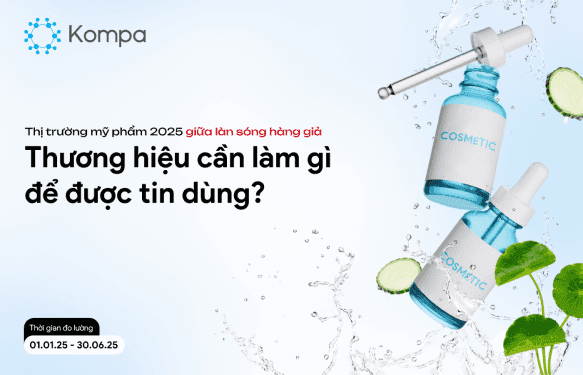
The 2025 cosmetics market amid a wave of counterfeit goods: What do brands need to do to earn consumers' trust?

The 2025 cosmetics market amid a wave of counterfeit goods: What do brands need to do to earn consumers' trust?

The 2025 cosmetics market amid a wave of counterfeit goods: What do brands need to do to earn consumers' trust?

|

Analytics

Analytics

The Ever-Evolving Cybersecurity Landscape

As social media is flooded with investigations into counterfeit cosmetics, false advertising, and products of unknown origin, trust in the beauty industry is hitting rock bottom. Consumers are no longer lenient—they are skeptical, asking questions, and demanding transparency. In that context, the report “Vietnam Cosmetics Market Insight 2025,” conducted by Kompa through an AI-Driven Social Listening system and analyzing more than 5.1 million discussions, clearly reveals what Vietnamese consumers truly think, say, and decide when buying cosmetics.
Below are the report’s notable findings.

Skincare leads the way – but the biggest barrier is trust

Skincare is the focal point of the beauty industry with 44.3% of total discussions, far ahead of makeup (25.4%) and fragrances (14%). Users are especially focused on serums (28%), moisturizers (22%), and makeup remover/cleansers (18%). But alongside high interest, consumers are also more cautious than ever. Allegations of low-quality cosmetics, especially involving famous KOLs, are forcing them to revisit a basic question: “What exactly am I putting on my face?”

In this wave of skepticism, trust has become a barrier—but also the biggest competitive advantage. Brands that maintain their position do so not only because of effectiveness, but also because of:

  • Clear product origin

  • Transparent ingredients

  • Reviews from real users and reputable KOLs

  • No avoidance of legal, disclosure, or testing issues

Consumers don’t wait to be convinced – they actively seek answers

Analysis of more than 2.2 million skincare discussions in the first half of 2025 shows that Vietnamese consumers no longer approach beauty products passively. They proactively share experiences, ask questions, and seek advice from the community—especially in Facebook groups, on TikTok, and on review forums.

  • 34% of users post real reviews and usage experiences, clearly stating pros and cons and how they felt after use.

  • 18% recommend specific products, acting as “community consultants” for different skin concerns.

  • 14% discuss ingredients, especially BHA, Niacinamide, Hyaluronic Acid…—evidence of increasingly in-depth knowledge.

  • 11% share causes of acne, oiliness, irritation… showing demand to understand the root causes of skin issues.

On the other hand, consumers also raise many questions before deciding to buy.

  • 37% of questions revolve around real effectiveness, side effects, price, and usage—showing high caution before purchase.

  • 25% compare skin conditions and solutions—especially common in beauty groups or TikTok comments.

  • 19% ask for routines and advice, showing the community’s role in shaping skincare journeys.

Purchase drivers and barriers for acne-treatment products from a social media perspective

With more than 292,000 discussions, acne-treatment products account for about 13.3% of total mentions in the skincare sector—showing this is a common need. The main driver that leads consumers to acne-treatment products is when skin experiences acute breakouts (33.1%), especially in the context of weather and environmental changes (24.9%) or when recommended by KOLs/friends (18.2%). In addition, factors such as preparing for important events (15.5%) or having been disappointed with previous products (8.3%) also help trigger purchasing behavior.

However, alongside strong demand, concerns about origin and authenticity are the biggest barriers causing hesitation. Specifically, 38% are concerned about products of unclear origin, while 21% fear counterfeits—a sensitive issue that has become even more notable amid a recent wave of investigations into low-quality cosmetics. Other factors such as lack of effectiveness (16%), side effects (11%), irritation (10%), and high price (4%) are also mentioned, but are less serious than risks related to transparency.

This sets a clear requirement for brands: transparent communication about product origin is no longer an advantage, but a minimum condition. At the same time, brands need to demonstrate rapid effectiveness—especially for sudden breakout situations—and commit to gentle formulas to ease users’ concerns about irritation.

Transparency and authenticity are no longer optional – they are minimum requirements

In a vibrant yet skepticism-filled market, consumers now care not only about product effectiveness but also have high expectations for brand transparency, safety, and authenticity. The report “Vietnam Cosmetics Market Insight 2025” not only reflects new consumer needs and behaviors in the cosmetics industry, but also suggests strategic directions to help brands maintain their position—through sincerity, data, and real quality.

The report is specifically researched for brands operating in the cosmetics and personal care industry. Register now to receive the full detailed analytical dataset, including visual charts, discussion maps by product segment, a list of standout community groups & KOLs, and communication strategy recommendations based on each consumer behavior pattern.

As social media is flooded with investigations into counterfeit cosmetics, false advertising, and products of unknown origin, trust in the beauty industry is hitting rock bottom. Consumers are no longer lenient—they are skeptical, asking questions, and demanding transparency. In that context, the report “Vietnam Cosmetics Market Insight 2025,” conducted by Kompa through an AI-Driven Social Listening system and analyzing more than 5.1 million discussions, clearly reveals what Vietnamese consumers truly think, say, and decide when buying cosmetics.
Below are the report’s notable findings.

Skincare leads the way – but the biggest barrier is trust

Skincare is the focal point of the beauty industry with 44.3% of total discussions, far ahead of makeup (25.4%) and fragrances (14%). Users are especially focused on serums (28%), moisturizers (22%), and makeup remover/cleansers (18%). But alongside high interest, consumers are also more cautious than ever. Allegations of low-quality cosmetics, especially involving famous KOLs, are forcing them to revisit a basic question: “What exactly am I putting on my face?”

In this wave of skepticism, trust has become a barrier—but also the biggest competitive advantage. Brands that maintain their position do so not only because of effectiveness, but also because of:

  • Clear product origin

  • Transparent ingredients

  • Reviews from real users and reputable KOLs

  • No avoidance of legal, disclosure, or testing issues

Consumers don’t wait to be convinced – they actively seek answers

Analysis of more than 2.2 million skincare discussions in the first half of 2025 shows that Vietnamese consumers no longer approach beauty products passively. They proactively share experiences, ask questions, and seek advice from the community—especially in Facebook groups, on TikTok, and on review forums.

  • 34% of users post real reviews and usage experiences, clearly stating pros and cons and how they felt after use.

  • 18% recommend specific products, acting as “community consultants” for different skin concerns.

  • 14% discuss ingredients, especially BHA, Niacinamide, Hyaluronic Acid…—evidence of increasingly in-depth knowledge.

  • 11% share causes of acne, oiliness, irritation… showing demand to understand the root causes of skin issues.

On the other hand, consumers also raise many questions before deciding to buy.

  • 37% of questions revolve around real effectiveness, side effects, price, and usage—showing high caution before purchase.

  • 25% compare skin conditions and solutions—especially common in beauty groups or TikTok comments.

  • 19% ask for routines and advice, showing the community’s role in shaping skincare journeys.

Purchase drivers and barriers for acne-treatment products from a social media perspective

With more than 292,000 discussions, acne-treatment products account for about 13.3% of total mentions in the skincare sector—showing this is a common need. The main driver that leads consumers to acne-treatment products is when skin experiences acute breakouts (33.1%), especially in the context of weather and environmental changes (24.9%) or when recommended by KOLs/friends (18.2%). In addition, factors such as preparing for important events (15.5%) or having been disappointed with previous products (8.3%) also help trigger purchasing behavior.

However, alongside strong demand, concerns about origin and authenticity are the biggest barriers causing hesitation. Specifically, 38% are concerned about products of unclear origin, while 21% fear counterfeits—a sensitive issue that has become even more notable amid a recent wave of investigations into low-quality cosmetics. Other factors such as lack of effectiveness (16%), side effects (11%), irritation (10%), and high price (4%) are also mentioned, but are less serious than risks related to transparency.

This sets a clear requirement for brands: transparent communication about product origin is no longer an advantage, but a minimum condition. At the same time, brands need to demonstrate rapid effectiveness—especially for sudden breakout situations—and commit to gentle formulas to ease users’ concerns about irritation.

Transparency and authenticity are no longer optional – they are minimum requirements

In a vibrant yet skepticism-filled market, consumers now care not only about product effectiveness but also have high expectations for brand transparency, safety, and authenticity. The report “Vietnam Cosmetics Market Insight 2025” not only reflects new consumer needs and behaviors in the cosmetics industry, but also suggests strategic directions to help brands maintain their position—through sincerity, data, and real quality.

The report is specifically researched for brands operating in the cosmetics and personal care industry. Register now to receive the full detailed analytical dataset, including visual charts, discussion maps by product segment, a list of standout community groups & KOLs, and communication strategy recommendations based on each consumer behavior pattern.

As social media is flooded with investigations into counterfeit cosmetics, false advertising, and products of unknown origin, trust in the beauty industry is hitting rock bottom. Consumers are no longer lenient—they are skeptical, asking questions, and demanding transparency. In that context, the report “Vietnam Cosmetics Market Insight 2025,” conducted by Kompa through an AI-Driven Social Listening system and analyzing more than 5.1 million discussions, clearly reveals what Vietnamese consumers truly think, say, and decide when buying cosmetics.
Below are the report’s notable findings.

Skincare leads the way – but the biggest barrier is trust

Skincare is the focal point of the beauty industry with 44.3% of total discussions, far ahead of makeup (25.4%) and fragrances (14%). Users are especially focused on serums (28%), moisturizers (22%), and makeup remover/cleansers (18%). But alongside high interest, consumers are also more cautious than ever. Allegations of low-quality cosmetics, especially involving famous KOLs, are forcing them to revisit a basic question: “What exactly am I putting on my face?”

In this wave of skepticism, trust has become a barrier—but also the biggest competitive advantage. Brands that maintain their position do so not only because of effectiveness, but also because of:

  • Clear product origin

  • Transparent ingredients

  • Reviews from real users and reputable KOLs

  • No avoidance of legal, disclosure, or testing issues

Consumers don’t wait to be convinced – they actively seek answers

Analysis of more than 2.2 million skincare discussions in the first half of 2025 shows that Vietnamese consumers no longer approach beauty products passively. They proactively share experiences, ask questions, and seek advice from the community—especially in Facebook groups, on TikTok, and on review forums.

  • 34% of users post real reviews and usage experiences, clearly stating pros and cons and how they felt after use.

  • 18% recommend specific products, acting as “community consultants” for different skin concerns.

  • 14% discuss ingredients, especially BHA, Niacinamide, Hyaluronic Acid…—evidence of increasingly in-depth knowledge.

  • 11% share causes of acne, oiliness, irritation… showing demand to understand the root causes of skin issues.

On the other hand, consumers also raise many questions before deciding to buy.

  • 37% of questions revolve around real effectiveness, side effects, price, and usage—showing high caution before purchase.

  • 25% compare skin conditions and solutions—especially common in beauty groups or TikTok comments.

  • 19% ask for routines and advice, showing the community’s role in shaping skincare journeys.

Purchase drivers and barriers for acne-treatment products from a social media perspective

With more than 292,000 discussions, acne-treatment products account for about 13.3% of total mentions in the skincare sector—showing this is a common need. The main driver that leads consumers to acne-treatment products is when skin experiences acute breakouts (33.1%), especially in the context of weather and environmental changes (24.9%) or when recommended by KOLs/friends (18.2%). In addition, factors such as preparing for important events (15.5%) or having been disappointed with previous products (8.3%) also help trigger purchasing behavior.

However, alongside strong demand, concerns about origin and authenticity are the biggest barriers causing hesitation. Specifically, 38% are concerned about products of unclear origin, while 21% fear counterfeits—a sensitive issue that has become even more notable amid a recent wave of investigations into low-quality cosmetics. Other factors such as lack of effectiveness (16%), side effects (11%), irritation (10%), and high price (4%) are also mentioned, but are less serious than risks related to transparency.

This sets a clear requirement for brands: transparent communication about product origin is no longer an advantage, but a minimum condition. At the same time, brands need to demonstrate rapid effectiveness—especially for sudden breakout situations—and commit to gentle formulas to ease users’ concerns about irritation.

Transparency and authenticity are no longer optional – they are minimum requirements

In a vibrant yet skepticism-filled market, consumers now care not only about product effectiveness but also have high expectations for brand transparency, safety, and authenticity. The report “Vietnam Cosmetics Market Insight 2025” not only reflects new consumer needs and behaviors in the cosmetics industry, but also suggests strategic directions to help brands maintain their position—through sincerity, data, and real quality.

The report is specifically researched for brands operating in the cosmetics and personal care industry. Register now to receive the full detailed analytical dataset, including visual charts, discussion maps by product segment, a list of standout community groups & KOLs, and communication strategy recommendations based on each consumer behavior pattern.

Sign up to receive reports

Sign up to receive reports

Sign up to receive reports

From Social Listening to AI Data Intelligence:

Helping businesses make smart, fast, and comprehensive decisions.

Hotline: 098.130.6460 (Kompa Sales)

Contact for services, quotations, or media partnerships: info@kompa.ai

Copyright © 2025 Kompa.
All Rights Reserved

From Social Listening to AI Data Intelligence:

Helping businesses make smart, fast, and comprehensive decisions.

Hotline: 098.130.6460 (Kompa Sales)

Contact for services, quotations, or media partnerships: info@kompa.ai

Copyright © 2025 Kompa.
All Rights Reserved

From Social Listening to AI Data Intelligence:

Helping businesses make smart, fast, and comprehensive decisions.

Hotline: 098.130.6460 (Kompa Sales)

Contact for services, quotations, or media partnerships: info@kompa.ai

Copyright © 2025 Kompa.
All Rights Reserved