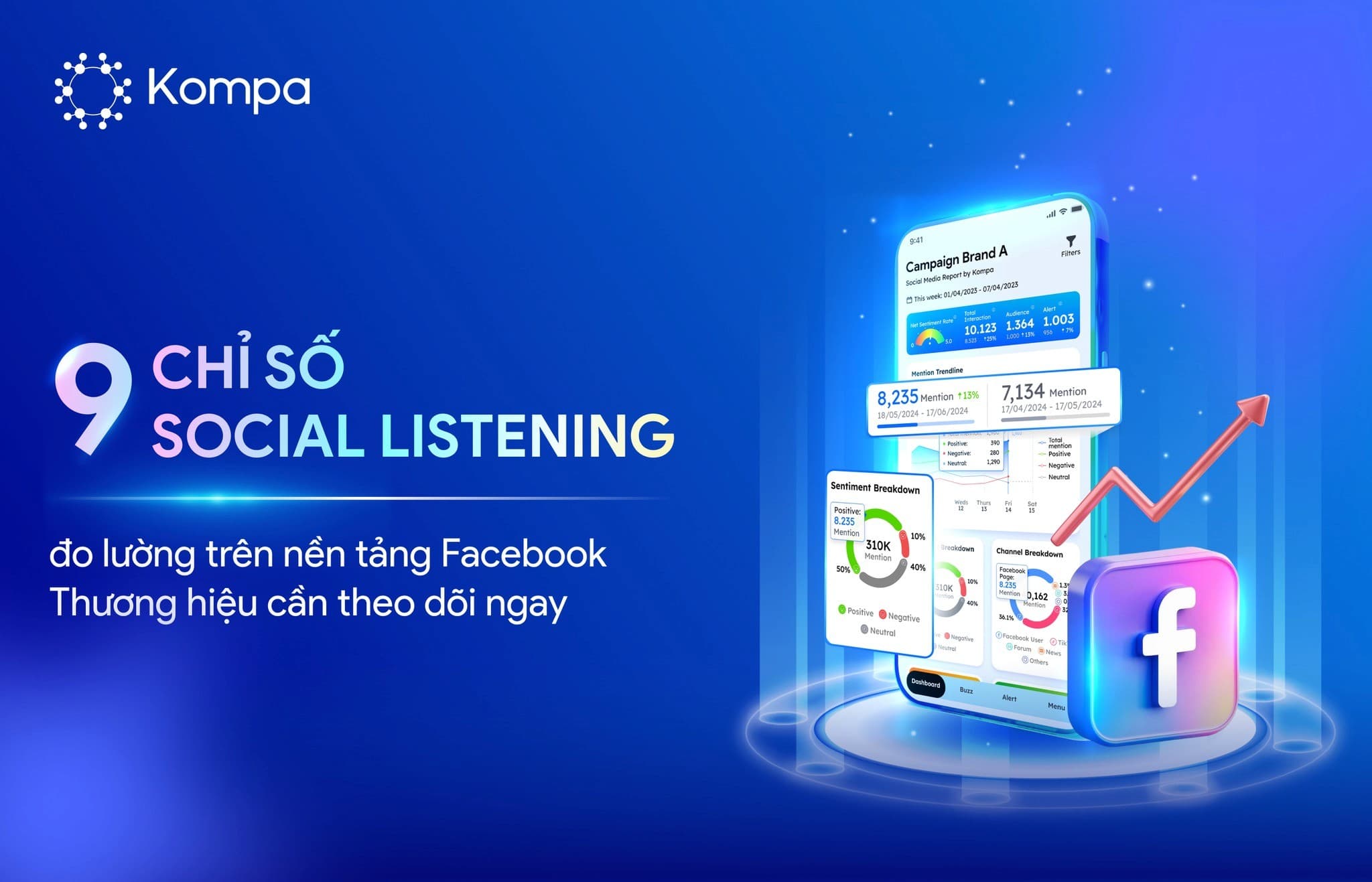
According to Datareportal, Facebook remains the social media platform with the highest monthly active users (MAU) in the world, with 3.07 billion users as of February 2025. On average, users spend about 30 minutes per day on this platform. Every passing minute, millions of posts, comments, and shares are created, authentically reflecting their emotions, needs, and perspectives. This is why Social Listening is a powerful tool to effectively exploit Facebook's massive data repository, analyze trends, measure sentiment, and derive Insights for Brands.
1. What is Facebook Social Listening and why is it important?
In an era where social media has become a place for users to express their daily emotions, opinions, and experiences, Facebook Social Listening helps monitor and analyze public discussions occurring on Facebook, enabling Brands to promptly capture what consumers are saying, thinking, and feeling about a specific product, service, or topic.
What makes Facebook Social Listening particularly important for Brands is that Facebook remains the leading platform used by people to share daily stories, react to events or topics, and engage in lively discussions. As of January 2025, Vietnam has approximately 76.2 million social media users, accounting for 75.2% of the country's population. According to DataReportal, Facebook has about 76.2 million users in Vietnam, equivalent to 75.2% of the population. By the share of internet users aged 16+ who use each platform every month, Facebook ranks first at 89.6%, followed by Zalo (86.6%), TikTok (80.9%) and Messenger (80.1%) (DataReportal, Digital 2025: Vietnam; GWI survey, Q3 2024).
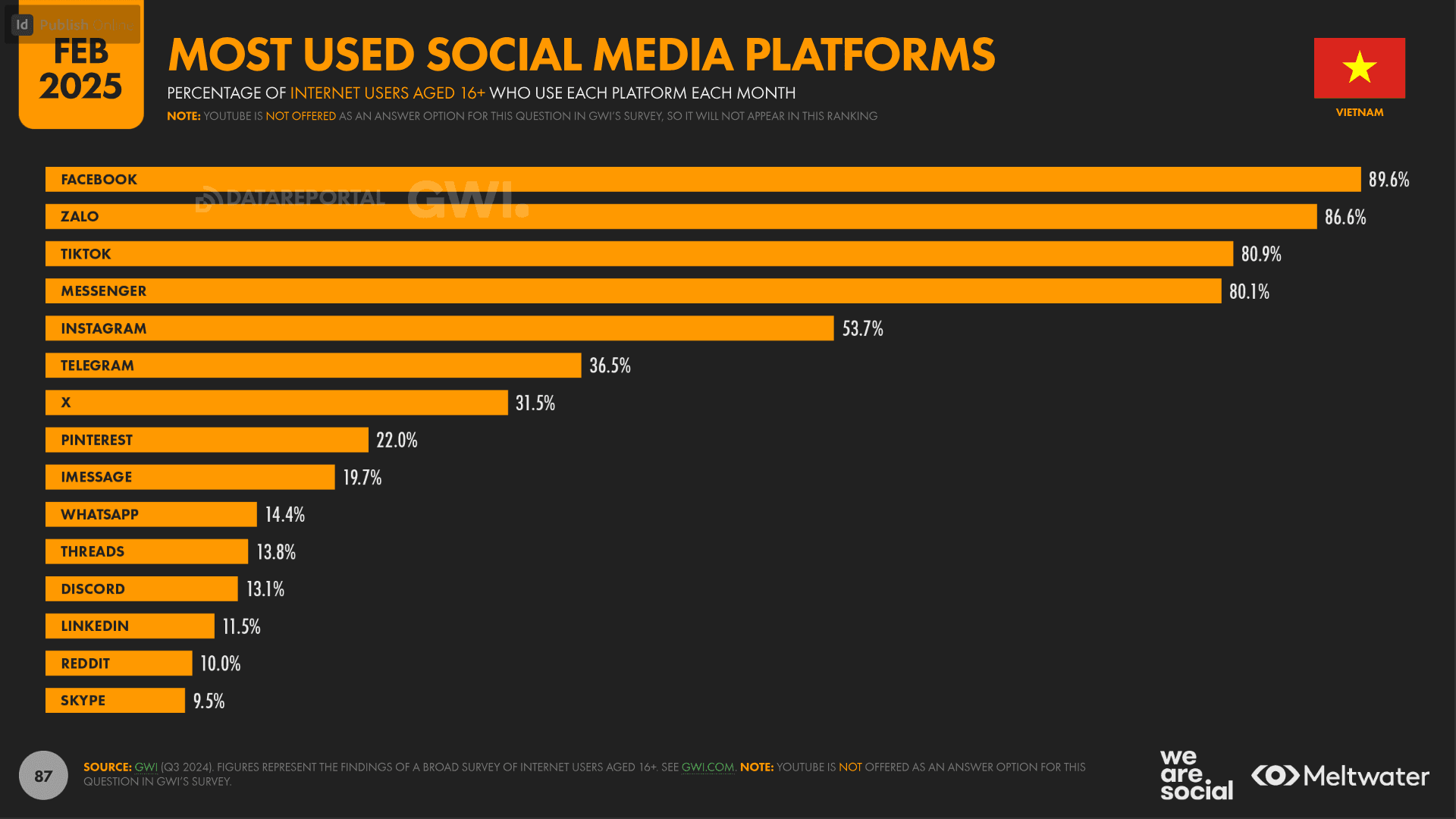
Facebook is the most used social media platform in Vietnam as of February 2025
By collecting, filtering, and analyzing discussions, Brands have the opportunity to see unmet needs, simmering emotions, or emerging trends within the consumer community.
2. Benefits of Facebook Social Listening for Brands
Beyond just collecting and analyzing data, Facebook Social Listening also helps Businesses become more proactive in strategic planning and crisis management.
2.1. Discovering latent consumer Insights
Deeper understanding of customers: Social Listening helps Brands analyze discussion trends, language, emotions, and user needs.
Optimize Marketing campaigns: Insights from Social Listening help Brands adjust advertising messages, select appropriate KOLs, or design products that address customer "pain points".

Social Listening on Facebook helps discover latent insights
2.2. Measuring Brand love/hate over time
Brand Sentiment Analysis: By monitoring the ratio of positive/negative mentions, Brands can measure customer satisfaction and detect potential issues (e.g., poor customer service, declining product quality).
Competitor benchmarking: Social Listening allows Brands to benchmark their influence and engagement against competitors, thereby adjusting competitive strategies.
2.3. Evaluating campaign effectiveness
Measure campaign effectiveness: Social Listening plays a crucial role in measuring and analyzing the effectiveness of communication campaigns on Facebook through a system of metrics: mention volume reflecting reach, total Engagement Rate showing community interest, and Sentiment Score measuring user satisfaction.
Determine Paid - Owned - Earned Media effectiveness: Social Listening is a tool that helps Brands measure the overall effectiveness of three types of media: Paid, Owned and Earned Media. This tool allows for tracking mentions, engagement, and sentiment from advertising campaigns (Paid Media); evaluating the performance of owned channels such as official Fanpages or Groups (Owned Media); and simultaneously measuring organic reach through user-generated content, unpaid mentions from KOL/KOC, and community discussions (Earned Media).
2.4. Tracking trends for appropriate development
Catching trends for effective Marketing: Social Listening on Facebook helps Brands promptly detect prominent community trends such as social slang (trending terms or ways of speaking), meme, or hot trends that are being widely shared. These signals are not only opportunities to catch "trends" for creative content and organize communication campaigns that resonate with users, but also serve as inspiration for Marketing activities that stay close to online culture.
Discovering needs: Through monitoring discussions around product topics or industries, Brands can also identify unmet needs – such as desires for more convenient packaging, healthier formulas, or more accessible services – thereby improving or developing new products that meet consumer expectations.
2.5. Early warning of communication risks
Preventing crises from the onset: A single post accusing a product of poor quality can spread rapidly on Facebook. Social Listening helps Brands detect this early and contact the customer to resolve the issue before it becomes a "public outcry".
Brand reputation management: When a scandal occurs, Brands can monitor community reactions and provide timely, transparent responses to minimize damage.
Social Listening on Facebook helps provide early warnings for communication risks
3. How Social Listening works on the Facebook platform
Facebook Social Listening measures and collects data on keywords, hashtags, and likes regarding specific topics from public sources such as fanpage posts, public group posts, public personal posts, and comments on viral articles. Through monitoring and collection, the social listening system analyzes the number of mentions, sentiment trends (positive, negative, neutral), prominent topics, and the user demographics involved in the discussion.
In most measurement activities, Facebook Social Listening focuses on public data on social media. Facebook group Social Listening specifically has certain limitations, as Facebook has tightened data access from private groups since 2018, but public groups remain a valuable data source if monitored correctly and with user privacy ensured.
4. Effective Facebook Social Listening implementation strategy
Social Listening on Facebook is not just about data collection; it requires a systematic process to turn information into strategic action. Below are 5 steps for effective Social Listening implementation,
4.1. Define clear objectives
Objectives will determine the direction of data collection, the tools used, and how effectiveness is measured. Without clear definitions, a Brand can easily be "drowned" in a sea of information without finding valuable Insight.
Common objectives:
Brand reputation monitoring: Measuring Sentiment around the Brand.
Marketing campaign evaluation: Analyzing user reactions to advertisements, events, and KOLs.
Potential crisis detection: Early warning of issues causing community outrage.
Customer Insight discovery: Exploring unmet needs, habits, and pain points.
Competitor research: Comparing mention levels and Brand Sentiment vs. competitors.
4.2 Selecting appropriate keywords, hashtags, and topics

Keywords are the "fishing rod" to collect the right data. If chosen incorrectly, the Brand will miss important information or collect noisy data.
Keyword list to monitor:
Brand & product names (including misspellings and nicknames).
Industry keywords (e.g., a milk Brand needs to monitor "clean milk", "organic milk").
Competitor names (to compare mention levels and Sentiment).
Related hashtags (e.g., #StarbucksVietnam, #TranhCaiDauGoiX).
Emotions & common issues (e.g., poor quality, bad service, satisfied...).
4.3 Focus on key metrics
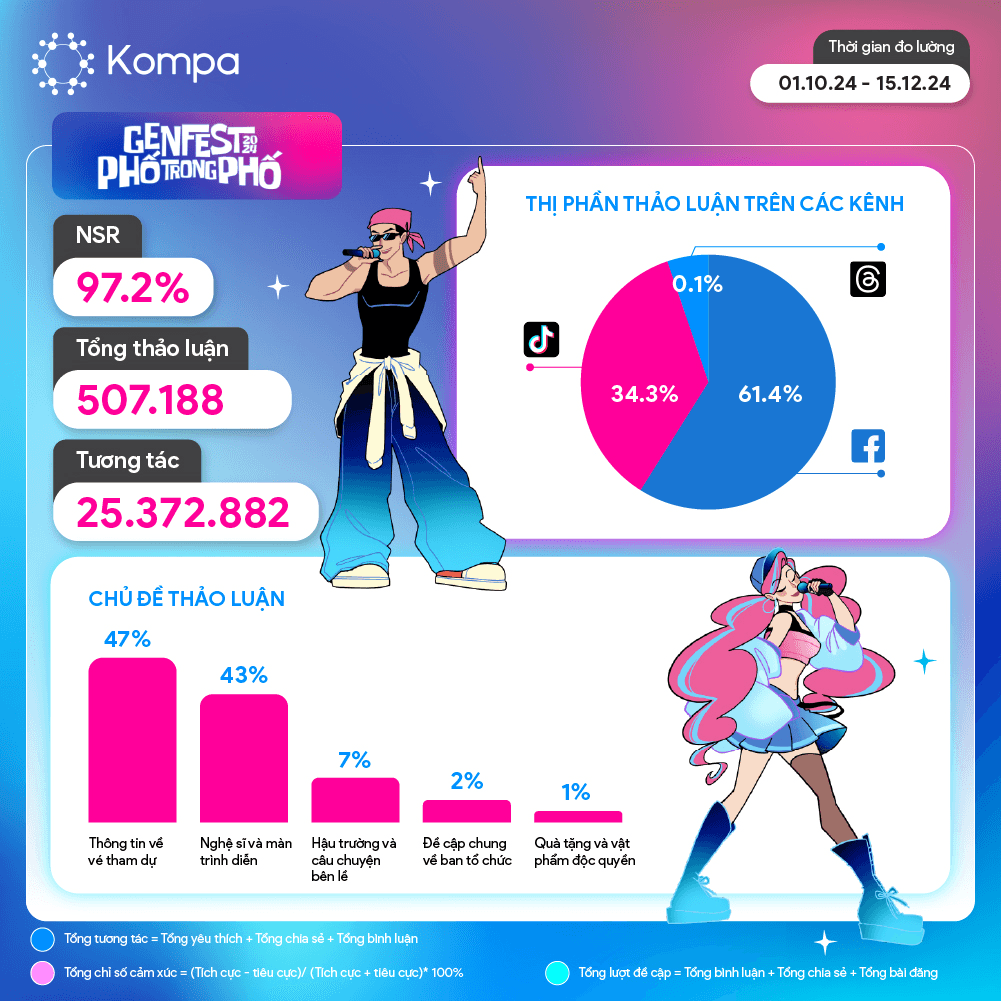
To make Social Listening truly effective, a Brand needs to focus on the following 7 core metrics in the analysis report. Each metric carries its own strategic meaning, helping Businesses make decisions based on real data.
Total Mention
The number of times a Brand, product, or target topic is mentioned on Facebook (including posts, comments, photo/video captions...). This metric represents the Brand's level of presence in community conversations.
Total Interaction
Includes likes, shares, comments, and emojis. This metric reflects the level of interest and reach achieved by the Brand or topic. High interaction is often associated with content that triggers strong emotions or touches on user "pain points"/"interests".
Excerpt from GENfest 2024 Event Social Listening report
Sentiment metric – Net Sentiment Rate (NSR)
The percentage ratio between positive and negative mentions. This is a measure of the community's general perception of the Brand. A high NSR proves the Brand is scoring well in the eyes of users.
Positive mention (%)
The Positive mention (%) rate represents the percentage of discussions, comments, or posts carrying positive emotions about the Brand/product compared to the total number of mentions. This is a crucial metric reflecting customer satisfaction, while also helping Businesses identify strengths to leverage, such as product quality, customer service, or marketing campaign effectiveness. When analyzing this metric, a Brand can identify which factors are making a good impression on the public, thereby providing a basis to replicate successful strategies.
Negative mention (%)
This metric reflects the proportion of negative discussions and comments about the Brand compared to the total number of mentions. This is an important metric that helps Businesses promptly identify issues needing rectification, from product quality and customer service to pricing policies. In particular, when many customers complain about the same issue (such as product defects or delivery delays), it can be an early warning sign of an impending communication crisis.
Share of Voice by channel (SOV by Channel)
Measures the Brand's presence compared to competitors in the same industry across different Facebook sources (Fanpage, Group, personal profiles). SOV helps Businesses understand their competitive position and allocate communication resources reasonably.
Top Topics
The content and topics related to the Brand that are mentioned most frequently. Monitoring top topics helps a Brand determine what users are discussing most, what is attracting attention, or what poses potential risks.
Top Sources
Top Sources is an important metric that helps a Brand identify who is talking about them the most and which are the main distribution channels, including: (1) prominent Fanpages, (2) Facebook Groups with high mention volumes, and (3) KOLs/Influencers or personal accounts generating high interaction. This metric helps Businesses clearly understand which channels are driving discussions about the Brand (Fanpage, Group, or personal) and who is influencing (positively/negatively) public perception.
Demographic
Including characteristics such as gender, age, and geographic location, this data can only be collected from users who make their personal information public on Facebook. Although limited, this remains a valuable data source that helps a Brand sketch the profile of real users who are interested in, discussing, or interacting with them. Understanding this audience not only helps optimize content, advertising campaigns, and Brand positioning more accurately but also opens opportunities to discover new potential customer segments. Additionally, combining demographics with sentiment and behavior analysis is an important foundation for effectively personalizing the customer experience journey.
The key to unlocking consumer Insight from Facebook
Social Listening on Facebook is not merely a monitoring tool – it is an extension that helps Brands gain deep and continuous consumer insights. From capturing emotions and trends to identifying risks and uncovering unmet needs, Social Listening provides businesses with a significant competitive advantage in building brand image, optimizing products, and planning marketing strategies. With a platform boasting a massive and highly interactive user community like Facebook, Social Listening is the key to helping Brands act faster and stay closer to consumers every day.