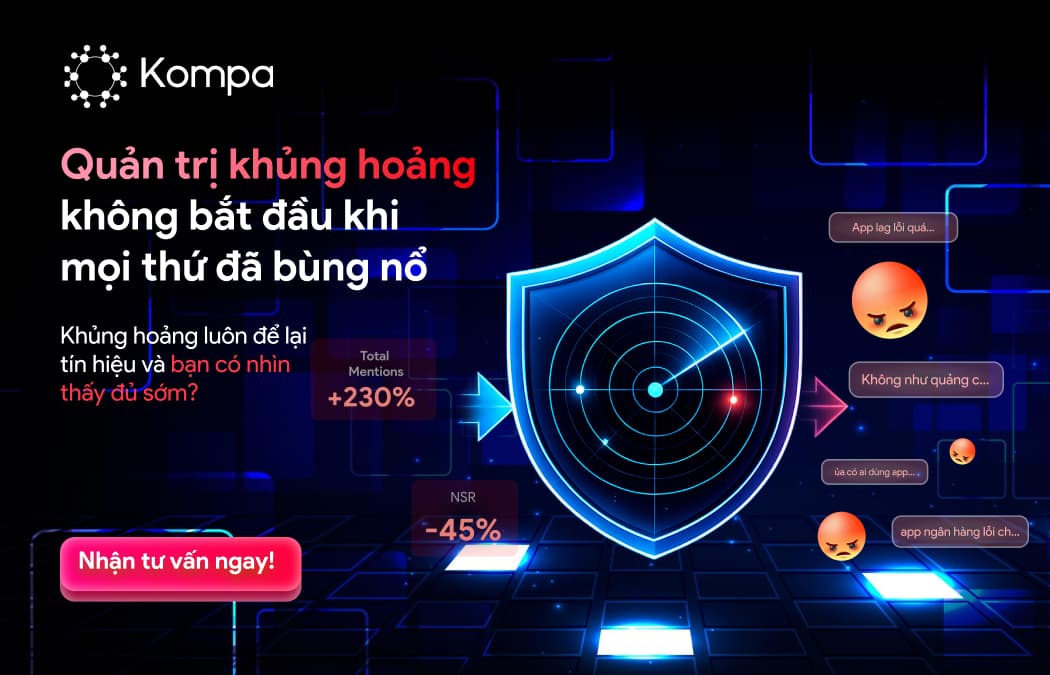
For many years, crisis management was often viewed as a communications challenge — where brands responded only after a crisis had already happened, through press releases, public apologies, or campaigns designed to “ease” public opinion. However, as social media has become the center of public conversation, this approach is increasingly revealing its limitations.
Today, crises no longer begin from mainstream news sources. Instead, they emerge from seemingly small interactions: a negative comment, a dissatisfied review, or a personal experience shared through video. Individually, these signals may appear insignificant. But when combined and amplified by platform algorithms, they can quickly evolve into a wave of public backlash beyond a brand’s control.
This shift raises a fundamental question: are brands truly “managing crises,” or simply “reacting to consequences”?
When the Speed of Virality Exceeds the Speed of Response
One of the defining characteristics of modern crises is speed. In the past, businesses might have had days — even weeks — to assess a situation and prepare a response. Today, that window has shrunk to just a few hours.
This is driven not only by user behavior, where people instinctively share emotions and opinions almost instantly, but also by the way platforms prioritize content. Controversial, negative, or emotionally charged content tends to spread faster, unintentionally placing brands in a reactive position before they fully understand what is happening.
Once a crisis has evolved into a widespread “phenomenon,” most response efforts become damage control. Brands may control their own messaging, but they cannot control how communities interpret and amplify it.
Insight: Crises Always Leave “Data Traces” Early On
When examined closely, most crises do not appear suddenly. They go through a “pre-crisis” phase where negative signals begin to emerge, but are not yet large enough to attract attention.
This may include a slight increase in negative sentiment, a small group of users repeatedly raising the same complaint, or the emergence of critical discussion topics. At scale, these signals are easy to overlook. But from a data perspective, they are early indicators of potential risk.
The problem is that most businesses do not lack data — they lack the ability to correctly interpret the signals within that data. By focusing only on summary reports or overly “smoothed” metrics, brands unintentionally miss the most critical stage: the point where a crisis is still manageable.
From Reaction to Prediction: The Core Shift in Crisis Management
To adapt to today’s environment, Crisis Management needs to be redefined. Instead of focusing solely on handling crises after they occur, the priority must shift toward early detection and prediction.
This requires systems capable of continuously monitoring conversations — not only at the surface level, but also at the level of emotion and context. When unusual signals appear, such as a sudden rise in negative reactions related to a specific experience, the system must be sensitive enough to detect them and fast enough to issue alerts.
More importantly, data should not stop at “detection.” It must help brands understand the nature of the issue itself. A crisis related to customer service requires a completely different response strategy than one driven by misinformation or communication failures. Without distinguishing between them, any response risks becoming ineffective — or even worsening the situation.
The 24 Hours That Shape a Crisis
Imagine a familiar scenario: a customer shares a negative experience at an F&B store. In the first few hours, the post attracts only limited engagement. However, as more people empathize and begin sharing similar experiences, the story gradually moves beyond an isolated incident.
Within just 24 hours, the content may be recreated in multiple formats — from long-form posts and short videos to viral comment threads — forming a broad network of discussions. At this stage, the issue is no longer about one customer experience; it has become a collective narrative about the brand.
If the brand only recognizes the issue at this point, every action becomes reactive. On the other hand, if the brand can detect the signals during the earliest hours — while conversations are still fragmented — it has the opportunity to intervene early, address the root cause, and prevent further amplification.
The Real Advantage Is Not Responding Better — It’s Seeing Earlier
In an environment where information spreads rapidly and emotions can escalate after only a few interactions, crisis management is no longer simply a matter of response.
The true competitive advantage lies in the ability to identify risks while they are still signals — before they become full-scale events. This requires brands to approach data differently: not merely as reporting material, but as a source for listening, analysis, and prediction.
Kompa: Turning Data into Brand Defense Capabilities
At Kompa, Crisis Management is built as a data-driven defense system where every market signal is monitored and analyzed in real time. Instead of waiting for crises to occur, the system enables brands to detect even the smallest fluctuations in online discussions, issue early warnings, and support timely decision-making.
This approach not only helps brands minimize risk, but also fundamentally transforms the role of Crisis Management — from a reactive function into a strategic capability for protecting and sustaining brand reputation.