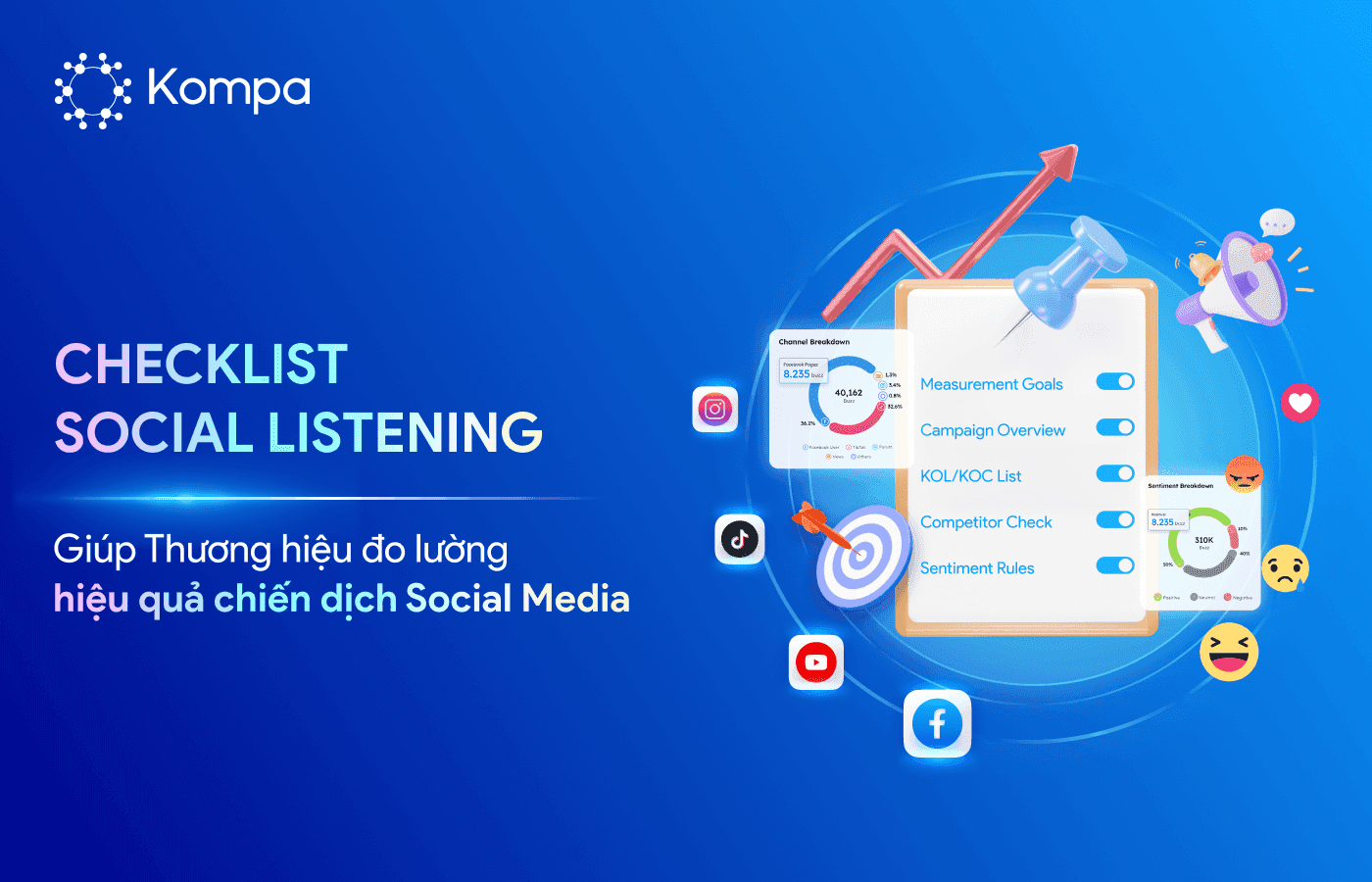
The Social Listening Checklist helps brands measure the effectiveness of social media campaigns

The Social Listening Checklist helps brands measure the effectiveness of social media campaigns

The Social Listening Checklist helps brands measure the effectiveness of social media campaigns

Marketers often measure social campaigns through metrics such as reach, click, lead, CPC, CPL to optimize Paid Media. And to gain a more holistic view of how the public actually receives a campaign, Social Listening helps marketers measure the effectiveness of Paid – Owned – Earned Media, KOL/KOC activities, identify content and messages that win public favor, while also listening to positive and negative real-time feedback from the community to optimize campaigns more deeply.

Social Listening: Standardizing campaign measurement data

Unlike Paid Media measurement reports that focus only on clicks, leads, or CPC, Social Listening helps brands listen to community discussions across multiple platforms (Facebook, TikTok, YouTube, online news, forums, e-commerce), accurately reflecting how customers perceive the campaign.

Social Listening data reflects:

  • Who is talking about the campaign?

  • With what sentiment?

  • Where are they talking?

  • Which content and messages are being loved or causing controversy?

For the measurement process to be effective, the brand side needs to prepare a complete, clear checklist to ensure accurate implementation and insight extraction for campaign optimization.

Checklist needed when measuring campaigns with Social Listening

A Social Listening report should not only provide raw data, but also be structured into methodical, systematic categories to help brands:

  • Measure performance across Paid – Owned – Earned Media.

  • Identify which KOL/KOC activities are truly driving effectiveness.

  • Find deep insights from customer discussions.

  • Control risks and potential crises in real time.

  • Create a foundation for optimizing messaging, content, and flexible channel budget allocation.

Below is a detailed checklist required when measuring the effectiveness of Social Media campaigns using Social Listening:

1. Clearly define measurement objectives

Before measuring, brands need to clearly define objectives to avoid collecting scattered data, wasting resources without reflecting the campaign’s true value. Clear objectives help Social Listening data connect with the overall plan, support the brand team in understanding how each Paid – Owned – Earned Media channel contributes, and determine the appropriate analysis method: measuring awareness, engagement, conversion, or extracting insights for market research (Research Insight).

Information to provide:

  • Measurement objectives: Awareness, Engagement, Conversion, Research Insight.

  • Specific KPIs: Share of Voice (SOV) versus competitors, positive sentiment rate,  mention volume, reach, engagement.

  • Measurement timeline (e.g., from the start date of KOL testing to the end of Paid Media).

Benefits:

  • Helps establish a measurement framework aligned with real objectives.

  • Avoids collecting irrelevant data unrelated to the campaign.

  • Helps the final report clearly connect with internal KPIs and brand strategy.

  • Saves processing time and measurement costs by focusing only on decision-making data.

2. Campaign overview information

For Social Listening to measure effectively, brands need to provide an overall campaign picture, including context, insight, messaging, key activities, and deployment channels. This helps the system set up keywords, hashtags, accurate tracking, and analysis aligned with real objectives. At the same time, understanding each phase and activities such as dance challenges, livestreams, minigames, unboxing, and offline events helps evaluate spread and responses by activity, thereby optimizing messages and channels for subsequent phases.

Information to provide:

  • Campaign name, insight, and key message.

  • Timeline of each phase (if any).

  • Official hashtags, slogan, and keywords.

  • Deployment channels: TikTok, Facebook, YouTube, Forum, News, E-commerce.

  • Main activities: dance challenge, livestream, minigame, unboxing, offline event…

Benefits:

  • Helps set up keyword sets, hashtags, and content classification for accurate measurement.

  • Ensures the measurement report is tied to the actual campaign.

  • Supports evaluation of each activity and each campaign phase.

  • Creates a foundation for analyzing community trends directly related to campaign messages and insights.

3. List of KOL/KOC and deployed content

KOL/KOC play an important role in spreading campaigns and creating natural viral effects, so brands need to provide a KOL/KOC list, post links, posting dates, and posts on fanpages or community groups. This helps Kompa track each KOL/KOC’s effectiveness by mentions, sentiment rate, and reception level, while clearly distinguishing Paid Media, Owned Media, and Earned Media to avoid duplication or missing important data.

Information to provide:

  • List of participating KOL/KOC, post links, and posting dates.

  • Post links from brand fanpages and community groups.

  • List of KOLs receiving unboxing products (if any).

Benefits:

  • Measure the effectiveness of Paid Media (KOL/KOC), Owned Media (fanpages, groups), and Earned Media (UGC).

  • Analyze KOL/KOC effectiveness in terms of mention volume, sentiment, and reach.

  • Support evaluation of ROI for KOL/KOC activities.

  • Find insights on the content, messages, and formats most favored by the community through KOL/KOC.

4. List of competitors for benchmarking

To clearly understand their campaign’s market position, brands need to provide a list of key competitors, competitor campaigns running in parallel or close in time, along with hashtags or campaign names if available. This list not only helps Social Listening measure Share of Voice, but also helps analyze sentiment and assess how the community is discussing competitors and the brand, thereby identifying "gaps" in user needs or points to improve in the current campaign.

Information to provide:

  • List of key competitors.

  • Competitor campaigns running at the same time.

  • Competitor hashtags and campaign names (if any).

Benefits:

  • Measure SOV and compare sentiment rates with competitors.

  • Find competitive insights to optimize campaigns.

  • Identify brand strengths and weaknesses versus competitors in the eyes of the community.

  • Support decision-making when optimizing messaging and content for the next campaign.

5. Sentiment classification guideline

Sentiment rate is an important metric in Social Listening reports, helping measure positive, negative, and neutral levels from the community. To classify consistently with brand orientation and avoid misinterpreting insights, brands need to provide sentiment classification guidelines along with a keyword and phrase list identified as positive, negative, or neutral so the system can classify clearly, while also pre-listing sensitive topics that require separate monitoring for early warning.

Information to provide:

  • Detailed sentiment classification guideline according to brand standards.

  • Sensitive topics that require separate tracking (if any).

Benefits:

  • Ensures sentiment classification is consistent with brand orientation.

  • Avoids misinterpreting community insights during data analysis.

  • Makes it easier to detect risks and potential crises during tracking.

  • Helps analyze user feedback close to real perceptions, serving message optimization.

Social Listening elevates campaign measurement

Social Listening is a solution that helps brands identify content and messages that fully win public favor, uncover hidden community insights, measure the effectiveness of Paid – Owned – Earned Media throughout the campaign, and control risks and negative feedback in real time. As a result, brands can optimize campaigns to both achieve objectives and align with long-term strategy. When fully prepared with data, Social Listening not only helps brands “measure” but also “listen” to the community in a fast-changing market.


Marketers often measure social campaigns through metrics such as reach, click, lead, CPC, CPL to optimize Paid Media. And to gain a more holistic view of how the public actually receives a campaign, Social Listening helps marketers measure the effectiveness of Paid – Owned – Earned Media, KOL/KOC activities, identify content and messages that win public favor, while also listening to positive and negative real-time feedback from the community to optimize campaigns more deeply.

Social Listening: Standardizing campaign measurement data

Unlike Paid Media measurement reports that focus only on clicks, leads, or CPC, Social Listening helps brands listen to community discussions across multiple platforms (Facebook, TikTok, YouTube, online news, forums, e-commerce), accurately reflecting how customers perceive the campaign.

Social Listening data reflects:

  • Who is talking about the campaign?

  • With what sentiment?

  • Where are they talking?

  • Which content and messages are being loved or causing controversy?

For the measurement process to be effective, the brand side needs to prepare a complete, clear checklist to ensure accurate implementation and insight extraction for campaign optimization.

Checklist needed when measuring campaigns with Social Listening

A Social Listening report should not only provide raw data, but also be structured into methodical, systematic categories to help brands:

  • Measure performance across Paid – Owned – Earned Media.

  • Identify which KOL/KOC activities are truly driving effectiveness.

  • Find deep insights from customer discussions.

  • Control risks and potential crises in real time.

  • Create a foundation for optimizing messaging, content, and flexible channel budget allocation.

Below is a detailed checklist required when measuring the effectiveness of Social Media campaigns using Social Listening:

1. Clearly define measurement objectives

Before measuring, brands need to clearly define objectives to avoid collecting scattered data, wasting resources without reflecting the campaign’s true value. Clear objectives help Social Listening data connect with the overall plan, support the brand team in understanding how each Paid – Owned – Earned Media channel contributes, and determine the appropriate analysis method: measuring awareness, engagement, conversion, or extracting insights for market research (Research Insight).

Information to provide:

  • Measurement objectives: Awareness, Engagement, Conversion, Research Insight.

  • Specific KPIs: Share of Voice (SOV) versus competitors, positive sentiment rate,  mention volume, reach, engagement.

  • Measurement timeline (e.g., from the start date of KOL testing to the end of Paid Media).

Benefits:

  • Helps establish a measurement framework aligned with real objectives.

  • Avoids collecting irrelevant data unrelated to the campaign.

  • Helps the final report clearly connect with internal KPIs and brand strategy.

  • Saves processing time and measurement costs by focusing only on decision-making data.

2. Campaign overview information

For Social Listening to measure effectively, brands need to provide an overall campaign picture, including context, insight, messaging, key activities, and deployment channels. This helps the system set up keywords, hashtags, accurate tracking, and analysis aligned with real objectives. At the same time, understanding each phase and activities such as dance challenges, livestreams, minigames, unboxing, and offline events helps evaluate spread and responses by activity, thereby optimizing messages and channels for subsequent phases.

Information to provide:

  • Campaign name, insight, and key message.

  • Timeline of each phase (if any).

  • Official hashtags, slogan, and keywords.

  • Deployment channels: TikTok, Facebook, YouTube, Forum, News, E-commerce.

  • Main activities: dance challenge, livestream, minigame, unboxing, offline event…

Benefits:

  • Helps set up keyword sets, hashtags, and content classification for accurate measurement.

  • Ensures the measurement report is tied to the actual campaign.

  • Supports evaluation of each activity and each campaign phase.

  • Creates a foundation for analyzing community trends directly related to campaign messages and insights.

3. List of KOL/KOC and deployed content

KOL/KOC play an important role in spreading campaigns and creating natural viral effects, so brands need to provide a KOL/KOC list, post links, posting dates, and posts on fanpages or community groups. This helps Kompa track each KOL/KOC’s effectiveness by mentions, sentiment rate, and reception level, while clearly distinguishing Paid Media, Owned Media, and Earned Media to avoid duplication or missing important data.

Information to provide:

  • List of participating KOL/KOC, post links, and posting dates.

  • Post links from brand fanpages and community groups.

  • List of KOLs receiving unboxing products (if any).

Benefits:

  • Measure the effectiveness of Paid Media (KOL/KOC), Owned Media (fanpages, groups), and Earned Media (UGC).

  • Analyze KOL/KOC effectiveness in terms of mention volume, sentiment, and reach.

  • Support evaluation of ROI for KOL/KOC activities.

  • Find insights on the content, messages, and formats most favored by the community through KOL/KOC.

4. List of competitors for benchmarking

To clearly understand their campaign’s market position, brands need to provide a list of key competitors, competitor campaigns running in parallel or close in time, along with hashtags or campaign names if available. This list not only helps Social Listening measure Share of Voice, but also helps analyze sentiment and assess how the community is discussing competitors and the brand, thereby identifying "gaps" in user needs or points to improve in the current campaign.

Information to provide:

  • List of key competitors.

  • Competitor campaigns running at the same time.

  • Competitor hashtags and campaign names (if any).

Benefits:

  • Measure SOV and compare sentiment rates with competitors.

  • Find competitive insights to optimize campaigns.

  • Identify brand strengths and weaknesses versus competitors in the eyes of the community.

  • Support decision-making when optimizing messaging and content for the next campaign.

5. Sentiment classification guideline

Sentiment rate is an important metric in Social Listening reports, helping measure positive, negative, and neutral levels from the community. To classify consistently with brand orientation and avoid misinterpreting insights, brands need to provide sentiment classification guidelines along with a keyword and phrase list identified as positive, negative, or neutral so the system can classify clearly, while also pre-listing sensitive topics that require separate monitoring for early warning.

Information to provide:

  • Detailed sentiment classification guideline according to brand standards.

  • Sensitive topics that require separate tracking (if any).

Benefits:

  • Ensures sentiment classification is consistent with brand orientation.

  • Avoids misinterpreting community insights during data analysis.

  • Makes it easier to detect risks and potential crises during tracking.

  • Helps analyze user feedback close to real perceptions, serving message optimization.

Social Listening elevates campaign measurement

Social Listening is a solution that helps brands identify content and messages that fully win public favor, uncover hidden community insights, measure the effectiveness of Paid – Owned – Earned Media throughout the campaign, and control risks and negative feedback in real time. As a result, brands can optimize campaigns to both achieve objectives and align with long-term strategy. When fully prepared with data, Social Listening not only helps brands “measure” but also “listen” to the community in a fast-changing market.


Marketers often measure social campaigns through metrics such as reach, click, lead, CPC, CPL to optimize Paid Media. And to gain a more holistic view of how the public actually receives a campaign, Social Listening helps marketers measure the effectiveness of Paid – Owned – Earned Media, KOL/KOC activities, identify content and messages that win public favor, while also listening to positive and negative real-time feedback from the community to optimize campaigns more deeply.

Social Listening: Standardizing campaign measurement data

Unlike Paid Media measurement reports that focus only on clicks, leads, or CPC, Social Listening helps brands listen to community discussions across multiple platforms (Facebook, TikTok, YouTube, online news, forums, e-commerce), accurately reflecting how customers perceive the campaign.

Social Listening data reflects:

  • Who is talking about the campaign?

  • With what sentiment?

  • Where are they talking?

  • Which content and messages are being loved or causing controversy?

For the measurement process to be effective, the brand side needs to prepare a complete, clear checklist to ensure accurate implementation and insight extraction for campaign optimization.

Checklist needed when measuring campaigns with Social Listening

A Social Listening report should not only provide raw data, but also be structured into methodical, systematic categories to help brands:

  • Measure performance across Paid – Owned – Earned Media.

  • Identify which KOL/KOC activities are truly driving effectiveness.

  • Find deep insights from customer discussions.

  • Control risks and potential crises in real time.

  • Create a foundation for optimizing messaging, content, and flexible channel budget allocation.

Below is a detailed checklist required when measuring the effectiveness of Social Media campaigns using Social Listening:

1. Clearly define measurement objectives

Before measuring, brands need to clearly define objectives to avoid collecting scattered data, wasting resources without reflecting the campaign’s true value. Clear objectives help Social Listening data connect with the overall plan, support the brand team in understanding how each Paid – Owned – Earned Media channel contributes, and determine the appropriate analysis method: measuring awareness, engagement, conversion, or extracting insights for market research (Research Insight).

Information to provide:

  • Measurement objectives: Awareness, Engagement, Conversion, Research Insight.

  • Specific KPIs: Share of Voice (SOV) versus competitors, positive sentiment rate,  mention volume, reach, engagement.

  • Measurement timeline (e.g., from the start date of KOL testing to the end of Paid Media).

Benefits:

  • Helps establish a measurement framework aligned with real objectives.

  • Avoids collecting irrelevant data unrelated to the campaign.

  • Helps the final report clearly connect with internal KPIs and brand strategy.

  • Saves processing time and measurement costs by focusing only on decision-making data.

2. Campaign overview information

For Social Listening to measure effectively, brands need to provide an overall campaign picture, including context, insight, messaging, key activities, and deployment channels. This helps the system set up keywords, hashtags, accurate tracking, and analysis aligned with real objectives. At the same time, understanding each phase and activities such as dance challenges, livestreams, minigames, unboxing, and offline events helps evaluate spread and responses by activity, thereby optimizing messages and channels for subsequent phases.

Information to provide:

  • Campaign name, insight, and key message.

  • Timeline of each phase (if any).

  • Official hashtags, slogan, and keywords.

  • Deployment channels: TikTok, Facebook, YouTube, Forum, News, E-commerce.

  • Main activities: dance challenge, livestream, minigame, unboxing, offline event…

Benefits:

  • Helps set up keyword sets, hashtags, and content classification for accurate measurement.

  • Ensures the measurement report is tied to the actual campaign.

  • Supports evaluation of each activity and each campaign phase.

  • Creates a foundation for analyzing community trends directly related to campaign messages and insights.

3. List of KOL/KOC and deployed content

KOL/KOC play an important role in spreading campaigns and creating natural viral effects, so brands need to provide a KOL/KOC list, post links, posting dates, and posts on fanpages or community groups. This helps Kompa track each KOL/KOC’s effectiveness by mentions, sentiment rate, and reception level, while clearly distinguishing Paid Media, Owned Media, and Earned Media to avoid duplication or missing important data.

Information to provide:

  • List of participating KOL/KOC, post links, and posting dates.

  • Post links from brand fanpages and community groups.

  • List of KOLs receiving unboxing products (if any).

Benefits:

  • Measure the effectiveness of Paid Media (KOL/KOC), Owned Media (fanpages, groups), and Earned Media (UGC).

  • Analyze KOL/KOC effectiveness in terms of mention volume, sentiment, and reach.

  • Support evaluation of ROI for KOL/KOC activities.

  • Find insights on the content, messages, and formats most favored by the community through KOL/KOC.

4. List of competitors for benchmarking

To clearly understand their campaign’s market position, brands need to provide a list of key competitors, competitor campaigns running in parallel or close in time, along with hashtags or campaign names if available. This list not only helps Social Listening measure Share of Voice, but also helps analyze sentiment and assess how the community is discussing competitors and the brand, thereby identifying "gaps" in user needs or points to improve in the current campaign.

Information to provide:

  • List of key competitors.

  • Competitor campaigns running at the same time.

  • Competitor hashtags and campaign names (if any).

Benefits:

  • Measure SOV and compare sentiment rates with competitors.

  • Find competitive insights to optimize campaigns.

  • Identify brand strengths and weaknesses versus competitors in the eyes of the community.

  • Support decision-making when optimizing messaging and content for the next campaign.

5. Sentiment classification guideline

Sentiment rate is an important metric in Social Listening reports, helping measure positive, negative, and neutral levels from the community. To classify consistently with brand orientation and avoid misinterpreting insights, brands need to provide sentiment classification guidelines along with a keyword and phrase list identified as positive, negative, or neutral so the system can classify clearly, while also pre-listing sensitive topics that require separate monitoring for early warning.

Information to provide:

  • Detailed sentiment classification guideline according to brand standards.

  • Sensitive topics that require separate tracking (if any).

Benefits:

  • Ensures sentiment classification is consistent with brand orientation.

  • Avoids misinterpreting community insights during data analysis.

  • Makes it easier to detect risks and potential crises during tracking.

  • Helps analyze user feedback close to real perceptions, serving message optimization.

Social Listening elevates campaign measurement

Social Listening is a solution that helps brands identify content and messages that fully win public favor, uncover hidden community insights, measure the effectiveness of Paid – Owned – Earned Media throughout the campaign, and control risks and negative feedback in real time. As a result, brands can optimize campaigns to both achieve objectives and align with long-term strategy. When fully prepared with data, Social Listening not only helps brands “measure” but also “listen” to the community in a fast-changing market.


Social Listening Demo & Free implementation consultation

Social Listening Demo & Free implementation consultation

Social Listening Demo & Free implementation consultation

Sustainable brand growth with Kompa

Sustainable brand growth with Kompa

Sustainable brand growth with Kompa

Spot opportunities early – Respond promptly to risks – Optimise communication effectiveness!

Spot opportunities early – Respond promptly to risks – Optimise communication effectiveness!

Spot opportunities early – Respond promptly to risks – Optimise communication effectiveness!

50%

50%

Brand awareness and engagement level

Brand awareness and engagement level

80%

80%

Time to detect and manage a communications crisis

Time to detect and manage a communications crisis

35%

35%

Marketing campaign effectiveness thanks to real-time data

Marketing campaign effectiveness thanks to real-time data

50%

Brand awareness and engagement level

80%

Time to detect and manage a communications crisis

35%

Marketing campaign effectiveness thanks to real-time data

From Social Listening to AI Data Intelligence:

Helping businesses make smart, fast, and comprehensive decisions.

Hotline: 098.130.6460 (Kompa Sales)

Contact for services, quotations, or media partnerships: info@kompa.ai

Copyright © 2025 Kompa.
All Rights Reserved

From Social Listening to AI Data Intelligence:

Helping businesses make smart, fast, and comprehensive decisions.

Hotline: 098.130.6460 (Kompa Sales)

Contact for services, quotations, or media partnerships: info@kompa.ai

Copyright © 2025 Kompa.
All Rights Reserved

From Social Listening to AI Data Intelligence:

Helping businesses make smart, fast, and comprehensive decisions.

Hotline: 098.130.6460 (Kompa Sales)

Contact for services, quotations, or media partnerships: info@kompa.ai

Copyright © 2025 Kompa.
All Rights Reserved