The journey of transforming insights from Social Listening into an execution strategy for the brand
The journey of transforming insights from Social Listening into an execution strategy for the brand
The journey of transforming insights from Social Listening into an execution strategy for the brand
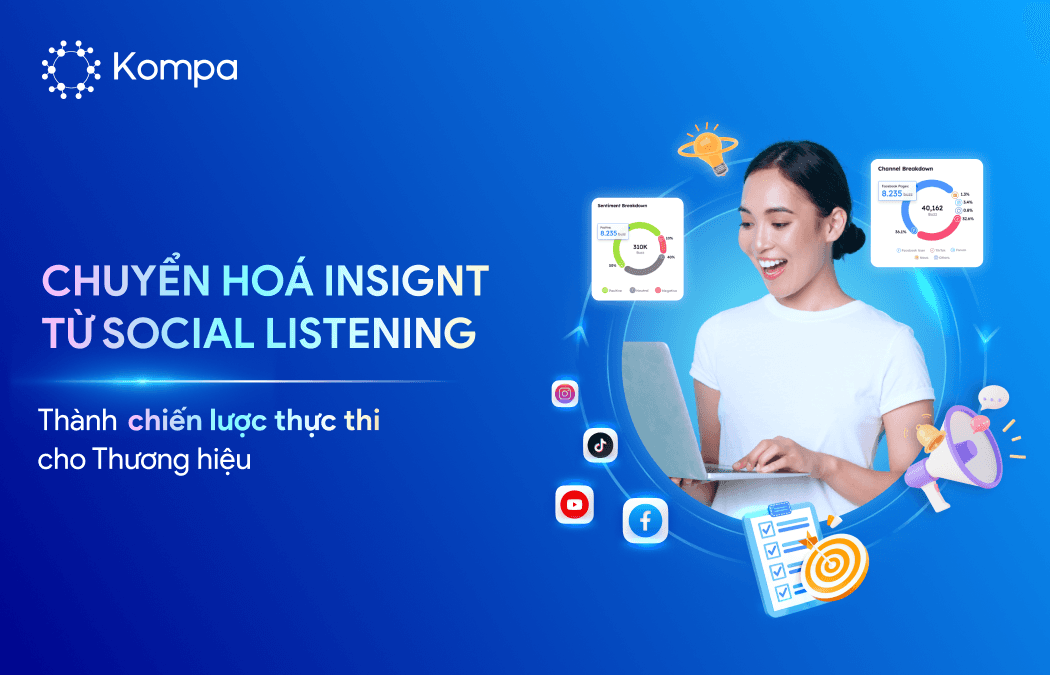
Social media is where consumers naturally express emotions, behaviors, and needs. With the ability to collect, analyze, and structure millions of signals from digital platforms, Social Listening becomes a strategic tool that helps brands distill actionable insights. However, an insight—no matter how profound—has no value if it cannot become part of an executable strategy. This article analyzes common barriers that prevent insights from Social Listening reports from being implemented, the journey to turn insights into strategy, and suggested ways to remove obstacles so data is not only “heard” but also “used” effectively.
Barriers that prevent Social Listening insights from becoming executable strategies
In practice, for a Social Listening insight to be “upgraded” into a strategy—and then turned into executional action—brands often face multiple layers of barriers, both internal and systemic. Below are the most common obstacles:
Budget & implementation scale: Consumer insights sometimes require an execution strategy with large scale and budget, far beyond the scope of resources currently available to the business.
Alignment with overall development direction: an insight may not be incorporated into an execution strategy if it does not truly align with the overall development direction
Lack of alignment across departments: An insight-based marketing strategy will struggle to reach its goals without seamless coordination from related departments such as product development, customer care, sales, etc. The lack of an interdepartmental process to jointly assess and act on one unified insight is a major barrier during the strategy planning and implementation stages.
Insight is not convincing enough for an effective strategy: For a strategy to be effective, the insight must clearly connect to brand objectives. If it cannot prove what it will improve, where it contributes, or what impact it creates, it is easily dismissed as “not urgent yet” or “still subjective.”
Suggested solutions for brands to remove barriers to operationalizing insights
For a brand to move from "listening" to "action," having a Social Listening tool is not enough. The ability to respond effectively to insights depends on how the business organizes its decision-making system, its situational analysis capabilities, and internal alignment to execute strategy according to actual available resources.
Below are suggested solutions corresponding to each common barrier, helping brands translate insights into intentional and feasible next steps.
Barrier 1: Budget & implementation scale
Nature of the barrier:
Consumer insights—especially strategic insights—can lead to proposals for large-scale marketing/product solutions that require resources beyond allocated budgets or the company’s current execution capacity.
Solution:
Instead of rejecting an insight because it exceeds capacity, brands can "repackage" the insight into a form that can be executed at smaller scale, in a shorter timeframe, with lower budget—while still ensuring clear impact potential (impact-driven).
Barrier 2: Fit with brand/business direction
Nature of the barrier:
An insight may be accurate for the market but still not suitable for the current development stage, brand positioning, or overall strategy.
Solution:
The insight needs to be reframed within the brand’s strategic context by finding the intersection between that insight and long-term goals.
Barrier 3: Lack of interdepartmental alignment and coordination
Nature of the barrier:
No matter how valuable an insight is, it will fall into an “ownerless” state if no department takes responsibility for translating it, or if departments are not connected to act in sync on the same data.
Solution:
Businesses can establish an interdepartmental feedback mechanism from intake – validation – challenge – action to align roles, timelines, and actions.
Barrier 4: Insight is not persuasive enough
Nature of the barrier:
Many insights are valuable but fail to gain agreement from decision-makers due to lack of evidence, weak KPI linkage, or no connection to specific business problems.
Solution:
Brands need to improve data storytelling skills—turning insight into a structured strategic proposal, including:
A specific problem to solve
Supporting metrics (sentiment, SOV, spread level, etc.)
Action opportunity
Proposed tactics + expected KPI
The combination of quantitative analysis (figures, dashboard) and qualitative analysis (voice of customer, quotes, illustrative videos) helps insights overcome persuasion barriers.
The journey of transforming insights from Social Listening reports into executable strategy
Transforming an insight from a Social Listening report into a feasible strategy is not merely a story of creativity or a “good idea”—it is a balancing act between brand vision and real-world execution capability.
Attach insights to a specific strategic problem: An insight is truly valuable only if it answers an existing strategic question:
What problem is the brand facing?
What exactly will this insight help improve?
Which objective does it support: increasing awareness, improving brand sentiment, driving conversion, or restoring trust after a crisis?
Analyze context and assess feasibility: Marketers need to evaluate that insight within the company’s current context in terms of feasible budget, resources, and current development stage.
Package insights into a clear strategic proposal: Insights only become persuasive when presented as a structured proposal that is specific, convincing, and aligned with strategic context. Depending on objectives, insights can be developed into:
Brand strategy proposals: refine positioning, adjust brand idea, expand customer segments
Communication proposals: change messaging, content format, communication channels
Product/service proposals: improve experience, features, packaging, or process
An effective proposal should include 5 core elements:
Problem to solve (current pain point of the brand or customer)
Insight derived from real data (with citations and specific evidence)
Strategic opportunity (market, user behavior, competition)
Specific proposed actions (what to change, how to do it)
Expected metrics (KPI) to measure effectiveness after implementation
From listening to execution: When insight needs a system to be operationalized
Social Listening opens the door for brands to listen to consumers, but real value is only created when insights obtained from that data are transformed into specific, directional, and measurable actions.
Although the journey of turning insights from reports into strategy is far from simple—with many barriers from budget and organizational structure to persuasion capability—it is entirely feasible if brands build a flexible response system with processes, clear ownership, and an execution mindset.
Social media is where consumers naturally express emotions, behaviors, and needs. With the ability to collect, analyze, and structure millions of signals from digital platforms, Social Listening becomes a strategic tool that helps brands distill actionable insights. However, an insight—no matter how profound—has no value if it cannot become part of an executable strategy. This article analyzes common barriers that prevent insights from Social Listening reports from being implemented, the journey to turn insights into strategy, and suggested ways to remove obstacles so data is not only “heard” but also “used” effectively.
Barriers that prevent Social Listening insights from becoming executable strategies
In practice, for a Social Listening insight to be “upgraded” into a strategy—and then turned into executional action—brands often face multiple layers of barriers, both internal and systemic. Below are the most common obstacles:
Budget & implementation scale: Consumer insights sometimes require an execution strategy with large scale and budget, far beyond the scope of resources currently available to the business.
Alignment with overall development direction: an insight may not be incorporated into an execution strategy if it does not truly align with the overall development direction
Lack of alignment across departments: An insight-based marketing strategy will struggle to reach its goals without seamless coordination from related departments such as product development, customer care, sales, etc. The lack of an interdepartmental process to jointly assess and act on one unified insight is a major barrier during the strategy planning and implementation stages.
Insight is not convincing enough for an effective strategy: For a strategy to be effective, the insight must clearly connect to brand objectives. If it cannot prove what it will improve, where it contributes, or what impact it creates, it is easily dismissed as “not urgent yet” or “still subjective.”
Suggested solutions for brands to remove barriers to operationalizing insights
For a brand to move from "listening" to "action," having a Social Listening tool is not enough. The ability to respond effectively to insights depends on how the business organizes its decision-making system, its situational analysis capabilities, and internal alignment to execute strategy according to actual available resources.
Below are suggested solutions corresponding to each common barrier, helping brands translate insights into intentional and feasible next steps.
Barrier 1: Budget & implementation scale
Nature of the barrier:
Consumer insights—especially strategic insights—can lead to proposals for large-scale marketing/product solutions that require resources beyond allocated budgets or the company’s current execution capacity.
Solution:
Instead of rejecting an insight because it exceeds capacity, brands can "repackage" the insight into a form that can be executed at smaller scale, in a shorter timeframe, with lower budget—while still ensuring clear impact potential (impact-driven).
Barrier 2: Fit with brand/business direction
Nature of the barrier:
An insight may be accurate for the market but still not suitable for the current development stage, brand positioning, or overall strategy.
Solution:
The insight needs to be reframed within the brand’s strategic context by finding the intersection between that insight and long-term goals.
Barrier 3: Lack of interdepartmental alignment and coordination
Nature of the barrier:
No matter how valuable an insight is, it will fall into an “ownerless” state if no department takes responsibility for translating it, or if departments are not connected to act in sync on the same data.
Solution:
Businesses can establish an interdepartmental feedback mechanism from intake – validation – challenge – action to align roles, timelines, and actions.
Barrier 4: Insight is not persuasive enough
Nature of the barrier:
Many insights are valuable but fail to gain agreement from decision-makers due to lack of evidence, weak KPI linkage, or no connection to specific business problems.
Solution:
Brands need to improve data storytelling skills—turning insight into a structured strategic proposal, including:
A specific problem to solve
Supporting metrics (sentiment, SOV, spread level, etc.)
Action opportunity
Proposed tactics + expected KPI
The combination of quantitative analysis (figures, dashboard) and qualitative analysis (voice of customer, quotes, illustrative videos) helps insights overcome persuasion barriers.
The journey of transforming insights from Social Listening reports into executable strategy
Transforming an insight from a Social Listening report into a feasible strategy is not merely a story of creativity or a “good idea”—it is a balancing act between brand vision and real-world execution capability.
Attach insights to a specific strategic problem: An insight is truly valuable only if it answers an existing strategic question:
What problem is the brand facing?
What exactly will this insight help improve?
Which objective does it support: increasing awareness, improving brand sentiment, driving conversion, or restoring trust after a crisis?
Analyze context and assess feasibility: Marketers need to evaluate that insight within the company’s current context in terms of feasible budget, resources, and current development stage.
Package insights into a clear strategic proposal: Insights only become persuasive when presented as a structured proposal that is specific, convincing, and aligned with strategic context. Depending on objectives, insights can be developed into:
Brand strategy proposals: refine positioning, adjust brand idea, expand customer segments
Communication proposals: change messaging, content format, communication channels
Product/service proposals: improve experience, features, packaging, or process
An effective proposal should include 5 core elements:
Problem to solve (current pain point of the brand or customer)
Insight derived from real data (with citations and specific evidence)
Strategic opportunity (market, user behavior, competition)
Specific proposed actions (what to change, how to do it)
Expected metrics (KPI) to measure effectiveness after implementation
From listening to execution: When insight needs a system to be operationalized
Social Listening opens the door for brands to listen to consumers, but real value is only created when insights obtained from that data are transformed into specific, directional, and measurable actions.
Although the journey of turning insights from reports into strategy is far from simple—with many barriers from budget and organizational structure to persuasion capability—it is entirely feasible if brands build a flexible response system with processes, clear ownership, and an execution mindset.
Social media is where consumers naturally express emotions, behaviors, and needs. With the ability to collect, analyze, and structure millions of signals from digital platforms, Social Listening becomes a strategic tool that helps brands distill actionable insights. However, an insight—no matter how profound—has no value if it cannot become part of an executable strategy. This article analyzes common barriers that prevent insights from Social Listening reports from being implemented, the journey to turn insights into strategy, and suggested ways to remove obstacles so data is not only “heard” but also “used” effectively.
Barriers that prevent Social Listening insights from becoming executable strategies
In practice, for a Social Listening insight to be “upgraded” into a strategy—and then turned into executional action—brands often face multiple layers of barriers, both internal and systemic. Below are the most common obstacles:
Budget & implementation scale: Consumer insights sometimes require an execution strategy with large scale and budget, far beyond the scope of resources currently available to the business.
Alignment with overall development direction: an insight may not be incorporated into an execution strategy if it does not truly align with the overall development direction
Lack of alignment across departments: An insight-based marketing strategy will struggle to reach its goals without seamless coordination from related departments such as product development, customer care, sales, etc. The lack of an interdepartmental process to jointly assess and act on one unified insight is a major barrier during the strategy planning and implementation stages.
Insight is not convincing enough for an effective strategy: For a strategy to be effective, the insight must clearly connect to brand objectives. If it cannot prove what it will improve, where it contributes, or what impact it creates, it is easily dismissed as “not urgent yet” or “still subjective.”
Suggested solutions for brands to remove barriers to operationalizing insights
For a brand to move from "listening" to "action," having a Social Listening tool is not enough. The ability to respond effectively to insights depends on how the business organizes its decision-making system, its situational analysis capabilities, and internal alignment to execute strategy according to actual available resources.
Below are suggested solutions corresponding to each common barrier, helping brands translate insights into intentional and feasible next steps.
Barrier 1: Budget & implementation scale
Nature of the barrier:
Consumer insights—especially strategic insights—can lead to proposals for large-scale marketing/product solutions that require resources beyond allocated budgets or the company’s current execution capacity.
Solution:
Instead of rejecting an insight because it exceeds capacity, brands can "repackage" the insight into a form that can be executed at smaller scale, in a shorter timeframe, with lower budget—while still ensuring clear impact potential (impact-driven).
Barrier 2: Fit with brand/business direction
Nature of the barrier:
An insight may be accurate for the market but still not suitable for the current development stage, brand positioning, or overall strategy.
Solution:
The insight needs to be reframed within the brand’s strategic context by finding the intersection between that insight and long-term goals.
Barrier 3: Lack of interdepartmental alignment and coordination
Nature of the barrier:
No matter how valuable an insight is, it will fall into an “ownerless” state if no department takes responsibility for translating it, or if departments are not connected to act in sync on the same data.
Solution:
Businesses can establish an interdepartmental feedback mechanism from intake – validation – challenge – action to align roles, timelines, and actions.
Barrier 4: Insight is not persuasive enough
Nature of the barrier:
Many insights are valuable but fail to gain agreement from decision-makers due to lack of evidence, weak KPI linkage, or no connection to specific business problems.
Solution:
Brands need to improve data storytelling skills—turning insight into a structured strategic proposal, including:
A specific problem to solve
Supporting metrics (sentiment, SOV, spread level, etc.)
Action opportunity
Proposed tactics + expected KPI
The combination of quantitative analysis (figures, dashboard) and qualitative analysis (voice of customer, quotes, illustrative videos) helps insights overcome persuasion barriers.
The journey of transforming insights from Social Listening reports into executable strategy
Transforming an insight from a Social Listening report into a feasible strategy is not merely a story of creativity or a “good idea”—it is a balancing act between brand vision and real-world execution capability.
Attach insights to a specific strategic problem: An insight is truly valuable only if it answers an existing strategic question:
What problem is the brand facing?
What exactly will this insight help improve?
Which objective does it support: increasing awareness, improving brand sentiment, driving conversion, or restoring trust after a crisis?
Analyze context and assess feasibility: Marketers need to evaluate that insight within the company’s current context in terms of feasible budget, resources, and current development stage.
Package insights into a clear strategic proposal: Insights only become persuasive when presented as a structured proposal that is specific, convincing, and aligned with strategic context. Depending on objectives, insights can be developed into:
Brand strategy proposals: refine positioning, adjust brand idea, expand customer segments
Communication proposals: change messaging, content format, communication channels
Product/service proposals: improve experience, features, packaging, or process
An effective proposal should include 5 core elements:
Problem to solve (current pain point of the brand or customer)
Insight derived from real data (with citations and specific evidence)
Strategic opportunity (market, user behavior, competition)
Specific proposed actions (what to change, how to do it)
Expected metrics (KPI) to measure effectiveness after implementation
From listening to execution: When insight needs a system to be operationalized
Social Listening opens the door for brands to listen to consumers, but real value is only created when insights obtained from that data are transformed into specific, directional, and measurable actions.
Although the journey of turning insights from reports into strategy is far from simple—with many barriers from budget and organizational structure to persuasion capability—it is entirely feasible if brands build a flexible response system with processes, clear ownership, and an execution mindset.
You might be interested
You might be interested
You might be interested
The Social Listening Checklist helps brands measure the effectiveness of social media campaigns
The Social Listening Checklist helps brands measure the effectiveness of social media campaigns
The Social Listening Checklist helps brands measure the effectiveness of social media campaigns
AI & Social Listening 2025: Unlock social data and lead the market with 5 new trends
AI & Social Listening 2025: Unlock social data and lead the market with 5 new trends
AI & Social Listening 2025: Unlock social data and lead the market with 5 new trends

Social Listening on TikTok: Decoding the customer journey and elevating brand strategy
Social Listening on TikTok: Decoding the customer journey and elevating brand strategy
Social Listening on TikTok: Decoding the customer journey and elevating brand strategy
How to use Social Listening to monitor competitors and manage your brand effectively
How to use Social Listening to monitor competitors and manage your brand effectively
How to use Social Listening to monitor competitors and manage your brand effectively
The journey of transforming insights from Social Listening into an execution strategy for the brand
The journey of transforming insights from Social Listening into an execution strategy for the brand
The journey of transforming insights from Social Listening into an execution strategy for the brand
Social Listening Demo & Free implementation consultation
Social Listening Demo & Free implementation consultation
Social Listening Demo & Free implementation consultation
Sustainable brand growth with Kompa
Sustainable brand growth with Kompa
Sustainable brand growth with Kompa
Spot opportunities early – Respond promptly to risks – Optimise communication effectiveness!
Spot opportunities early – Respond promptly to risks – Optimise communication effectiveness!
Spot opportunities early – Respond promptly to risks – Optimise communication effectiveness!
50%
50%
Brand awareness and engagement level
Brand awareness and engagement level
80%
80%
Time to detect and manage a communications crisis
Time to detect and manage a communications crisis
35%
35%
Marketing campaign effectiveness thanks to real-time data
Marketing campaign effectiveness thanks to real-time data
50%
Brand awareness and engagement level
80%
Time to detect and manage a communications crisis
35%
Marketing campaign effectiveness thanks to real-time data


From Social Listening to AI Data Intelligence:
Helping businesses make smart, fast, and comprehensive decisions.
Hotline: 098.130.6460 (Kompa Sales)
Contact for services, quotations, or media partnerships: info@kompa.ai






Copyright © 2025 Kompa.
All Rights Reserved
From Social Listening to AI Data Intelligence:
Helping businesses make smart, fast, and comprehensive decisions.
Hotline: 098.130.6460 (Kompa Sales)
Contact for services, quotations, or media partnerships: info@kompa.ai
Copyright © 2025 Kompa.
All Rights Reserved
From Social Listening to AI Data Intelligence:
Helping businesses make smart, fast, and comprehensive decisions.
Hotline: 098.130.6460 (Kompa Sales)
Contact for services, quotations, or media partnerships: info@kompa.ai
Copyright © 2025 Kompa.
All Rights Reserved