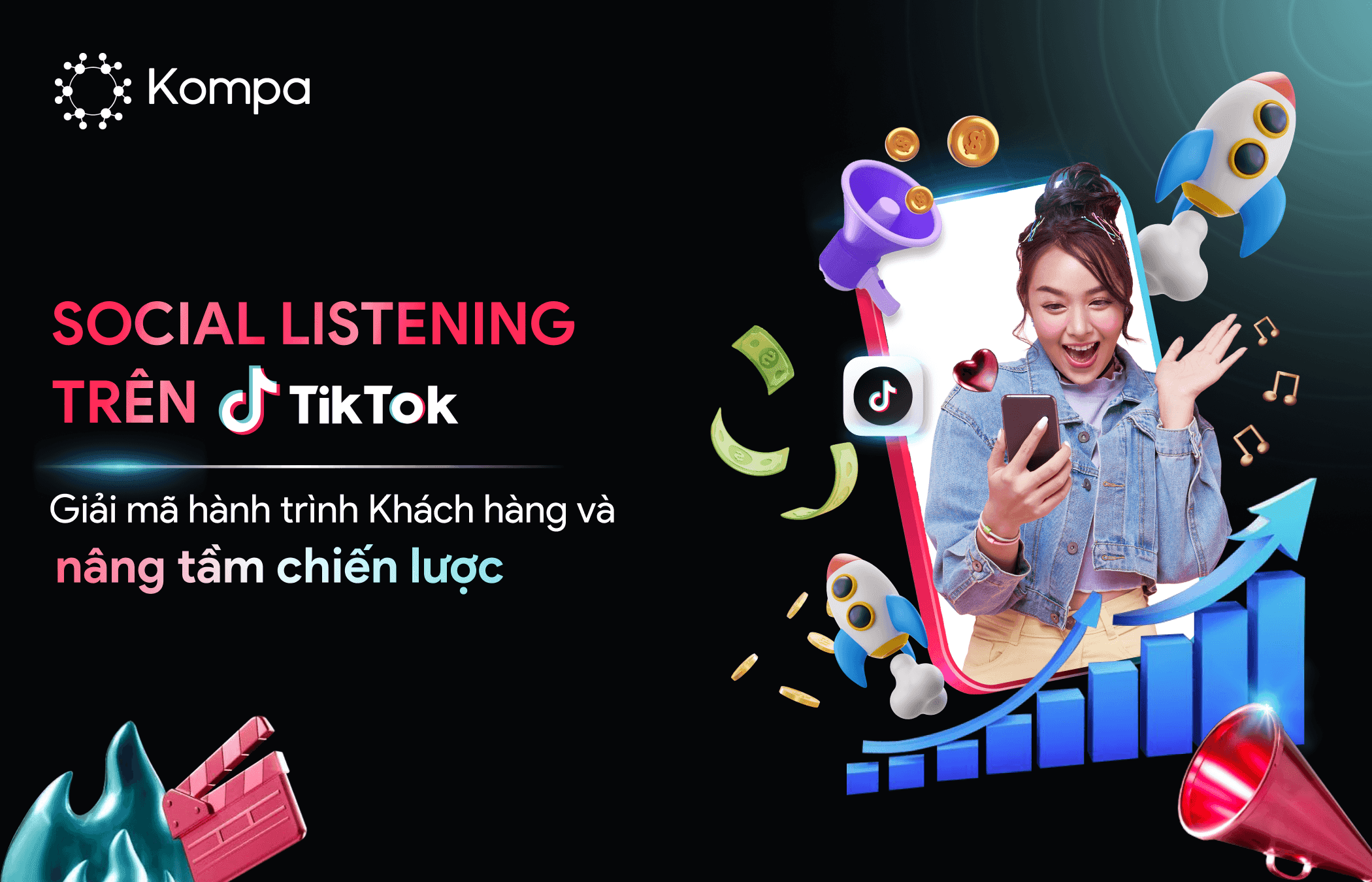
Social Listening on TikTok: Decoding the customer journey and elevating brand strategy

Social media users in Vietnam are increasingly tending to search for products directly on the platforms they use, with 34.8% of users saying the main reason they use social media is to "search for products to buy" (We Are Social x Meltwater, 2/2025). Among them, TikTok is the second most favored platform (27.7%), only behind Facebook (32.5%), showing TikTok’s growing role in the consumer journey. Not just an entertainment channel, TikTok is becoming an important shopping touchpoint where users discover, evaluate, and share product experiences.
Through Social Listening on TikTok, Brands can comprehensively decode the customer journey—from awareness and consideration to action—thereby gaining deeper understanding and making more accurate decisions at each stage.
Why should you track the customer journey with Social Listening on TikTok?
Imagine a TikTok user who has just developed a need to buy a product—for example, moisturizer for sensitive skin. The customer opens TikTok and types keywords into the search bar. A series of videos appears: from product reviews and real experience sharing to comparison clips between different cream lines. The customer then starts filtering by personal criteria: which products are many people trying? Are there promotions? Is the quality worth the price? Which brand is currently “hot”?
After that, the customer watches reviews carefully—especially paying attention to the comments below. Did previous users encounter any issues? Do they say the product is truly effective? The customer scrolls through a series of clips and comments to find verified proof that this product suits their skin and expectations. Only when all factors are satisfied—from features and real-life feedback to community sentiment—does the customer make a purchase decision.
That behavioral sequence seems simple, but in fact it is a multi-layered consumer journey happening right on TikTok—where consumers not only seek entertainment but also actively evaluate, consider, and decide. And Social Listening is exactly the tool that helps Brands “decode this journey” fully and in detail.
By tracking mention volume, analyzing sentiment, measuring Brand health, campaign effectiveness, and managing reputation in real time, Brands can understand what customers are thinking at each step—from when they first become interested, consider options, and are ready to act, to even becoming advocates. As a result, Brands not only know how to “show up”—but also how to “show up at the right time, in the right way, and for the right need”, making consumers trust that: “This brand is truly for me.”
Social Listening on TikTok - Strategy for every step of the customer journey
To help Brands appear at the right time and in the right way in consumers’ decision-making journey on TikTok, Social Listening is not only a listening tool but a strategy that helps Businesses evaluate their market position, performance, and credibility in real time. Specifically, Social Listening can play a role at three key touchpoints:
1. Measure Brand health – impact on the awareness stage
When consumers begin learning about a product or category, they unconsciously remember Brands that repeatedly appear in the TikTok content they watch. Social Listening allows Brands to measure this level of presence by tracking:
Total mention volume of the Brand in the category: where does our Brand stand versus competitors?
Community sentiment: Is the attitude around the Brand and competitors positive or negative?
Most-mentioned standout factors: Quality, price, customer service—which factors are creating favorability or controversy?
Coverage on TikTok: Is the Brand truly being mentioned organically yet?
Identify highly influential KOLs/KOCs in the category: Who is truly impacting customer perception?
These data points help Brands assess their current awareness strength, understand whether they are prominent enough for consumers to “recognize and recall” them, and then orient campaigns to increase coverage or improve Brand image.
2. Measure campaign effectiveness – impact on the consideration stage
When Brands begin implementing communication campaigns or collaborating with KOLs/KOCs, Social Listening can provide fast, practical feedback data:
Measure the effectiveness of each influencer: who generates more mentions? Who helps increase positive sentiment or influence purchase intent?
Track which content creates the strongest consideration effect: detailed review videos, comparisons, or entertainment clips?Identify the golden moments in the campaign: When does mention volume peak? Which topics generate the most discussion?
Based on these signals, Brands can adjust messaging, optimize content, and allocate media budgets within the campaign itself.
3. Reputation management – ensure positive sentiment at the decision stage
At the stage when consumers are preparing to make a decision, any negative content about the product, service, or Brand can make them “change their mind.” Social Listening helps Brands:
Detect negative signals early, from isolated comments to viral complaint videos
Analyze sentiment trends shifting in a positive or negative direction
Intervene in time through responses, corrections, or appropriate alternative content
Maintain a positive and consistent image in the community, helping customers feel reassured when making purchase decisions
More importantly, Brands can proactively build an early warning system to help prevent reputation risks and avoid leaving a negative impression in customers’ minds at the exact moment they need final reassurance before “checking out.”
Social Listening on TikTok – A data-driven strategy for the customer journey
Social Listening on TikTok not only helps Brands measure presence and performance, but also serves as a “data sensor suite” to understand psychology, predict behavior, and respond promptly to market signals. As consumers become increasingly proactive in researching and sharing experiences, Brands need to know where to appear, when to appear, and with what message—to truly connect with their emotions and needs.
Social media users in Vietnam are increasingly tending to search for products directly on the platforms they use, with 34.8% of users saying the main reason they use social media is to "search for products to buy" (We Are Social x Meltwater, 2/2025). Among them, TikTok is the second most favored platform (27.7%), only behind Facebook (32.5%), showing TikTok’s growing role in the consumer journey. Not just an entertainment channel, TikTok is becoming an important shopping touchpoint where users discover, evaluate, and share product experiences.
Through Social Listening on TikTok, Brands can comprehensively decode the customer journey—from awareness and consideration to action—thereby gaining deeper understanding and making more accurate decisions at each stage.
Why should you track the customer journey with Social Listening on TikTok?
Imagine a TikTok user who has just developed a need to buy a product—for example, moisturizer for sensitive skin. The customer opens TikTok and types keywords into the search bar. A series of videos appears: from product reviews and real experience sharing to comparison clips between different cream lines. The customer then starts filtering by personal criteria: which products are many people trying? Are there promotions? Is the quality worth the price? Which brand is currently “hot”?
After that, the customer watches reviews carefully—especially paying attention to the comments below. Did previous users encounter any issues? Do they say the product is truly effective? The customer scrolls through a series of clips and comments to find verified proof that this product suits their skin and expectations. Only when all factors are satisfied—from features and real-life feedback to community sentiment—does the customer make a purchase decision.
That behavioral sequence seems simple, but in fact it is a multi-layered consumer journey happening right on TikTok—where consumers not only seek entertainment but also actively evaluate, consider, and decide. And Social Listening is exactly the tool that helps Brands “decode this journey” fully and in detail.
By tracking mention volume, analyzing sentiment, measuring Brand health, campaign effectiveness, and managing reputation in real time, Brands can understand what customers are thinking at each step—from when they first become interested, consider options, and are ready to act, to even becoming advocates. As a result, Brands not only know how to “show up”—but also how to “show up at the right time, in the right way, and for the right need”, making consumers trust that: “This brand is truly for me.”
Social Listening on TikTok - Strategy for every step of the customer journey
To help Brands appear at the right time and in the right way in consumers’ decision-making journey on TikTok, Social Listening is not only a listening tool but a strategy that helps Businesses evaluate their market position, performance, and credibility in real time. Specifically, Social Listening can play a role at three key touchpoints:
1. Measure Brand health – impact on the awareness stage
When consumers begin learning about a product or category, they unconsciously remember Brands that repeatedly appear in the TikTok content they watch. Social Listening allows Brands to measure this level of presence by tracking:
Total mention volume of the Brand in the category: where does our Brand stand versus competitors?
Community sentiment: Is the attitude around the Brand and competitors positive or negative?
Most-mentioned standout factors: Quality, price, customer service—which factors are creating favorability or controversy?
Coverage on TikTok: Is the Brand truly being mentioned organically yet?
Identify highly influential KOLs/KOCs in the category: Who is truly impacting customer perception?
These data points help Brands assess their current awareness strength, understand whether they are prominent enough for consumers to “recognize and recall” them, and then orient campaigns to increase coverage or improve Brand image.
2. Measure campaign effectiveness – impact on the consideration stage
When Brands begin implementing communication campaigns or collaborating with KOLs/KOCs, Social Listening can provide fast, practical feedback data:
Measure the effectiveness of each influencer: who generates more mentions? Who helps increase positive sentiment or influence purchase intent?
Track which content creates the strongest consideration effect: detailed review videos, comparisons, or entertainment clips?Identify the golden moments in the campaign: When does mention volume peak? Which topics generate the most discussion?
Based on these signals, Brands can adjust messaging, optimize content, and allocate media budgets within the campaign itself.
3. Reputation management – ensure positive sentiment at the decision stage
At the stage when consumers are preparing to make a decision, any negative content about the product, service, or Brand can make them “change their mind.” Social Listening helps Brands:
Detect negative signals early, from isolated comments to viral complaint videos
Analyze sentiment trends shifting in a positive or negative direction
Intervene in time through responses, corrections, or appropriate alternative content
Maintain a positive and consistent image in the community, helping customers feel reassured when making purchase decisions
More importantly, Brands can proactively build an early warning system to help prevent reputation risks and avoid leaving a negative impression in customers’ minds at the exact moment they need final reassurance before “checking out.”
Social Listening on TikTok – A data-driven strategy for the customer journey
Social Listening on TikTok not only helps Brands measure presence and performance, but also serves as a “data sensor suite” to understand psychology, predict behavior, and respond promptly to market signals. As consumers become increasingly proactive in researching and sharing experiences, Brands need to know where to appear, when to appear, and with what message—to truly connect with their emotions and needs.
Social media users in Vietnam are increasingly tending to search for products directly on the platforms they use, with 34.8% of users saying the main reason they use social media is to "search for products to buy" (We Are Social x Meltwater, 2/2025). Among them, TikTok is the second most favored platform (27.7%), only behind Facebook (32.5%), showing TikTok’s growing role in the consumer journey. Not just an entertainment channel, TikTok is becoming an important shopping touchpoint where users discover, evaluate, and share product experiences.
Through Social Listening on TikTok, Brands can comprehensively decode the customer journey—from awareness and consideration to action—thereby gaining deeper understanding and making more accurate decisions at each stage.
Why should you track the customer journey with Social Listening on TikTok?
Imagine a TikTok user who has just developed a need to buy a product—for example, moisturizer for sensitive skin. The customer opens TikTok and types keywords into the search bar. A series of videos appears: from product reviews and real experience sharing to comparison clips between different cream lines. The customer then starts filtering by personal criteria: which products are many people trying? Are there promotions? Is the quality worth the price? Which brand is currently “hot”?
After that, the customer watches reviews carefully—especially paying attention to the comments below. Did previous users encounter any issues? Do they say the product is truly effective? The customer scrolls through a series of clips and comments to find verified proof that this product suits their skin and expectations. Only when all factors are satisfied—from features and real-life feedback to community sentiment—does the customer make a purchase decision.
That behavioral sequence seems simple, but in fact it is a multi-layered consumer journey happening right on TikTok—where consumers not only seek entertainment but also actively evaluate, consider, and decide. And Social Listening is exactly the tool that helps Brands “decode this journey” fully and in detail.
By tracking mention volume, analyzing sentiment, measuring Brand health, campaign effectiveness, and managing reputation in real time, Brands can understand what customers are thinking at each step—from when they first become interested, consider options, and are ready to act, to even becoming advocates. As a result, Brands not only know how to “show up”—but also how to “show up at the right time, in the right way, and for the right need”, making consumers trust that: “This brand is truly for me.”
Social Listening on TikTok - Strategy for every step of the customer journey
To help Brands appear at the right time and in the right way in consumers’ decision-making journey on TikTok, Social Listening is not only a listening tool but a strategy that helps Businesses evaluate their market position, performance, and credibility in real time. Specifically, Social Listening can play a role at three key touchpoints:
1. Measure Brand health – impact on the awareness stage
When consumers begin learning about a product or category, they unconsciously remember Brands that repeatedly appear in the TikTok content they watch. Social Listening allows Brands to measure this level of presence by tracking:
Total mention volume of the Brand in the category: where does our Brand stand versus competitors?
Community sentiment: Is the attitude around the Brand and competitors positive or negative?
Most-mentioned standout factors: Quality, price, customer service—which factors are creating favorability or controversy?
Coverage on TikTok: Is the Brand truly being mentioned organically yet?
Identify highly influential KOLs/KOCs in the category: Who is truly impacting customer perception?
These data points help Brands assess their current awareness strength, understand whether they are prominent enough for consumers to “recognize and recall” them, and then orient campaigns to increase coverage or improve Brand image.
2. Measure campaign effectiveness – impact on the consideration stage
When Brands begin implementing communication campaigns or collaborating with KOLs/KOCs, Social Listening can provide fast, practical feedback data:
Measure the effectiveness of each influencer: who generates more mentions? Who helps increase positive sentiment or influence purchase intent?
Track which content creates the strongest consideration effect: detailed review videos, comparisons, or entertainment clips?Identify the golden moments in the campaign: When does mention volume peak? Which topics generate the most discussion?
Based on these signals, Brands can adjust messaging, optimize content, and allocate media budgets within the campaign itself.
3. Reputation management – ensure positive sentiment at the decision stage
At the stage when consumers are preparing to make a decision, any negative content about the product, service, or Brand can make them “change their mind.” Social Listening helps Brands:
Detect negative signals early, from isolated comments to viral complaint videos
Analyze sentiment trends shifting in a positive or negative direction
Intervene in time through responses, corrections, or appropriate alternative content
Maintain a positive and consistent image in the community, helping customers feel reassured when making purchase decisions
More importantly, Brands can proactively build an early warning system to help prevent reputation risks and avoid leaving a negative impression in customers’ minds at the exact moment they need final reassurance before “checking out.”
Social Listening on TikTok – A data-driven strategy for the customer journey
Social Listening on TikTok not only helps Brands measure presence and performance, but also serves as a “data sensor suite” to understand psychology, predict behavior, and respond promptly to market signals. As consumers become increasingly proactive in researching and sharing experiences, Brands need to know where to appear, when to appear, and with what message—to truly connect with their emotions and needs.
You might be interested

The Social Listening Checklist helps brands measure the effectiveness of social media campaigns

AI & Social Listening 2025: Unlock social data and lead the market with 5 new trends

Social Listening on TikTok: Decoding the customer journey and elevating brand strategy

How to use Social Listening to monitor competitors and manage your brand effectively

The journey of transforming insights from Social Listening into an execution strategy for the brand
Social Listening Demo & Free implementation consultation
Sustainable brand growth with Kompa
Spot opportunities early – Respond promptly to risks – Optimise communication effectiveness!
50%
50%
Brand awareness and engagement level
80%
80%
Time to detect and manage a communications crisis
35%
35%
Marketing campaign effectiveness thanks to real-time data
50%
Brand awareness and engagement level
80%
Time to detect and manage a communications crisis
35%
Marketing campaign effectiveness thanks to real-time data