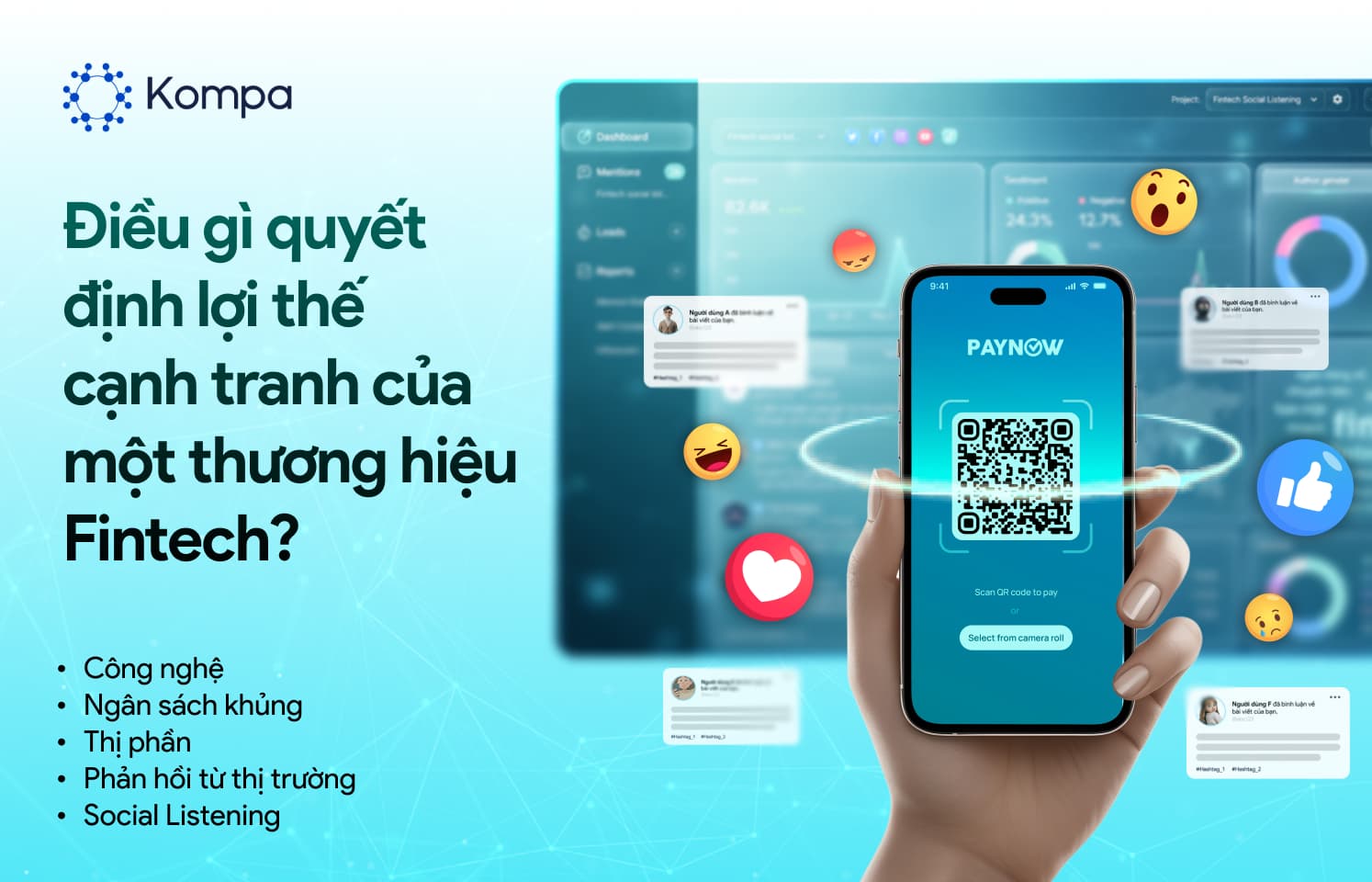
In the Fintech industry, competition is not limited to technology, product development speed, or marketing budgets. An increasingly important competitive advantage is the ability to understand the market, customers, and competitors faster and make the right decisions at the right time.
Every day, thousands of conversations about digital banking, e-wallets, payments, investments, and financial products take place across Facebook, TikTok, Threads, YouTube, forums, and other online platforms.
Behind these conversations lies valuable data: What are users talking about? Which brands are being mentioned? Which features are receiving positive feedback? Which experiences are causing frustration? How much attention are competitors attracting? And which issues could potentially escalate into a communications risk?
Social Listening helps Fintech businesses turn these conversations into actionable data for market monitoring, competitive analysis, customer understanding, and growth opportunity discovery.
Fintech Is Not Just Competing for More Users
Fintech businesses operate in a rapidly changing market. A new feature can quickly gain traction—or become a source of debate. A competitor's campaign can generate a surge of conversations and shift market attention almost overnight.
Therefore, alongside internal metrics such as user numbers, transaction volumes, and conversion rates, businesses also need to understand what is happening outside their own ecosystem.
Marketing, Product, and Business teams are constantly asking questions such as:
How often is our brand being mentioned compared with competitors?
How are users responding to new products and features?
Which aspects of the customer experience are driving satisfaction or frustration?
What products, campaigns, or initiatives are attracting attention to competitors?
Which KOLs and Creators are influencing conversations in the industry?
Which negative feedback signals could potentially escalate into a crisis?
Social media data can provide an important additional perspective on these questions.
5 Ways Fintech Brands Can Use Social Listening
1. Monitor Brand and Competitive Positioning
In a market where multiple brands compete on products and customer experience, tracking your own performance alone is not enough.
Social Listening enables businesses to monitor Share of Voice (SOV), mentions, engagement, and sentiment, while benchmarking these indicators against competitors.
Instead of simply asking:
“How many times is our brand being mentioned?”
Businesses can ask a broader question:
“How much of the industry's conversation does our brand own?”
For example, when a competitor launches a new feature and quickly attracts significant attention on social media, Social Listening can help identify changes in conversation volume and understand what is driving them.
This gives Marketing and Business teams additional evidence to evaluate brand positioning and competitive movements in the market.
2. Analyze Product and Feature Feedback
For Fintech businesses, product functionality and user experience directly influence customer retention. However, data from surveys and customer service systems often captures only part of the overall customer journey.
On social media, users voluntarily share:
Which features they like.
What makes the app difficult to use.
Why they switched to another brand.
Which features they want to see next.
Which experiences made them satisfied or frustrated.
Social Listening enables businesses to aggregate and analyze this feedback at scale, identifying recurring themes and issues across user conversations.
Conversely, a frequently mentioned unmet need could become an input for new product or feature ideas.
This is where Social Listening extends beyond Marketing and becomes a valuable source of intelligence for Product teams.
3. Discover Customer Experience Insights
In Fintech, customer experience goes far beyond an app's interface.
Users may evaluate a brand across numerous touchpoints: account registration, identity verification, money transfers, payments, deposits and withdrawals, issue resolution, or customer support.
Social Listening helps businesses identify which touchpoints users talk about most frequently and the sentiment associated with each one.
For example, if negative conversations consistently focus on a specific step in the customer journey, this could indicate an experience that requires further investigation.
Conversely, topics that consistently generate positive feedback can help businesses understand what creates a differentiated customer experience.
Social Listening data can therefore serve as an additional source of insight for Product and Customer Experience teams when identifying and prioritizing areas for improvement.
4. Track KOLs, Creators, and Emerging Media Trends
In Fintech, brand conversations are not generated solely by businesses themselves. KOLs, Creators, financial experts, and user communities can significantly influence how a product or brand is perceived.
Social Listening helps businesses identify:
Who is generating the most conversations?
Which KOLs or Creators influence target customer groups?
Which topics are attracting the most attention?
How are audiences responding to the brand's or competitors' campaigns?
Which emerging trends are beginning to take shape?
Instead of selecting KOLs based solely on follower counts, businesses can also consider conversation volume, engagement, and the relevance of a Creator's audience and content to the topics the brand wants to own.
This gives Influencer Marketing and Content Marketing teams a stronger data foundation for selecting partners and optimizing campaigns.
5. Detect Communications Risks Early
One of the most important benefits of Social Listening for Fintech is its ability to identify unusual signals in community conversations.
A minor issue involving a transaction, app error, or customer service experience can quickly attract more users and escalate into a broader discussion.
If a problem is detected only after the information has already spread widely, the business may have missed the optimal window for intervention.
By monitoring conversation volume, sentiment, topics, and the speed at which discussions spread, businesses can identify issues that require attention at an earlier stage.
Social Listening therefore does more than answer:
“What are users complaining about?”
It can also help answer:
“Which issues have the potential to become a larger risk?”
This provides relevant teams with an opportunity to investigate, verify the issue, and determine an appropriate response before it escalates further.
From “Tracking” to Turning Data Into Action
Monitoring the market is only the first step.
The greater value of Social Listening lies in its ability to connect data with business decisions.
User feedback can inspire the next product feature. Competitor conversations can reveal market gaps. Emerging content trends can create opportunities for Marketing campaigns. Meanwhile, a rapid increase in negative feedback can serve as an early signal for businesses to investigate and address an issue before it has a broader impact on the brand.
Social Listening therefore should not stop at listening and reporting. It should become a continuous process that connects monitoring, data analysis, insight discovery, and concrete action.
When properly leveraged, Social Listening data can support multiple functions across the organization:
Marketing gains a clearer understanding of market conversations, competitor activity, campaign performance, and relevant KOL/Creator opportunities.
Product can leverage real-world feedback to identify unmet needs and prioritize areas for improvement.
Business can monitor market movements, identify emerging trends, and assess competitive positioning.
Customer Experience can identify touchpoints that drive satisfaction or frustration and prioritize improvements accordingly.
Communications & Brand can proactively detect negative signals, monitor how conversations evolve, and mitigate potential brand risks.
Fintech Brands Need to “Listen” to the Market Faster
In a constantly evolving market, competitive advantage does not simply come from how much data a business has.
More importantly, it comes from which signals the business can detect, how quickly it can understand them, and how effectively it can turn them into action.
Social Listening gives Fintech businesses a perspective that extends beyond internal data, enabling them to observe the broader conversations taking place across the market—from brands, competitors, products, and customers to KOLs, campaigns, and emerging risks.
With Kompa Social Listening, Fintech businesses can monitor the market in real time, analyze user feedback, benchmark competitors, and uncover valuable insights to support Marketing, Product, Business, and Customer Experience teams in making more data-driven decisions.