The healthcare industry is facing a new "trust gap" on social media
Hospitals often view the press as the "starting point" of a communication crisis. However, a new front has emerged even before the press: TikTok, Facebook comments, and emotional videos.
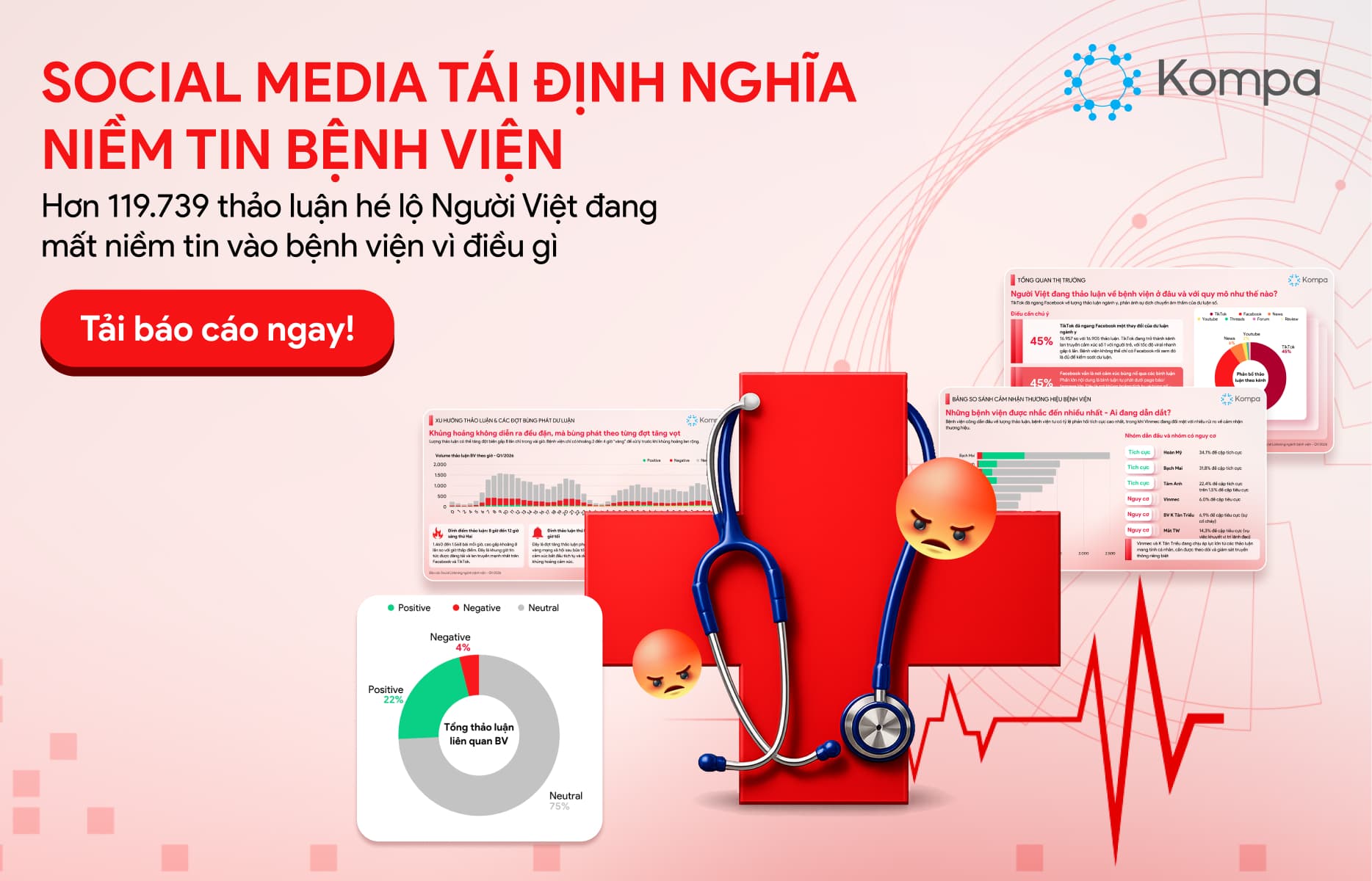
Key figures
From the full report, measured with Kompa Social Listening
- 16,957 discussionsHospital-related discussions on TikTok, level with Facebook at 16,905p. 4
- 3.7%Of hospital-related discussion is negative; 21.6% is positivep. 5
- 1,460–1,568 posts/hourDiscussion between 8 and 12 a.m. on Mondays, about 8 times the off-peak hoursp. 6
- 75%Of discussion falls into three topics — general mentions, medical staff and costs; the top 10 topics make up 96%p. 7
- 49.1%Of complaints concern medical ethics, costs, misconduct and corruption, and paperwork — not clinical competencep. 8
| Doctors' ethics / trust in expertise | 191 (13.9%) |
|---|---|
| High costs / overcharging | 183 (13.3%) |
| Misconduct / corruption / scandals | 154 (11.2%) |
| Cumbersome paperwork | 147 (10.7%) |
| Long waits / queues | 126 (9.1%) |
| Health-insurance shortcomings | 96 (7%) |
| Poor hygiene / run-down facilities | 92 (6.7%) |
| Overcrowded public hospitals / beds in corridors | 65 (4.7%) |
For years, hospitals have often viewed the press as the “starting point” of a communication crisis. An incident only truly becomes a crisis when it is published by the press and spreads to the public.
But user behavior is changing.
Vietnamese people are increasingly:
Trusting TikTok more than press releases
Reading comments before trusting a brand
Trusting individual doctors more than hospital fanpages
And spreading emotions faster than any traditional crisis management process
This is creating a major shift for the hospital industry:
Crises no longer start from the press. They start from social media.
A TikTok video, a Google Maps review, or dozens of emotional comments under a fanpage can now become the trigger for a massive wave of public opinion within just a few hours.
That is why Kompa has conducted the “Q1/2026 Hospital Industry Crisis and Brand Trust Analysis Report,” analyzing over 119,739 discussions via Social Listening on Facebook, TikTok, YouTube, the press, forums, and review platforms to measure:
The trust gap in the hospital industry
The most viral crisis models
The biggest patient pain points
And the level of brand vulnerability among hospitals
TikTok has reached parity with Facebook in healthcare discussions
One of the most notable findings of the report is that TikTok has now reached the same level as Facebook in terms of discussions related to hospitals. TikTok recorded 16,957 discussions, while Facebook recorded 16,905. The notable point is not the volume, but the speed of emotional spread.
While Facebook remains the place where comments and controversies accumulate, TikTok is becoming the new “emotional amplifier” for the healthcare industry. Just one personal video can generate thousands of discussions in a few hours and quickly shape community perception.
This makes the traditional crisis management models of many hospitals start to lag behind the speed of social media spread.
Patients do not lose trust in expertise first
Another important Insight from the report is:
The biggest issues causing patient frustration are currently not just related to medical expertise.
From the 1,379 negative responses analyzed, nearly 50% of the biggest pain points relate to:
Doctor ethics
Treatment costs
Violations and corruption
Paperwork and procedures
In other words:
Patients do not judge a hospital solely by treatment results.
They judge based on the feeling of being treated fairly, transparently, and with empathy.
Private hospitals have better Sentiment Score but are more vulnerable
Kompa data shows that private hospitals such as Tam Anh, Hoan My, or Phuong Dong have higher positive discussion rates than the industry average. However, they are also the group most vulnerable to controversies related to service costs.
Just one story about hospital fees, insurance denials, or being "overcharged" can quickly pull the Sentiment Score down.
This reflects a new reality:
Patients do not expect cheap hospitals.
But they do expect transparent hospitals.
Download the report to discover in full:
The biggest patient pain points today
Crisis models spreading within the healthcare industry
The new role of TikTok in healthcare marketing
Changes in hospital selection behavior among Vietnamese people
And the trust gap that hospitals need to address in the next 12 months
Social Listening Demo & Implementation Consulting free
Spot opportunities early — Respond to risks in time — Maximize communications effectiveness!
Sustainable brand growth with Kompa
You may also be interested in

DECODING THE SOCIAL ECHO OF VIETNAMESE THEATRICAL FILMS DURING THE SEPTEMBER 2 HOLIDAY THROUGH 678,411 DISCUSSIONS
Real Estate Market Shifts: From Price Appreciation Expectations to Cash Flow Challenges