DECODING BRAND CONCERT PERFORMANCE THROUGH 381,842 SOCIAL MEDIA MENTIONS
Kompa’s social listening data for four concerts organized or co-organized by the brand recorded 381,842 mentions between April 1 and August 31, 2026.
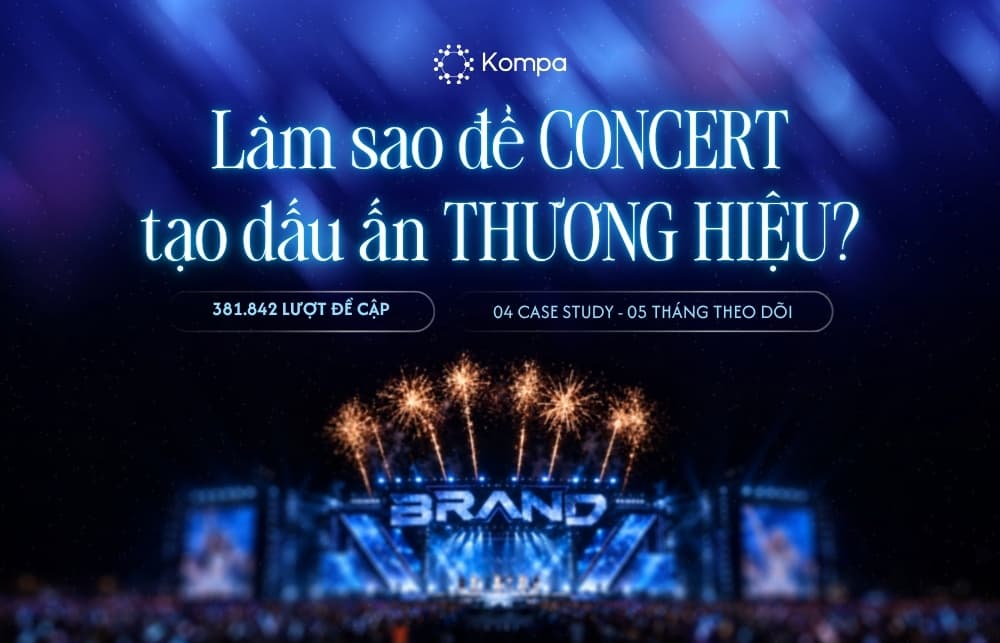
Key Statistics
Excerpted from the full report, measured using Kompa Social Listening.
Data period: April 1–August 31, 2026
Data volume: 381,842 mentions across 4 concert case studies
Core analysis sample: 60,226 direct mentions related to the events or artists, after excluding brand posts, redemption-related content, and off-topic content.
4 Case Studies Analyzed
OCB × OSUN FEST
Samsung × Awesome Vibe Station
MSB × M-Festival
ShopeeFood × Da Nang Food Tour
Key Findings
173,602 mentions: ShopeeFood × Da Nang Food Tour led in event appeal, but its brand attribution rate was only 17.8%.
63.2%: MSB × M-Festival had the highest brand attribution rate among the four cases.
6 integration levels: A framework developed by Kompa, ranging from brand presence and event naming to product integration, purpose, experience, and content ownership.
3,424 positive emotional mentions: Capturing sentiments such as being moved, pride, gratitude, and appreciation.
36.9%: The share of mentions generated after the concert, indicating that conversations continued beyond the event itself.
These metrics reflect different dimensions of concert performance and should not be used interchangeably.
Concerts are increasingly becoming an important touchpoint between brands and audiences. Beyond attracting attention through artists and stage performances, concerts create opportunities to build emotional connections, drive engagement, and bring communities into the brand narrative.
However, a concert that generates significant discussion does not necessarily translate into proportional brand recognition.
Kompa's Social Listening data across four brand-organized or co-organized concerts recorded 381,842 mentions from April 1 to August 31, 2026. A deeper analysis reveals that the differences extend beyond discussion volume to include how frequently brands are named, audience sentiment, and the momentum of conversations after the event.
So, what creates real value for a brand through a concert?
1. Event Appeal and Brand Impact: Two Metrics That Should Not Be Confused
Looking only at total mentions, ShopeeFood × Da Nang Food Tour stands out as the leading case, with 173,602 mentions. However, when measured by brand attribution rate, the picture changes.
Concert | Total Mentions | Brand Attribution Rate |
|---|---|---|
ShopeeFood × Da Nang Food Tour | 173,602 | 17.8% |
MSB × M-Festival | 34,949 | 63.2% |
OCB × OSUN FEST | 57,157 | 44.2% |
Samsung × Awesome Vibe Station | 116,134 | 24.8% |
ShopeeFood led in mention volume, while MSB achieved the highest brand attribution rate. This demonstrates that the scale of a conversation and the extent to which a brand features in that conversation are two distinct dimensions.
A concert can attract attention through artists, fandoms, on-site experiences, or side activities. But for that excitement to translate into brand impact, it is important to assess whether audiences actually mention the brand and recognize its role in the experience.
Total mentions reflect event appeal, while brand attribution rate helps assess how prominently the brand features in the audience's narrative.
Therefore, concert measurement should go beyond asking, “How many mentions did the event generate?” to explore a more important question: “How many of those conversations are genuinely connected to the brand?”
2. Six Levels of Brand Integration: From Presence to Becoming Part of the Event
Brands can be integrated into concerts at different levels. Based on the four case studies, Kompa developed a six-level integration framework to analyze how brands participate in the structure and experience of an event.
The six levels are:
Presence: The brand appears at the event.
Event Naming: The brand is incorporated into the concert or event name.
Product Integration: Products are incorporated into event activities or experiences.
Purpose: The event is tied to a meaningful brand milestone or objective.
Experience: The brand helps shape the audience experience.
Content Ownership: Concert content is developed into communication assets that can be leveraged beyond the event.
When compared with brand attribution rates, MSB achieved 4 out of 6 integration levels, corresponding to 63.2%; OCB achieved 3 out of 6, at 44.2%. Samsung and ShopeeFood each achieved 2 out of 6 levels, with attribution rates of 24.8% and 17.8%, respectively.
Notably, incorporating the brand into the event name and connecting the concert to a meaningful milestone emerged as two distinguishing features of the cases with higher brand attribution.
MSB × M-Festival is a notable example. The brand was incorporated into the event, while the concert was positioned within the narrative of MSB's 35th anniversary. This integration created an opportunity for the brand to become part of the event's purpose and the story audiences shared afterward.
However, these are observations from four case studies and are insufficient to establish that the number of integration levels consistently determines brand attribution. Product integration can also stimulate product-related conversations without necessarily increasing brand recall to the same extent.
The challenge is not simply where a brand appears, but whether it becomes part of the reason people attend, the experience they have, and the story they tell about the concert.
3. Emotional Value: When the Brand Becomes Part of the Audience's Story
Beyond brand attribution, emotion is an important dimension for understanding how audiences connect with brands through concerts.
The data recorded 3,424 positive emotional mentions, including expressions of being moved, pride, gratitude, and appreciation. These conversations indicate that audiences are not only sharing content about artists or on-site activities, but also expressing how they perceive the meaning and role of the brand.
MSB stood out, with 22.2% of mentions containing emotional content. Of these, 13.3% were associated with meaning and appreciation, while 3.8% expressed internal pride.
Other cases displayed different emotional patterns. Samsung was associated with closeness, a youthful spirit, and generosity, while OCB stood out for reactions related to enjoyment, excitement, and being emotionally moved.
These findings suggest that concerts are not merely platforms for brands to communicate messages. They can also create spaces where audiences actively connect brands with their own experiences and emotions.
Another notable signal emerged in the timing of expressions of gratitude. The share of mentions containing words of thanks rose from 0.9% before the event to 6.0% during the period 4–14 days after the concert, reaching 6.8% after two weeks.
Emotional engagement, therefore, does not necessarily end when the concert does. As audiences continue sharing, reminiscing, and expressing appreciation, a concert can extend the brand's emotional connection with audiences well beyond the event itself.
4. After the Final Performance, the Conversation Continues
One aspect that is easily overlooked when evaluating concert performance is the social media afterglow.
Across the four cases, 36.9% of mentions occurred after the concert. The data also recorded 17,221 messages of support from 1,679 accounts and 1,670 expressions of gratitude.
These signals suggest that the concert experience can continue through fandom activities, recap content, thank-you messages, and post-event conversations.
For brands, this is a particularly valuable phase because the content is no longer limited to information distributed by event organizers. Audiences can share their own perspectives, recount their experiences, and revisit the moments that left the strongest impressions.
This creates an opportunity to extend communication beyond the concert itself. Rather than concentrating all resources on the event date, brands can continue developing content around artists, communities, and memorable moments.
However, social media afterglow does not directly equate to sales or actual conversions. A more comprehensive assessment of behavioral impact requires combining Social Listening with sales data, on-site event data, and additional measurement methods.
A concert's value lies not only in what happens on stage, but also in what audiences continue to say after the event ends.
5. Measuring Concert Performance: From a Single Metric to Four Layers of Impact
The four case studies show that no single metric can fully capture concert performance. Kompa proposes an approach built around four layers of impact:
Impact Layer | Key Question | Suggested Metrics |
|---|---|---|
Event Appeal | How much attention did the concert attract? | Total mentions, discussion trends over time, sources of discussion |
Brand Impact | How prominently was the brand recognized? | Brand attribution rate, mentions of the brand's role, brand associations |
Behavioral Impact | Did audiences show interest in products or participation activities? | Mentions of products, promotions, booths, and participation mechanics; supplemented by sales and on-site data |
Community Impact | Did conversations continue after the event? | Post-concert mentions, fandom activities, expressions of gratitude, recap content, and replay-related discussions |
This approach helps distinguish between event buzz, brand attribution, behavioral signals, and community-driven momentum.
Metrics should also be interpreted in the context of each concert's specific objectives. An event designed to build awareness requires a different evaluation approach from one focused on product experience or behavioral activation.
Measuring concert performance is not just about counting mentions. It is about identifying which types of impact the event generated and what evidence supports those conclusions.
From Concert Buzz to Brand Value
The four case studies show that concerts can create multiple layers of value: attracting attention, building emotional connections, driving engagement, and sustaining conversations after the event. However, these outcomes do not automatically follow simply because a concert is large-scale or generates high mention volume.
Brands need to consider how they integrate into the event, select relevant touchpoints, leverage the reach of artists and fandoms, and establish a measurement framework that covers the periods before, during, and after the concert.
Kompa's report, “Brand Concerts: A Data-Driven Guide to Social Media Insights,” analyzes four real-world cases, introduces a six-level brand integration framework, and proposes a way to evaluate concert performance across four layers of impact.
📥 Download the report to explore the full dataset, in-depth findings, and recommendations for brands planning, executing, and measuring concerts.
Social Listening Demo & Implementation Consulting free
Spot opportunities early — Respond to risks in time — Maximize communications effectiveness!
Sustainable brand growth with Kompa
You may also be interested in
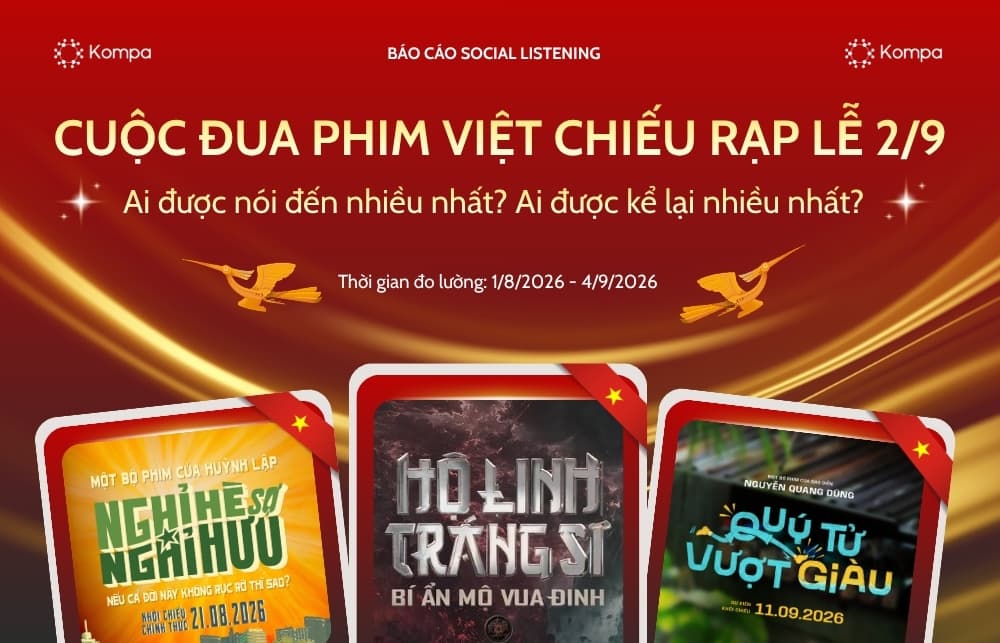
DECODING THE SOCIAL ECHO OF VIETNAMESE THEATRICAL FILMS DURING THE SEPTEMBER 2 HOLIDAY THROUGH 678,411 DISCUSSIONS
Real Estate Market Shifts: From Price Appreciation Expectations to Cash Flow Challenges