After the peak season, 6 questions to help Tech brands evaluate campaign performance, decode market shifts, and identify white spaces for the next strategy.
With the Back-to-School 2026 season now coming to an end, it is time for Tech brands to look beyond how much discussion their campaigns generated and examine how the market has changed, what consumers truly care about, and where the next opportunities may lie.
Preliminary measurement data from July 2026 reveals a highly active Tech market dominated by a “promotion storm.” Brands have continuously relied on familiar promotional mechanics such as discounts, gifts/accessories, 0% installment plans, and trade-in programs.
But as these formulas become increasingly common across the market, the question is no longer:
“What promotions does the brand offer?”
but rather:
“What does the brand offer beyond promotions?”
Answering this question requires evaluating the Back-to-School campaign within a broader picture: campaign performance, competitive dynamics, consumer needs, and brand white spaces.
1. Are Promotions Still a Competitive Advantage—or Have They Become the “Price of Entry”?
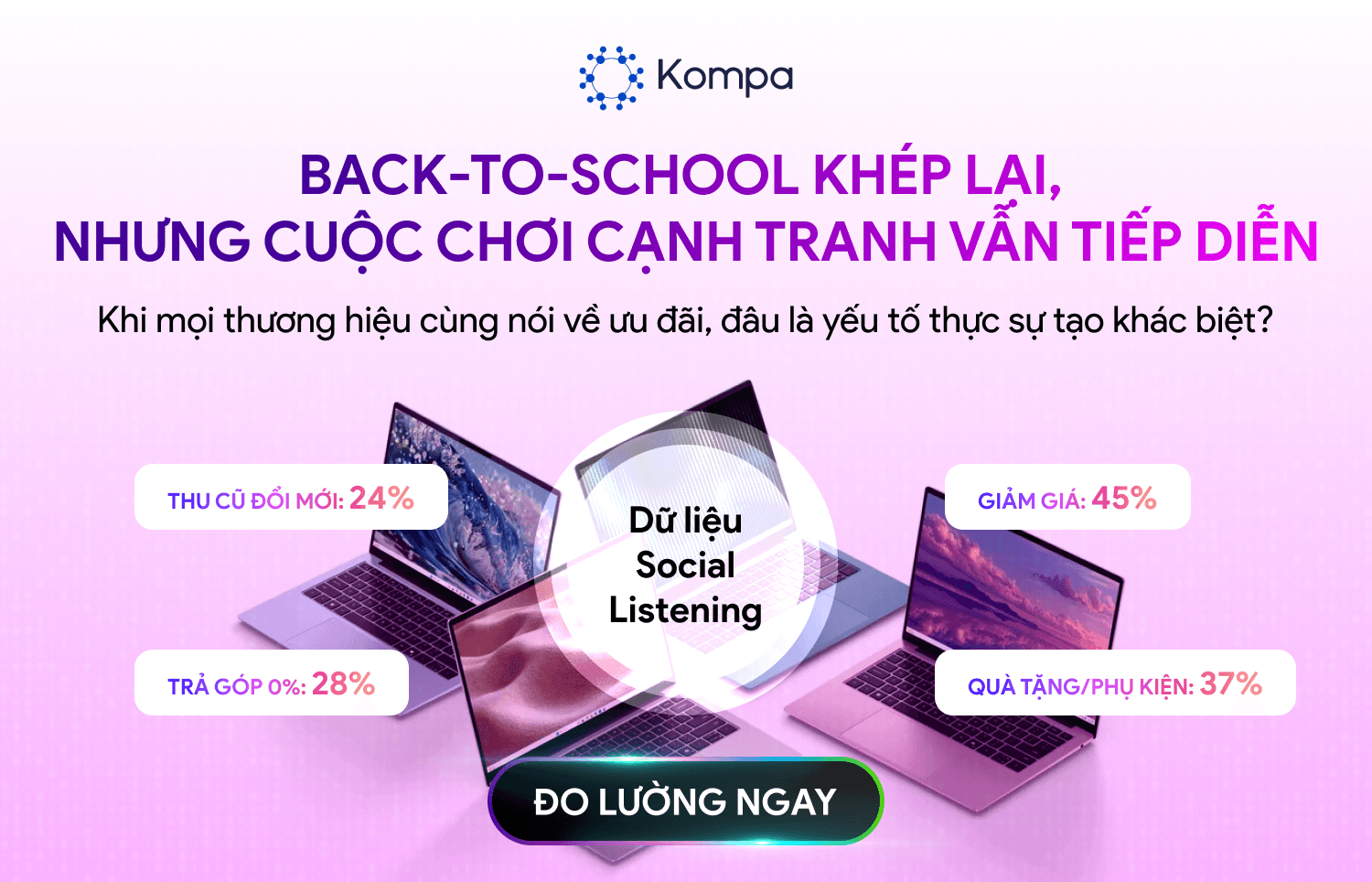
Back-to-School is traditionally a peak season for promotional campaigns. However, preliminary measurement data from July 2026 shows a notable level of similarity in promotional mechanics across multiple retail chains:
Discounts: 45%
Gifts/Office supplies/Accessories: 37%
0% installments: 28%
Trade-in programs: 24%
When the same formulas are repeatedly used across the market, promotions gradually shift from being a “competitive advantage” to becoming a “condition of entry.”
This creates a new challenge for Tech brands. If competitors are also offering discounts, accessories, 0% installments, and trade-in programs, simply adding another promotion may not be enough to differentiate the brand.
Instead, brands need to understand:
What proposition are competitors building beyond promotions?
Which factors do consumers genuinely value?
What needs are being discussed but remain insufficiently addressed by brands?
Which white spaces could become an advantage in the next campaign?
Social Listening enables brands not only to measure campaign performance, but also to place those results within the competitive landscape and identify opportunities for differentiation.
2. Does the Price Range Your Brand Promotes Actually Match What Consumers Are Looking For?
A campaign may focus on promoting laptops priced between VND 18–24 million. But is this actually the price range most consumers are looking for during Back-to-School?
Preliminary measurement data from July 2026 reveals a notable gap.
Among 1,279 mentions of specific price points:
42% were below VND 7 million.
16% fell between VND 7–10 million.
This means nearly 58% of price-related conversations were below VND 10 million.
Meanwhile, the products receiving the most prominent communication were concentrated in the VND 18–24 million range.
Placing these two data points side by side reveals a potential gap between:
Consumer Demand
→ The price range consumers are actually looking for
and
Brand Offer
→ The price range of products being prominently promoted
This gap does not necessarily mean the brand is moving in the wrong direction. However, it is an important signal for Brand and Marketing Teams to consider:
How much of the market demand currently lies outside the product range the brand is prioritizing in its communications?
3. What Is the Used-Laptop Market Revealing About Consumer Needs and Trust?
The price gap may partly explain the growing activity around the used/like-new laptop market.
Data shows that 8.4% of discussions mention used devices, while 37% of posts mention issues related to defects, damage, or warranty.
Together, these figures reveal an interesting paradox: demand for used devices may exist, but consumer trust has not necessarily caught up.
For budget-conscious consumers, used or like-new laptops can be an attractive option. However, concerns about product quality, origin, condition, and warranty may become significant barriers to purchase.
From a brand perspective, the opportunity may therefore lie not simply in “selling at a lower price,” but in “building greater trust.”
This could include:
Greater transparency around trade-in products.
Clearer communication about product quality and condition.
Stronger warranty policies.
More effective communication of product value.
Building a more trustworthy trade-in experience.
Social Listening helps brands see not only the demand for lower prices, but also the barriers behind consumers’ purchase decisions.
4. Consumers May All Be Buying Laptops—but They Are Solving Different Problems
One of the key challenges in Tech marketing is the tendency to treat customers as one homogeneous group.
During Back-to-School, however, needs can vary significantly across audiences.
School students need devices primarily for learning.
University students may care more about performance, design, and suitability for their field of study.
Parents may place greater emphasis on price, durability, and long-term value.
As a result, a single message is unlikely to effectively persuade everyone.
Instead of simply asking:
“Which laptop do customers want to buy?”
brands need to go deeper:
Who is buying?
What do they actually care about?
What is the budget for each group?
What are they using the device for?
Which factors influence their purchase decision?
Which messages are most relevant to each audience?
This is why segmenting conversations by consumer group and need can generate more valuable insights than simply looking at total discussion volume.
Understanding each customer segment is the first step toward building a Back-to-School campaign that does not “speak with one voice to everyone.”
5. Are Consumers Buying “Specs”—or a Device That Fits the Way They Use It?
From a technical perspective, a laptop can be described through its processor, RAM, SSD, or graphics card.
But when consumers are actually looking for a laptop during Back-to-School, their questions may be much simpler:
“What are you studying?”
“What’s your budget?”
“Do you play games?”
“Do you need something lightweight to carry to class?”
July 2026 data shows that 31% of core posts mention a specific field of study, including graphic design, architecture, programming, engineering, and medicine.
Even more notably:
31.7% of core posts mention battery life/thin-and-light design.
Only 13.9% mention processor/RAM/SSD specifications.
This suggests that consumers are not simply looking for a laptop with powerful specifications.
They are looking for a device that fits the way they study, work, and use technology.
6. After Back-to-School, What Should You Measure to Understand Where Your Campaign Really Stands?
A campaign generating a large volume of discussion does not necessarily mean the brand has gained a competitive advantage.
After the Back-to-School season, Brand and Marketing Teams need to evaluate the campaign in relation to the brand, consumers, competitors, and the broader market.
Key questions include:
How much discussion and engagement did the campaign generate?
How did consumers respond to the campaign message?
What propositions are competitors using to compete?
Which promotional mechanics have become a “price of entry” in the category?
Does the price range promoted by the brand align with actual consumer demand?
Which consumer segments have unmet needs?
Which factors are genuinely influencing purchase decisions?
Where are the brand’s white spaces?
Which insights can be translated into content and communication strategies for the next campaign?
This is where Social Listening evolves from a “campaign reporting” tool into a layer of data that supports strategic decision-making for what comes next.
From Campaign Measurement to Identifying Growth White Spaces
Back-to-School 2026 may be over, but the conversations left behind by the market can still provide valuable signals for the next campaign season.
Based on July 2026 data, at least three notable white spaces emerge:
01. Competitive White Space
As promotional mechanics become increasingly similar, brands need to identify a differentiated proposition beyond discounts and incentives.
02. Consumer Demand White Space
When there is a gap between the price ranges consumers are searching for and the products being prominently promoted, brands should reassess the alignment between Brand Offer and Consumer Demand.
03. Content White Space
When consumers search for laptops based on field of study × budget × usage needs, there is an opportunity for content to move beyond product specifications and instead address specific consumer problems and use cases.
With Kompa Social Listening, businesses can connect multiple layers of data across campaigns, brands, competitors, consumers, topics, price ranges, and needs to build a more comprehensive view of the market.
The goal is not simply to understand what happened during Back-to-School 2026, but to uncover what the market is telling brands to do next.