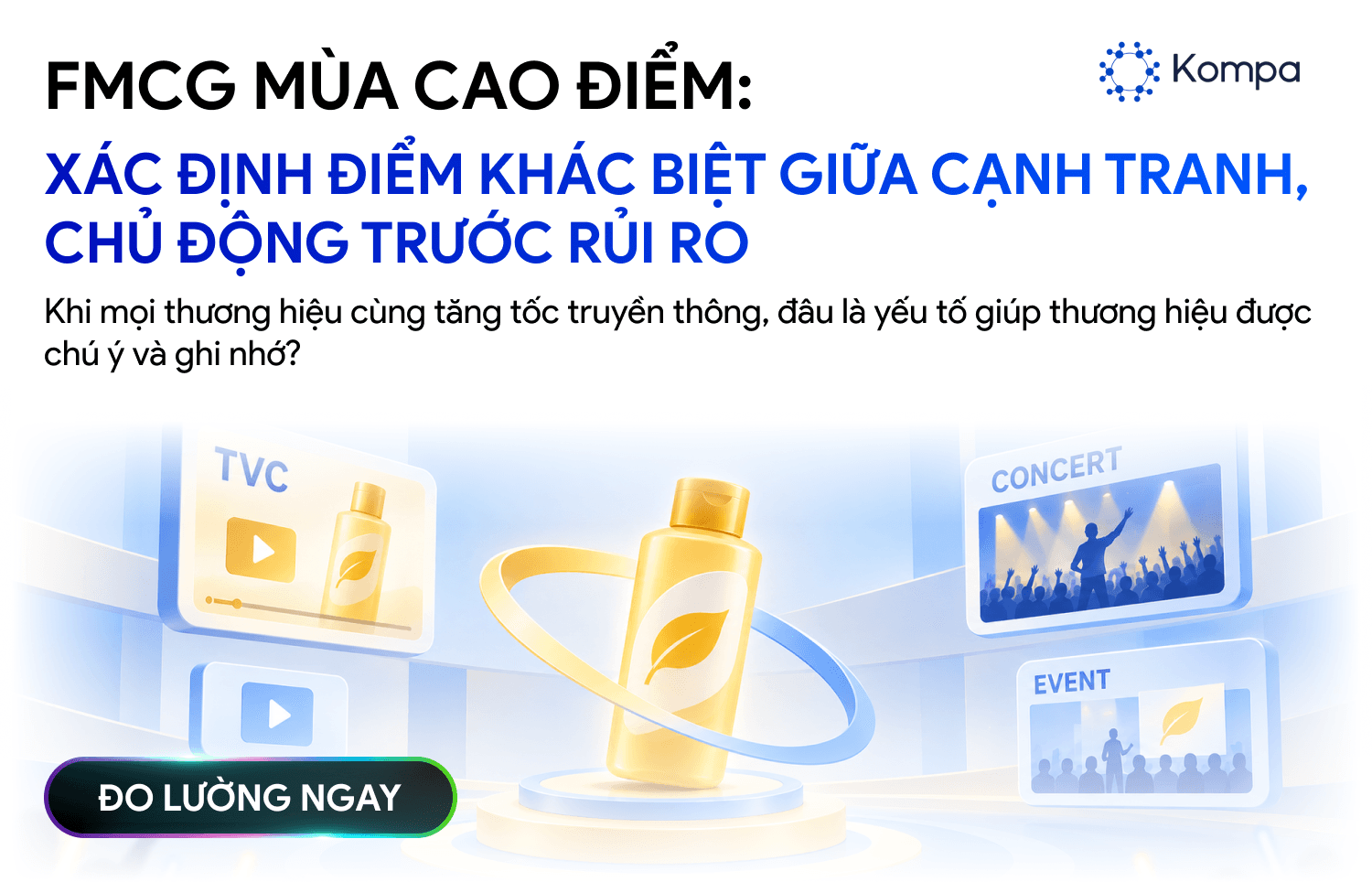
During peak communication seasons, Social Listening helps FMCG brands understand the competitive landscape, assess public reactions, and turn data into actionable insights for their next strategic moves.
From September through the 2027 Lunar New Year, the FMCG market enters a highly active period, with multiple campaigns running simultaneously across Social Media, TVCs, OOH, concerts, and offline activations.
As brands increase investment to expand reach, capture attention, and strengthen brand awareness, competition is no longer simply about which brand appears more frequently, but also about which brand creates meaningful differentiation and connects with consumers in the right way.
However, the greater the communication intensity, the more important it becomes to monitor how audiences receive and interpret brand messages. An idea designed to capture attention can still trigger mixed reactions if its imagery, wording, or context does not align with public expectations.
So, what can FMCG brands do to both make an impact during peak season and proactively identify potential communication risks?
Social Listening can help brands answer four key questions.
1. Amid the “Campaign Storm,” What Makes Your Brand Different?
Peak communication seasons often see multiple FMCG campaigns launched simultaneously, many built around familiar themes such as family, love, Tet, and togetherness.
These themes can resonate strongly with consumers. However, when multiple brands communicate similar messages, creating a distinctive brand footprint becomes a critical challenge for Marketing and Brand Teams.
At this point, brands need to look beyond questions of reach:
What topics are competitors focusing their communication on?
What are consumers currently interested in and discussing?
Which messages are becoming prevalent across the market?
What unmet needs, content themes, or approaches remain underexplored?
Social Listening Helps Identify Differentiated Propositions
By analyzing social media conversations, brands can gain a broader view of the communication landscape, identify competitors’ activities, and uncover the topics that matter most to consumers.
This data can then serve as a foundation for brands to:
Identify content directions that better align with consumer interests.
Discover differentiated propositions within a competitive messaging landscape.
Build communication strategies grounded in consumer needs and market context.
Differentiation does not always come from saying something completely new. It can also come from understanding what consumers care about and responding to it in the right way.
2. An Attention-Grabbing Idea — But How Is the Public Actually Receiving It?
In the creative race, brands are constantly looking for new ideas to capture attention. Yet there can always be a gap between the creative team’s intention and how audiences interpret the message.
The same message can be received in very different ways depending on consumers’ experiences, expectations, cultural context, and individual perspectives.
For example, a brand may communicate:
“A mother always chooses what’s best for her child.”
For the brand, this may be intended as an expression of love and care for the family.
However, some audiences may interpret the message as placing pressure on mothers, suggesting that any other choice is somehow not good enough for their children.
This example illustrates how a message that is positive in its original intent can still generate different interpretations when received within specific contexts.
Questions to Ask Before a Campaign Goes Live
Does the message align with the expectations of different customer segments?
Which visual elements or forms of expression could lead to alternative interpretations?
How have similar sensitive topics or debates emerged in the market previously?
Could audiences associate the message with particular experiences or broader social issues?
Social Listening Helps Evaluate Messages and Identify Risks
Social Listening enables brands to analyze user conversations, identify sensitive topics, and understand interpretations that have emerged in similar discussions.
These insights can serve as a reference throughout the process of:
Evaluating messaging and creative concepts.
Anticipating potential interpretations.
Incorporating consumer perspectives into content review.
Identifying issues that require attention as part of communication risk management.
Social Listening does not replace creative review processes or legal assessment. Instead, it provides an additional perspective grounded in real-world audience data.
3. Decode the Signals Behind Public Reactions
A campaign running across multiple platforms can generate different streams of consumer responses.
Conversations may emerge across:
Fanpages and TikTok.
Threads and online communities.
KOLs/KOCs.
Forums and news sources.
When negative reactions begin to increase, simply tracking total mentions or comment volume is not enough to understand the full picture.
Not every negative reaction will escalate into a crisis. However, unusual changes in discussion volume, sentiment, or topics can serve as signals that require closer monitoring and deeper analysis.
4 Factors to Analyze When Monitoring Public Reactions
1. Volume – Discussion Volume
Is mention volume increasing sharply compared with the usual level of discussion?
2. Sentiment – Emotional Response
Are negative reactions increasing, declining, or changing after the brand takes action?
3. Topic – Discussion Topics
Are users reacting to the product, message, imagery, execution, or another issue associated with the brand?
4. Source – Sources of Spread
Where did the conversation originate, and which platforms or communities is it spreading across?
Social Listening Helps Track Developments and Set Priorities
With Social Listening data, Brand, Marketing, PR, and Customer Service teams can monitor discussion developments, analyze the issues receiving the most attention, and assess public reactions following response actions.
This gives businesses additional grounds to:
Identify unusual shifts in conversation.
Understand the causes and scope of public reactions.
Determine which issues require priority monitoring.
Evaluate how audience responses evolve after the brand takes action.
Early detection does not mean eliminating every potential risk. However, it gives brands more data to respond in a timely and appropriate manner.
4. When One Campaign Ends, a New Insight Begins
A campaign generating a high volume of discussion does not necessarily provide a complete picture of communication effectiveness.
After peak season, brands need to look beyond metrics such as reach, mentions, and interactions and examine the factors behind those results:
Which activities generated significant attention?
Which content generated responses aligned with the brand positioning?
How are consumers perceiving the brand?
Which channels and audience groups contributed to campaign performance?
What needs to be adjusted before the next campaign?
From Campaign Data to Strategic Learnings
Social Listening helps brands connect data across campaigns, competitors, categories, topics, sentiment, and discussion sources to evaluate performance from multiple perspectives.
Instead of stopping at the question:
“What did the campaign achieve?”
Businesses can go further by exploring more strategic questions:
What do consumers actually care about?
What elements of the campaign generated positive or mixed reactions?
What differentiation did the brand create compared with competitors?
What should the next campaign continue, adjust, or change?
When analyzed within the right context, data from a single campaign can become a source of insight for multiple future activities—from content development and message selection to communication strategy optimization.
Measurement Is Not Just About Looking Back — It Is About Moving Forward
The value of Social Listening does not lie solely in summarizing what has already happened. More importantly, it helps brands develop a deeper understanding of the market, public reactions, and opportunities that can be explored in the future.
Every campaign should not end simply with a performance report. It should also open the door to new insights for the next decision.
Conclusion
The FMCG peak season presents an opportunity for brands to strengthen awareness, connect with consumers, and create a distinctive presence in the market. However, as competition for attention intensifies, brands need a data-driven approach to understand both opportunities for differentiation and potential communication risks.
Social Listening helps brands:
Assess the competitive landscape: Understand competitors’ activities and the topics consumers care about.
Analyze public reactions: Monitor discussions, sentiment, topics, and sources of spread.
Optimize communication strategy: Turn data into insights, content opportunities, and more relevant campaign directions.
Learn from campaign performance: Connect real-world data with future communication decisions.
Measure your campaign today to build a more effective communication strategy for tomorrow.