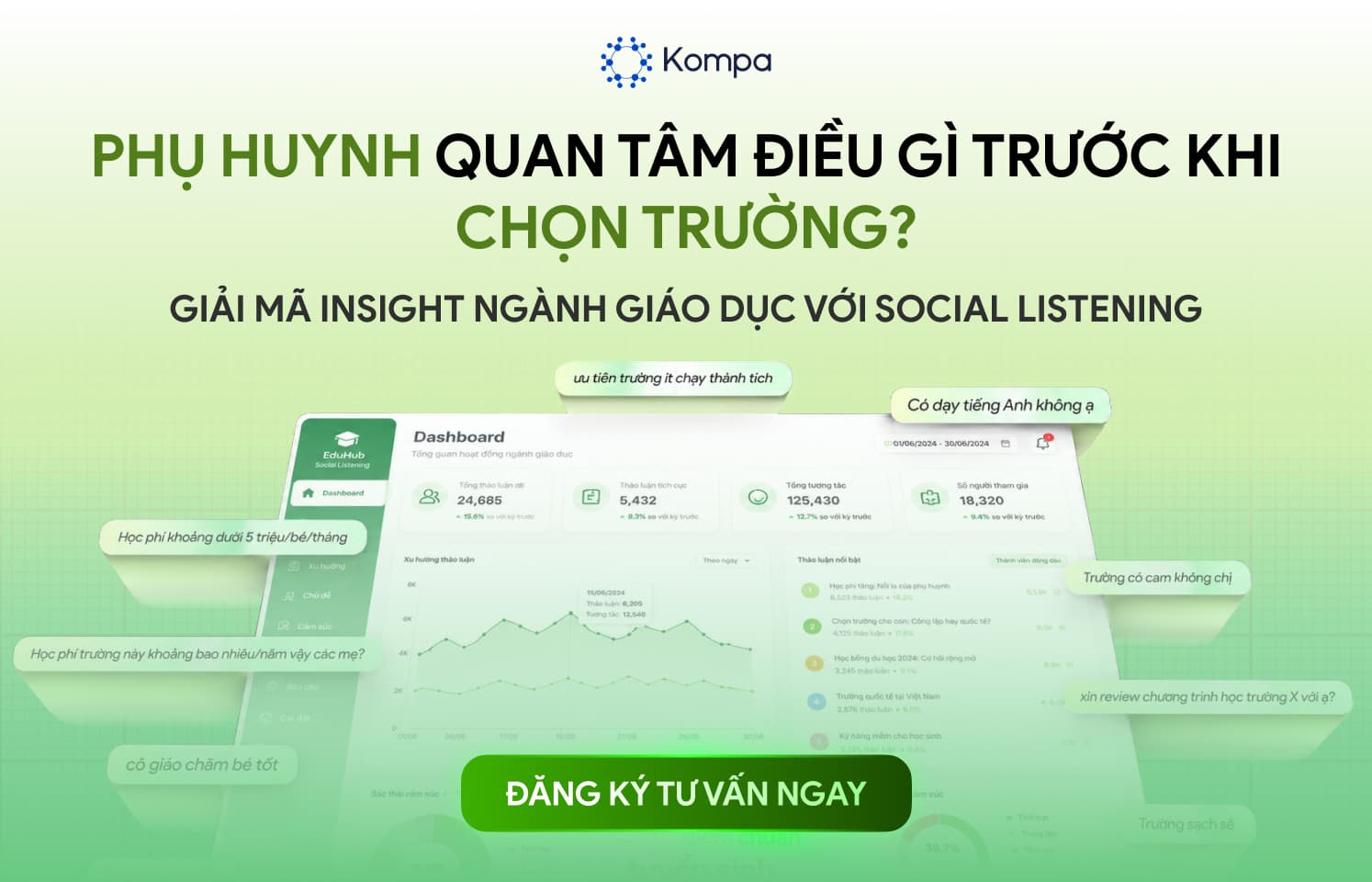
The education market is changing rapidly. Alongside these changes, the ways parents search for information, evaluate options, and choose schools are becoming increasingly diverse.
Before making a decision, parents may turn to Facebook to ask for recommendations, look for reviews in online communities, watch TikTok videos, read experiences shared by other parents, and compare curricula, tuition fees, teachers, facilities, and many other factors.
These conversations not only reflect what parents are thinking, but also reveal how the education market is evolving.
So, are educational institutions truly listening to these signals?
1. Understanding Parents Through Everyday Conversations
When choosing a school, every parent may have different priorities.
Some care about the curriculum and teaching methods. Others place greater emphasis on teacher quality. Some parents may be more concerned about tuition fees, the learning environment, facilities, or opportunities for their children’s holistic development.
These needs are often expressed naturally through conversations on social media.
Questions such as:
“Is the curriculum here too demanding, moms?”
“Are the teachers attentive to the children?”
“How much is the annual tuition fee, moms?”
“Is the learning environment stressful?”
may appear to be nothing more than individual questions. But when collected and analyzed at scale, they can become important signals of parents’ needs and school selection criteria.
This is one of the key values of Social Listening: helping education brands identify the concerns emerging within their communities instead of relying solely on existing assumptions.
2. Staying Ahead of Emerging Education Trends
Parent insights are constantly evolving.
What parents care about today can quickly change as new educational trends, learning methods, or expectations emerge.
For example, alongside traditional criteria such as tuition fees, curriculum, and facilities, parents may increasingly be interested in topics such as:
STEM education and technology.
The application of AI in learning.
Soft skills and holistic development.
Students’ mental well-being.
Extracurricular activities and real-world experiences.
Personalized learning.
The key is not simply knowing that these topics are being discussed, but identifying which topics are actually gaining momentum and generating interest within the community.
Social Listening helps brands track how conversations evolve over time, allowing them to identify emerging topics and stay more closely aligned with the market.
Instead of waiting for a trend to become mainstream before responding, schools can proactively observe the signals as they begin to emerge.
3. Understanding the Journey Before Parents Choose a School
The decision to choose a school rarely happens immediately after parents encounter information for the first time.
It is typically a journey:
Research → Evaluate → Compare → Decide
At each stage, parents have different questions and concerns.
During the research stage, they may focus on the curriculum, tuition fees, or location.
When evaluating options, they may look for reviews, ask other parents for recommendations, and pay closer attention to teachers and the learning environment.
During the comparison stage, factors such as quality, cost, development opportunities, and real-world experiences may become more important.
Social Listening helps brands monitor these conversations to understand what is driving or hindering parents’ decisions at each stage.
This provides valuable insight for schools to tailor their content, messaging, and enrollment activities more closely to real-world needs.
4. Every Piece of Feedback Is a Signal About the Brand
Social Listening is not only useful for understanding needs before enrollment. It also helps schools monitor what parents and students are saying after they have experienced the brand.
A positive comment may reveal a strength worth reinforcing.
A complaint may highlight a touchpoint in the customer experience that needs improvement.
A negative topic that suddenly increases in frequency may serve as an early warning signal of potential brand risk.
For example:
“The teacher is very dedicated. My child really enjoys going to school.”
or:
“I’ve raised this issue several times, but it still hasn’t been resolved.”
For schools, these are not simply positive or negative comments. They are data reflecting customers’ real experiences.
Social Listening helps organize this feedback by topic, sentiment, and changes over time, enabling schools to identify which issues should be prioritized.
5. Turning Feedback Into Better Experiences
An education brand is evaluated not only by what it promises, but also by the actual experiences of parents and students.
Therefore, monitoring conversations can help schools answer important questions:
What is making parents satisfied?
What is causing disappointment?
Which issues are being mentioned most frequently?
Which experiences could influence long-term loyalty?
As a result, Social Listening can become a data source that supports not only Marketing and Enrollment, but also Customer Experience, operations, and the improvement of education services.
Because understanding customers is not simply about knowing why they choose you, but also understanding what makes them stay.
6. Identifying Positive Voices to Build a Community
In the education industry, one parent’s real-life experience can become an important reference point for another.
A recommendation within a community, a positive review, or a story about a child’s experience can naturally influence how others perceive a brand.
Social Listening helps schools identify:
Parents who frequently share positive experiences.
Students who create content related to the school.
Communities with high levels of discussion about the brand.
Topics generating positive reactions.
From there, schools can identify influential voices that genuinely resonate with the community and build Word-of-Mouth based on authentic experiences.
7. From “Listening” to “Decision-Making”
The greatest value of Social Listening does not lie in knowing how many people are talking about a school.
What matters more is understanding what those conversations reveal about the market, customers, and brand.
A conversation can uncover a new need.
An emerging trend can reveal an opportunity to develop a new program.
A negative comment can help identify an issue at an early stage.
A positive community can become a source of organic brand advocacy.
When analyzed effectively, these data points can help education brands:
Gain deeper understanding of parents’ needs and behaviors.
Stay ahead of emerging trends in education.
Optimize enrollment strategies based on real-world insights.
Improve experiences for parents and students.
Manage brand reputation and detect early risk signals.
Build communities through positive voices and authentic advocacy.
Social Listening: Listening to the Market to Understand Parents
In a market where parents’ needs and expectations are constantly evolving, relying solely on internal data or periodic surveys may no longer be enough.
Every day, the market generates new signals through thousands of conversations across social media.
Social Listening helps schools turn conversations into data, data into insights, and insights into action.
With Kompa Social Listening, education organizations can monitor the market, analyze the voices of parents and students, track emerging trends, manage reputation, and uncover valuable insights to make the right decisions at the right time.
Listen to parents. Understand the market. Stay ahead of trends. Make data-driven decisions.