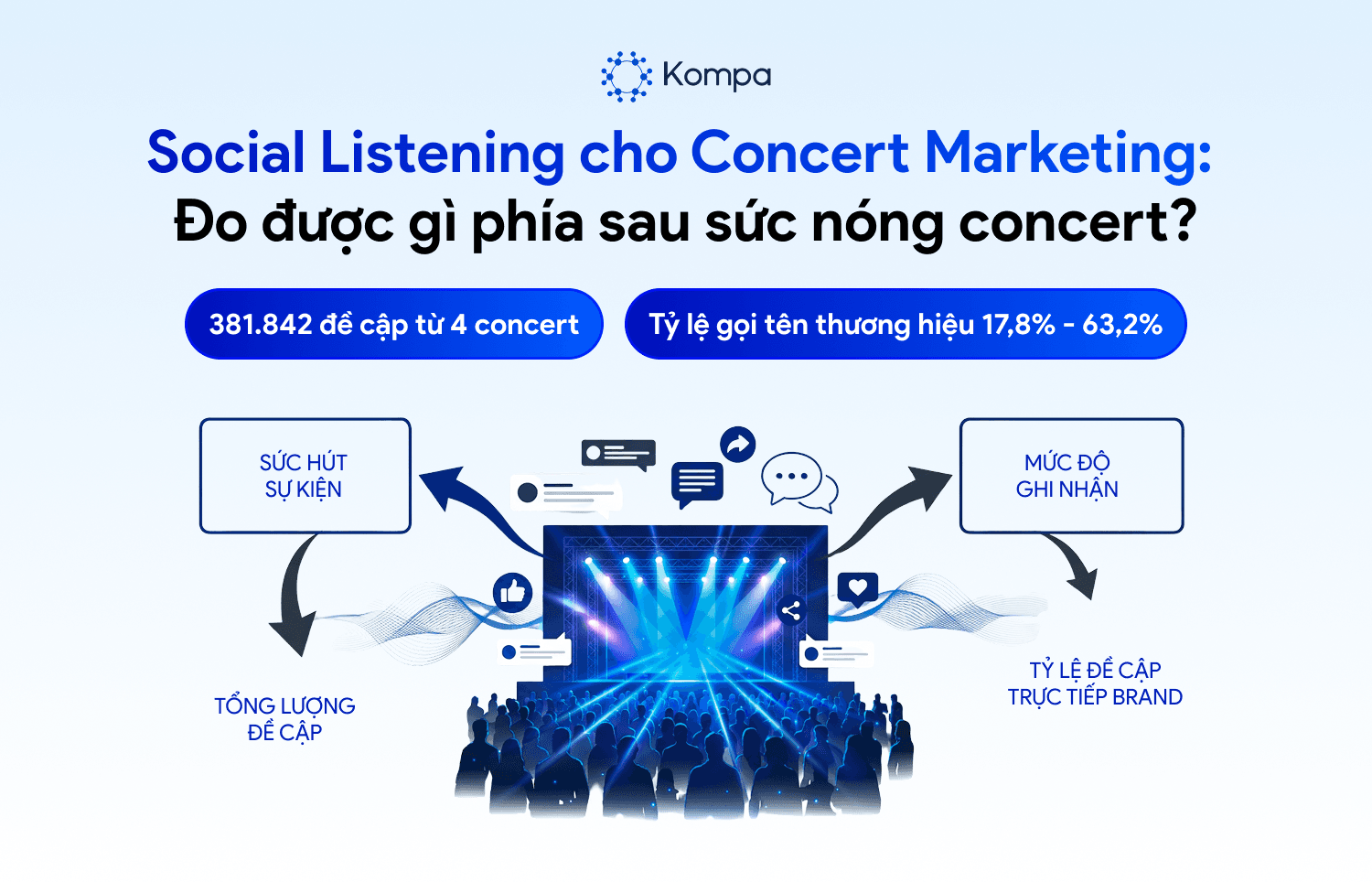
Concerts are becoming an increasingly important part of brands’ communication investments. Beyond providing opportunities to reach large audiences, music events create multiple brand touchpoints through artists, fan communities, interactive activities, and social media content that spreads organically.
However, high discussion volume alone is not enough to reflect the actual communication value a brand receives. A concert may attract tens of thousands of mentions thanks to an artist’s popularity and fandom engagement, but that does not necessarily mean the sponsoring or organizing brand receives the same level of recognition.
1. Measuring Artist Appeal and Brand Connection
Artists are among the key factors driving concert appeal. The appearance of popular performers can trigger sharing, commenting, and content amplification across fan communities.
Data from four concerts shows that 90.8% of artist-related mentions were concentrated around eight performers who rose to prominence through domestic music television shows.
This figure highlights how strongly audience attention can concentrate around a select group of artists. However, an artist’s popularity and fandom engagement do not necessarily translate into equivalent brand recognition. In fact, the share of direct brand mentions varied considerably across the events analyzed.
This presents a strategic challenge for businesses: choosing popular artists is only one part of the equation. Brands need to define their role in the concert narrative, from the event name and purpose to communication messages and the actual audience experience.
What can Social Listening help Brand Teams evaluate?
Discussion volume surrounding each artist and their fan community.
The proportion of direct brand mentions compared with total event discussions.
The level of connection between artists, fandoms, and brands in shared content.
Topics, visuals, and activities that can help brands appear more naturally in audience conversations.
These insights give businesses a clearer basis for assessing whether the appeal of their artist line-up genuinely supports brand communication objectives or primarily benefits the artists and their fan communities.
2. Tracking the Post-Concert Buzz Instead of Focusing Only on Event Night
One limitation of concert performance measurement is the tendency to focus solely on the event itself. In reality, the communication journey continues long after the stage lights go out.
Recap videos, fancams, reviews, behind-the-scenes footage, and audience experiences can sustain community attention while creating further opportunities for brands to be mentioned.
According to Kompa’s Concert Data Playbook, 47.9% of direct mentions were concentrated within the seven-day period surrounding the concert. However, the share of positive mentions reached 47.4% in the following week — the highest level across the analyzed journey.
Notably, 36.9% of total mentions across the four concerts occurred after the events. This means businesses that measure performance only during the event itself may overlook a significant portion of post-concert conversations.
With Social Listening, Brand Teams can track discussion trends across three key stages:
Pre-concert: Monitor initial interest, shared information, and audience expectations.
During the concert: Measure direct brand mentions, artist-related discussions, on-site activities, and attendee reactions.
Post-concert: Track recaps, fancams, reviews, shared experiences, and shifts in community sentiment.
Monitoring the entire journey helps businesses identify when positive discussions increase, recognize the content that continues to sustain attention, and optimize post-event communication plans.
3. Evaluating Concert Marketing Performance Through Four Impact Areas
Mentions, interactions, and media reach are essential metrics, but they are not enough to provide a comprehensive picture of concert investment performance.
To better understand the value generated by an event, Kompa’s Concert Data Playbook proposes evaluating Concert Marketing performance across four impact areas:
3.1. Event Appeal – How Much Attention Does the Concert Attract?
This group of metrics reflects the scale and evolution of conversations surrounding the concert, including:
Total mentions and discussion volume.
Number and distribution of discussion sources.
Mention trends over time.
These metrics provide a basis for evaluating the event’s overall appeal and identifying the moments that generate the greatest social media attention.
3.2. Brand Impact – How Is the Brand Recognized?
Beyond total mention volume, businesses need to determine whether their brand actually appears in conversations about the concert.
Key aspects to analyze include:
The proportion of direct mentions that explicitly name the brand.
How audiences recognize the brand’s role in the event.
Associations formed between the brand and the concert.
This group of metrics helps Brand Teams understand the gap between an event’s popularity and the brand’s actual presence in audience conversations and perceptions.
3.3. Behavioral Impact – What Are Audiences Interested in and Engaging With?
Beyond capturing attention, businesses need to monitor conversations that reflect audience interest in brand-related activities.
Key areas of analysis include:
Discussions about products and services.
Interest in promotions and giveaways.
Conversations about booths and experiential activities.
Content related to event participation.
These insights help businesses better understand which concert touchpoints attract audience interest and engagement.
3.4. Community Impact – How Long Does the Event's Buzz Last?
A concert is more than an event that takes place over a few hours. It is an experience that communities continue to share and amplify.
This impact area focuses on:
Fan community discussions and activities.
User-generated content (UGC).
Recaps, fancams, and reviews.
Post-event discussion momentum.
These indicators help evaluate a concert’s ability to sustain audience attention and identify opportunities to extend communication activities beyond event night.
By connecting all four impact areas, businesses can assess concert performance from multiple perspectives rather than relying on just a handful of headline metrics.
4. Social Listening: From Measuring Event Buzz to Maximizing Concert Marketing Investment
A concert that successfully attracts attention is not necessarily a successful communication investment for the brand.
What matters is understanding where that attention comes from, how prominently the brand features in conversations, how audiences respond, and what communication value continues to generate engagement after the event.
Through Social Listening, Marketing Teams can connect data on artists, fandoms, brands, audience behavior, and sentiment to:
Evaluate brand presence: Identify the proportion of direct brand mentions and the brand’s role in event-related conversations.
Identify strategic gaps: Uncover where event appeal has yet to translate into brand recognition.
Optimize communication activities: Determine the right topics, timing, and touchpoints to sustain post-concert discussions.
Improve future investments: Use insights from completed events to inform artist selection, brand integration, and experience design in future strategies.
With its social data analytics capabilities, Kompa helps businesses monitor the entire concert discussion journey — from event appeal to brand recognition and lasting community engagement.
Measuring concert performance is not just about knowing how much attention an event attracts, but understanding what value the brand has actually created.