For the hot pot industry, the festive and Tet season is one of the most important business periods of the year. From Christmas and New Year to year-end parties and the days leading up to Tet, the demand for gatherings with family, friends, and colleagues makes hot pot chains a familiar choice.
However, increased revenue is only part of the story. Behind it lies a race for social media attention, rising customer expectations, and operational pressures that can create risks for brand reputation.
An analysis of 153,218 mentions of 17 hot pot chains from December 1, 2025 to February 28, 2026, based on Kompa's Social Listening data, offers several valuable insights for brands preparing for the 2027 Tet season.
1. Tet Conversations Start Early and Peak Within a Short Window
One of the most important findings concerns timing. Discussions about hot pot chains do not increase steadily until New Year's Eve. Instead, they peak much earlier.
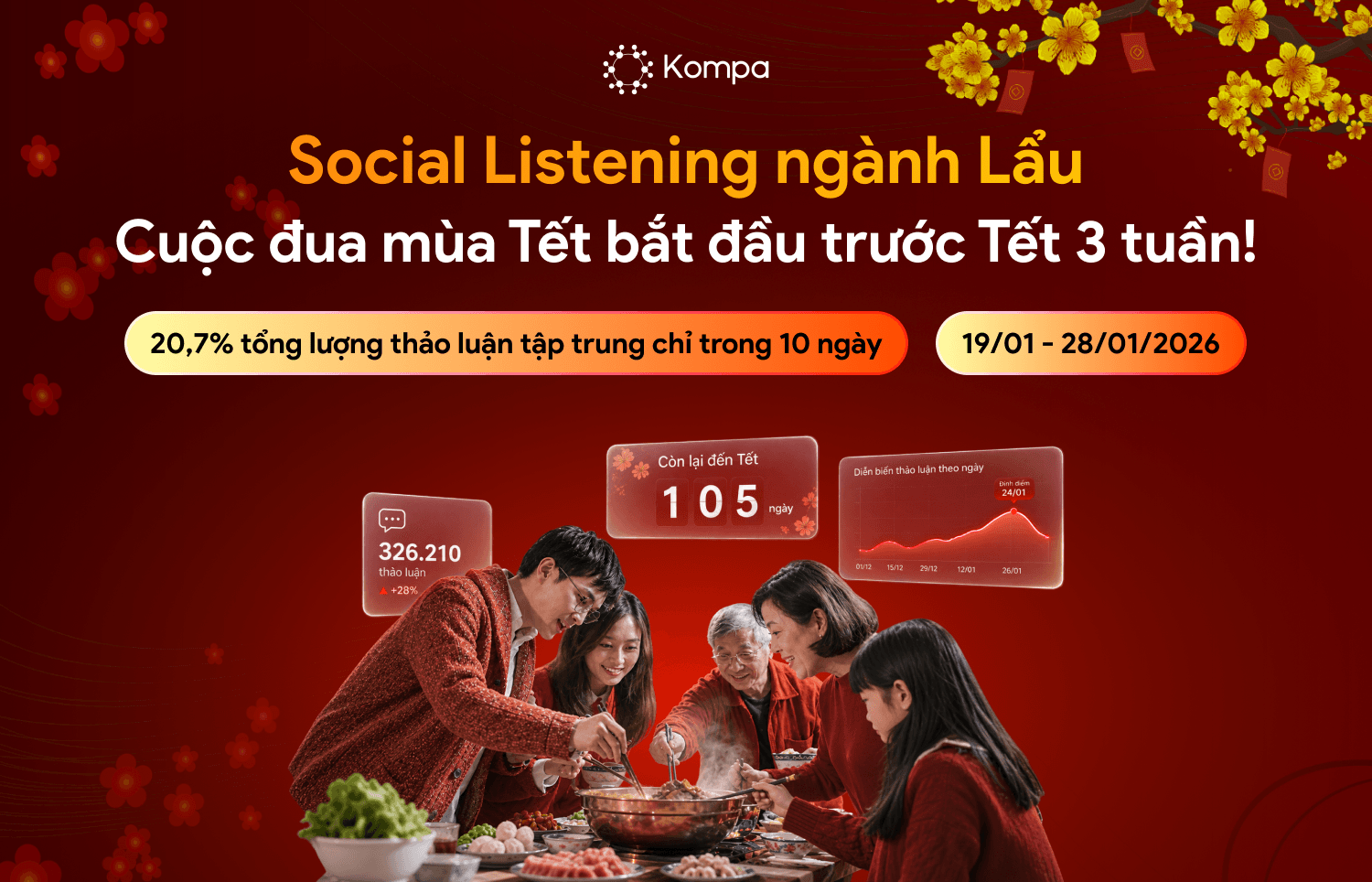
Data shows that 20.7% of total discussions occurred within the 10-day period from January 19 to January 28, 2026, approximately three weeks before Lunar New Year. During this period, the daily average reached 3,168 mentions, nearly double the season-wide average of 1,702 mentions per day.
Earlier, the Christmas–New Year period (December 20, 2025 – January 1, 2026) had already generated 17.3% of total mentions, serving as the starting point for the festive season. After Tet, discussion volume dropped sharply to approximately 572 mentions per day.
This suggests that if brands only launch their campaigns in the days immediately before Tet, they may have already missed most of the opportunity to reach customers. The discussion peak coincides with the year-end gathering season, when groups of friends, companies, and families begin planning their get-togethers.
What can Social Listening help Brand Teams evaluate?
Daily and weekly mention trends throughout the festive season.
When customer interest begins to rise and when it reaches its peak.
The relationship between key occasions (Christmas, New Year, year-end parties, and Tet) and discussion volume.
The optimal timing for promotions, content campaigns, and staffing plans.
2. Share of Voice Is Concentrated, While Experiences Shape the Conversation
Festive-season discussions are not evenly distributed among brands. The top five hot pot chains accounted for 90.5% of total mentions, with the leading brand alone capturing 49.3% — nearly as much as the other 16 brands combined.
What is particularly noteworthy is where these discussions originate. Comments accounted for 77.6% of mentions, while 57.3% appeared on TikTok. For the leading brand, TikTok accounted for more than 75% of discussions, largely driven by customer-generated videos featuring check-ins, reviews, tableside performances, birthday celebrations, and group gatherings.
In contrast, many other brands relied more heavily on official channels and Facebook deal-hunting groups to generate discussions. Promotional content can quickly boost mention volume, but its impact is often tied to the campaign period and is less likely to achieve the same organic reach as experience-driven content.
The challenge for businesses is therefore not simply to increase advertising budgets during peak season, but to create memorable moments that customers want to revisit and share.
What can Social Listening help Brand Teams evaluate?
Brand Share of Voice compared with competitors across different periods.
The proportion of user-generated content (UGC) versus content from owned channels.
Discussion distribution across TikTok, Facebook, YouTube, Threads, and news media.
Experiences, dishes, and activities with the potential to generate organic conversations.
3. What Do Customers Care About During the Festive and Tet Season?
As Tet approaches, customer interests also shift noticeably. A comparison between December 2025 and February 2026 reveals:
Discussions about prices and promotions increased from 21.5% to 36.8%.
Discussions about holidays, birthdays, and family gatherings rose from 9.8% to 23.9%.
Discussions about service and staff increased from 8.3% to 29.2%.
Another notable finding: within positive discussions, content mentioning gifts and complimentary items accounted for 20.6%, nearly twice the share of mentions about vouchers and discounts (10.9%).
This suggests that while discounts help attract customers, generosity in the overall experience — complimentary dishes, birthday gifts, and attentive service — is what customers remember and proactively share.
How can Social Listening help businesses?
Identify shifts in customer interests across different periods.
Evaluate reactions to different promotions, combos, and gifts.
Understand dining occasions (year-end parties, birthdays, and family gatherings) to develop more relevant offerings.
4. Peak Season Is Also a High-Risk Period
As customer traffic increases, operational pressure rises accordingly. Waiting times, food quality, and staff attitudes become potential sources of complaints.
During the 2026 festive and Tet season, negative discussions accounted for only 1.9% of total mentions. However, this small figure does not necessarily indicate low risk:
23.1% of negative discussions were related to dipping sauces and hot pot broth — two defining elements of the dining experience that keep customers coming back. When quality changes, loyal customers are often among the most vocal.
A single post sharing a negative experience triggered 471 negative comments, accounting for a large share of the brand's negative discussions that month.
One hot pot chain's Net Sentiment Rate (NSR) dropped from 0.89 to -0.07 in just one month, after the brand was mentioned in viral TikTok and news reports about ingredients of unclear origin.
Content about service staff can attract substantial viewership on TikTok, but may also negatively affect brand image if not properly addressed.
With Social Listening, businesses can establish an early-warning system, monitor how quickly negative content spreads, and respond proactively before an isolated experience escalates into a crisis.
5. Preparing for Tet 2027 Through a Four-Stage Measurement Framework
The 2027 Lunar New Year falls on February 6, 2027, approximately 11 days earlier than Tet 2026. If discussion patterns follow the previous season, the peak period could begin in early January 2027 — leaving brands with a shorter preparation window.
Based on data from the 2026 festive and Tet season, Kompa recommends that hot pot brands monitor performance across four stages:
5.1. Pre-season (October–November) – Where Does the Brand Stand?
This is the baseline measurement stage, providing benchmarks for comparison during peak season:
Share of Voice compared with competitors.
Sentiment metrics and existing customer pain points.
Channels and discussion sources generating the most conversations.
5.2. Kick-off (Christmas–New Year) – How Are Customers Responding?
The Christmas–New Year period offers an opportunity to test campaigns before the Tet peak:
Feedback on festive menus, combos, and promotions.
Check-in content, reviews, and UGC generated by customers.
Experiences with the potential to gain traction and be scaled up during Tet.
5.3. Peak Season (3–4 Weeks Before Tet) – Are There Any Unusual Signals?
This is the period that requires the closest monitoring, covering both opportunities and risks:
Discussions about waiting times, reservations, service quality, and food.
The speed at which negative content spreads.
Industry-related information that could affect brand reputation.
5.4. Post-Tet – What Value Did the Festive Season Generate?
Post-season evaluation helps businesses build a knowledge base for future campaigns:
Campaign performance compared with baseline metrics and competitors.
Changes in customer sentiment across different stages.
Lessons learned about operations, products, and communications.
By connecting all four stages, businesses can view the Tet season as a continuous journey rather than just a few weeks of peak sales.
6. Social Listening: Turning 2026 Tet Data into a 2027 Strategy
A successful festive season is not measured solely by customer traffic or revenue, but also by how people talk about the brand, how customers feel, and which risks have been effectively managed.
Through Social Listening, Marketing Teams can connect data on timing, competitors, customer experiences, and sentiment to:
Identify the right timing: Launch communication campaigns, promotions, and staffing plans before demand reaches its peak.
Evaluate competitive positioning: Monitor Share of Voice and sentiment metrics against other hot pot chains.
Optimize customer experience: Identify pain points and the factors that generate positive discussions.
Proactively manage risks: Detect negative signals early and respond promptly during peak season.
With its social data analytics capabilities, Kompa helps F&B brands monitor the entire festive-season discussion journey, from pre-season benchmarks to post-Tet performance evaluation.
Measuring the Tet season is not just about knowing how often a brand is mentioned, but understanding what it needs to prepare for the next season.