Every year, before developing a new Marketing strategy, Brand and Marketing Teams review business performance, campaigns, communication channels, and competitor activities. Behind these data points lie bigger questions: Where does the brand stand in the market? What are its strengths to build on, what gaps need to be addressed, and what priorities should be incorporated into the 2027 strategy? What should the brand do, where should it communicate, and how should it reach consumers?
To answer these questions with data rather than assumptions, digital Brand Health assessment is an important step before making strategic decisions. Instead of looking at the brand’s performance in isolation, a Brand Health Check should evaluate the brand in relation to competitors, the category, and consumers, providing a more comprehensive view of its current position and the opportunities that should be prioritized in 2027.
1. Reassessing Brand Position: Where Do You Stand Against Competitors?
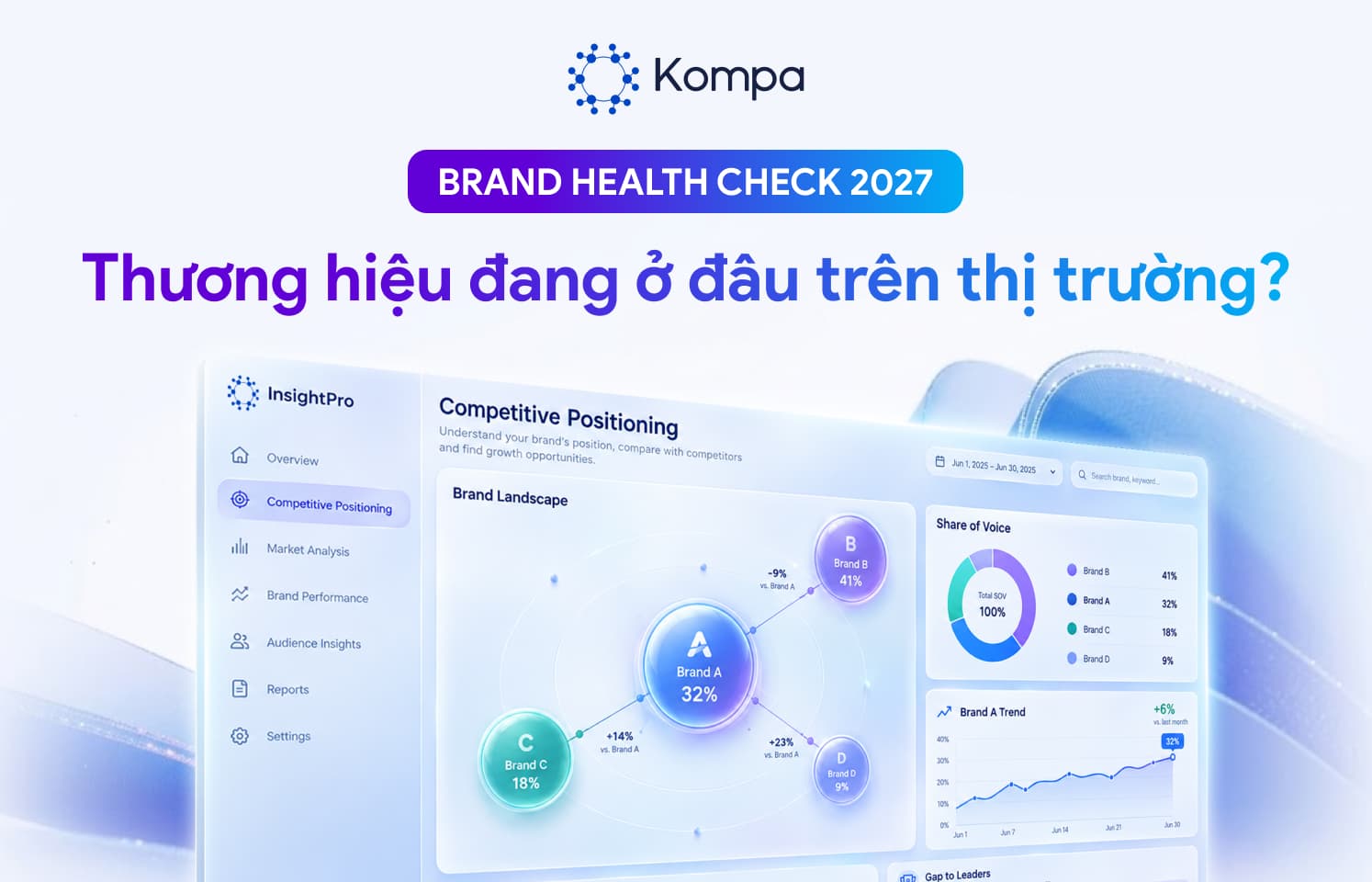
To understand where a brand stands, its performance first needs to be viewed in the context of the market and competitors. A brand may increase its discussion volume compared with the previous year, but if competitors are growing faster, its competitive position may not have improved. Conversely, a brand with a smaller discussion volume may still have a unique advantage if it owns important topics within the category.
A Brand Health assessment should therefore examine:
The brand’s level of presence compared with competitors.
Whether its Share of Voice is increasing or declining.
The gap between the brand and market leaders.
The topics that help the brand stand out or get overshadowed by competitors.
The activities driving significant changes in consumer attention.
For example, in a Brand Health Analysis within the retail industry, Kompa does not assess Brand A in isolation. Instead, it places the brand in the context of Brand B, Brand C, and other competitors within the category to compare positioning, presence, and the key drivers of discussion.
The analysis can then be broken down by different business segments, such as food retail, non-food retail, and commercial real estate, helping businesses gain a clearer view of the performance and positioning of each segment.
Data only becomes meaningful when it is viewed through a competitive lens.
2. Evaluating the Factors Shaping Brand Position
Knowing where the brand stands is only the first step. The next question is: What is driving that position?
Discussion volume may increase because of a campaign, store opening, promotion, livestream, KOL/KOC activity, or an unexpected event. But not every driver of attention creates equal value for the brand.
A Brand Health Check needs to go deeper to determine:
Which activities generate the highest volume of discussion?
Which topics genuinely attract consumer attention?
Which types of content generate significant engagement?
Which activities create short-term spikes versus sustainable momentum?
Are changes in discussion being driven by the brand or by external sources?
For example, in the retail industry, Kompa can trace discussion peaks back to specific activities: Brand A may stand out through a store-opening campaign, while Brand B sustains discussion through livestream commerce.
This allows brands to clearly identify which activities are driving consumer attention.
This approach helps businesses move from simply “recording results” to “understanding what drives those results.” It also provides a foundation for determining which activities should continue to receive investment, which need to be adjusted, and which learnings can be carried forward into the 2027 plan.
3. Understanding Where the Market Is Moving: How Are the Category and Competitors Shifting?
A brand cannot build its strategy based solely on what has happened to itself.
During the same period, competitors may be changing how they engage consumers, new topics may be emerging within the category, and communication platforms may be taking on different roles.
A Brand Health Check should therefore expand from the brand to the broader category landscape:
Is overall category discussion increasing or declining?
Which brands are gaining momentum?
How is Share of Voice shifting?
Which platforms are consumers using most actively for discussion?
What new topics are emerging?
What activities or content are competitors using to capture attention?
For a multi-category retail brand, Kompa can break down Brand Health by business segment to identify differences in discussion volume, communication channels, and engagement drivers.
For example, livestreams and minigames may be key drivers in food retail, while dining, shopping, and entertainment experiences may generate stronger discussion within commercial real estate.
Recognizing these differences helps brands avoid a common mistake: applying the same approach to markets that are fundamentally evolving in different ways.
4. Understanding How Consumers Perceive the Brand
Once the brand’s position and market dynamics are understood, the next critical question is: What do consumers actually think about the brand?
A brand that is frequently mentioned is not necessarily perceived positively. Conversely, a relatively small discussion segment can still reveal an important issue if the conversation centers around critical experiences or perceptions.
Therefore, a Brand Health Check needs to look beyond the volume and examine the content behind those conversations:
What are consumers saying about the brand?
Which topics generate positive perceptions?
Which issues trigger negative feedback?
Which activities are being well received?
Are negative issues isolated or likely to spread?
How are consumer perceptions of the brand changing over time?
In a Brand Health Analysis within the retail industry, Kompa not only analyzes the proportion of positive, neutral, and negative sentiment, but also cross-references sentiment with specific activities and discussion topics.
This enables brands to identify which activities are generating positive responses, which issues require attention, and how significantly they may affect brand perception.
It helps Brand Teams move beyond the question:
“How many people are talking about the brand?”
to the more important question:
“What are they saying, and what does it mean for the brand?”
5. Looking Beyond the Big Picture: Which Channels and Sources Are Driving Influence?
A comprehensive Brand Health picture should also answer where discussions are happening and who is driving them.
A brand’s total discussion volume may come from Fanpages, TikTok, communities, content creators, news media, or other sources. Each source represents a different form of influence on the brand.
Social Listening helps businesses analyze:
Which channels generate the most discussion?
Which channels are showing the strongest growth?
Are discussions primarily driven by the brand or by external users?
Which sources contribute significantly to the brand’s overall presence?
How does the role of each channel change over time?
Kompa does more than identify which channels are mentioning the brand. It also identifies the sources generating the largest share of discussion.
This allows businesses to understand which channels, communities, content creators, or media sources are contributing most significantly to the brand’s visibility.
6. From What Happened to What Should Be Prioritized in 2027
A valuable Brand Health Check should not stop at summarizing the previous year. Its greater value lies in helping Brand and Marketing Teams identify the issues and opportunities that should shape the next strategy.
By connecting data across the brand, competitors, category, and consumers, businesses can begin answering:
Which strengths should continue to be leveraged?
Which gaps need to be addressed?
Where do competitors have an advantage?
Which trends should be monitored?
Which channels have the potential for greater investment?
Which topics could become communication opportunities?
Which issues need to be addressed before they develop into larger risks?
With Kompa Social Listening & AI Data Intelligence, businesses can build a multi-layered Brand Health picture across brand, competitors, category, business segments, channels, discussion sources, topics, activities, and consumer sentiment.
These data points can then be connected to uncover the changes and underlying drivers behind the results—providing a stronger data foundation for deciding what to prioritize, where to invest, and how to shape the 2027 strategy.